BENDER WR70x175S (P)… WR200x500S (P)
Product Overview
(1) Product positioning and core applications
WR70x175S (P)… WR200x500S (P) is an industrial grade rectangular measuring current transformer developed by BENDER in Germany. It is designed for current signal conversion and precise acquisition, and is used in conjunction with residual current monitoring systems and insulation fault location systems to achieve current monitoring and fault tracing in industrial electrical circuits. It is suitable for AC/DC hybrid power supply scenarios and can convert high or positioning currents on the primary side into assessable standard signals on the secondary side, providing accurate data support for backend monitoring equipment. It is widely used in industrial scenarios such as factory distribution systems, busbar systems, IT systems (ungrounded systems), etc.
(2) Core Features and Compliance Standards
1. Core Features
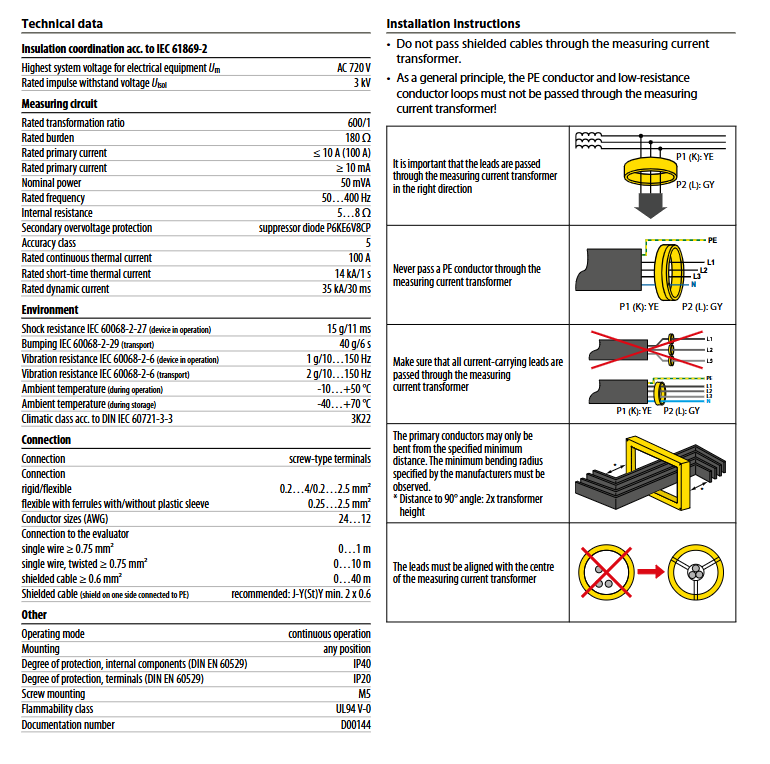
Dual scenario adaptation: compatible with RCM/RCMS series residual current monitoring systems, converting AC current signals; It can also be paired with EDS series insulation fault location system (IT system) to collect the positioning current generated by PGH positioning current injector or IRDH series insulation monitoring instrument.
Series differentiation design: divided into the S series without integrated shielding and the SP series with integrated shielding. The SP series is designed specifically for busbar systems with load currents ≥ 500A, which can avoid false triggering of backend devices caused by high load currents or surge currents.
High reliability: Equipped with a built-in secondary side overvoltage protection diode, it has strong resistance to impact and vibration, and is suitable for harsh industrial environments.
Flexible installation: Supports installation in any direction, adapts wires to multiple specifications, and meets different on-site wiring needs.
2. Compliance and Certification
Following standards: DIN EN 60044-1 (General Technical Standard for Current Transformers), IEC 61869 (Power Transformer Standard), IEC 61869-2 (Insulation Coordination Standard), DIN IEC 60721-3-3 (Climate Rating Standard).
Safety level: The flame retardant rating of the shell reaches UL94 V-0, the internal component protection level is IP40, and the terminal protection level is IP20, effectively preventing solid foreign objects from entering and electrical safety risks.
Product classification and core parameters
(1) Product series and model differentiation
Series Core Features Applicable Scenarios Model Range
S series without integrated shielding, basic design for conventional industrial scenarios, circuits with load current<500A WR70x175S、WR115x305S、WR150x350S、WR200x500S
SP series with integrated shielding, strong anti-interference ability, busbar system, circuit with load current ≥ 500A, high interference environment WR70x175SP, WR115x305SP, WR150x350SP, WR200x500SP
(2) Key electrical parameters
Category specific specification remarks
Maximum system voltage (Um) AC 720 V suitable for medium and high voltage industrial distribution systems
Rated impulse withstand voltage (Uisol) 3 kV meets industrial insulation coordination requirements
Rated transformation ratio 600:1 Fixed transformation ratio to ensure signal conversion consistency
Rated load 180 Ω matching backend monitoring/positioning equipment input impedance
Rated primary current minimum ≥ 10 mA, maximum ≤ 10 A (100 A) to cover small signal acquisition and high current monitoring requirements
Rated nominal power of 50 mVA ensures sufficient signal transmission power
Rated frequency 50… 400 Hz, suitable for industrial scenarios of power frequency and intermediate frequency
Internal resistance of 5… 8 Ω reduces signal transmission loss
Secondary side overvoltage protection suppression diode P6KE6V8CP prevents overvoltage damage to backend equipment
Accuracy level 5 meets the requirements of industrial current measurement error
Rated continuous thermal current of 100 A, stable long-term operation without overheating risk
Rated short-time thermoelectric current 14 kA/1 s withstand short-time short-circuit current surge
Rated dynamic current of 35 kA/30 ms to resist instantaneous dynamic current surge
(3) Physical dimensions and weight
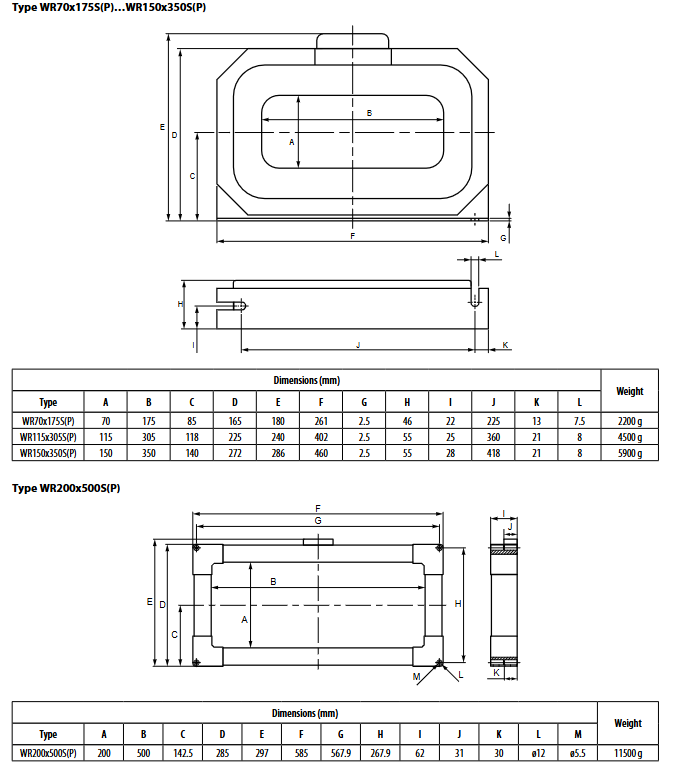
1. Size and weight of WR70x175S (P)~WR150x350S (P)
Model size (mm) Weight
A (internal width) B (internal height) C D E F G H I J K L
WR70x175S(P) 70 175 85 165 180 261 2.5 46 22 225 13 7.5 2200 g
WR115x305S(P) 115 305 118 225 240 402 2.5 55 25 360 21 8 4500 g
WR150x350S(P) 150 350 140 272 286 460 2.5 55 28 418 21 8 5900 g
2. WR200x500S (P) size and weight
Model size (mm) Weight
A (internal width) B (internal height) C D E F G H I J K L M
WR200x500S(P) 200 500 142.5 285 297 585 567.9 267.9 62 31 30 ø12 ø5.5 11500 g
Installation and wiring specifications
(1) Core installation requirements
Prohibited conductors to pass through:
It is strictly prohibited to pass shielded cables, PE conductors, and low resistance conductor circuits through transformers, otherwise interference signals may be introduced, leading to a decrease in measurement accuracy or misjudgment by backend equipment.
All current carrying wires must pass through the transformer completely without omission, ensuring comprehensive collection of current signals.
Wire threading direction and position:
The wire needs to be threaded in from the P1 (K end, yellow mark) side and out from the P2 (L end, gray mark) side. Incorrect direction can cause signal polarity reversal and affect data accuracy.
The wires need to be aligned with the center position of the transformer to avoid uneven magnetic field distribution caused by offset, further ensuring measurement accuracy.
Wire bending and spacing:
The bending of the primary side conductor must follow the minimum bending radius specified by the manufacturer, and the 90 ° bending distance must not be less than twice the height of the transformer to prevent insulation damage to the conductor and distortion of current distribution.
Installation and fixation:
Supports installation in any direction (horizontal, vertical, etc.), fixed on the installation surface with M5 screws to ensure a firm and secure installation without looseness, and to avoid vibration affecting performance during operation.
(2) Wiring and Connection Specifications
Conductor adaptation:
The terminal block is screw type and supports rigid conductors (0.2… 4mm ²), flexible conductors (0.2… 2.5mm ²), and flexible conductors with/without plastic collars (0.25… 2.5mm ²), compatible with AWG 24… 12 specification conductors.
Cable selection and distance:
Single core wire (≥ 0.75mm ²): maximum connection distance of 1m.
Twisted single core wire (≥ 0.75mm ²): maximum connection distance of 10m.
Shielded cable (≥ 0.6mm ²): maximum connection distance of 40m, recommended model J-Y (St) Y 2 × 0.6mm ², shielding layer needs to be connected to PE at one end to reduce electromagnetic interference.
Wiring precautions:
Before wiring, the power supply must be disconnected to ensure construction safety; Tighten the terminal screws after wiring to avoid signal distortion caused by poor contact.
Connected to backend devices (RCM/RCMS/EDS) through two-wire cables, S1 (k) and S2 (l) terminals correspond to device signal input interfaces.
Environmental adaptability and mechanical characteristics
(1) Environmental parameters
Category specific specifications
Working environment temperature -10 ℃…+50 ℃
Storage environment temperature -40 ℃…+70 ℃
Climate grade DIN IEC 60721-3-3 (3K22)
Impact resistance performance (in operation) 15 g/11 ms (IEC 60068-2-27)
Anti collision performance (during transportation) 40 g/6 ms (IEC 60068-2-29)
Vibration resistance performance (in operation) 1 g/10… 150 Hz (IEC 60068-2-6)
Vibration resistance performance (during transportation) 2 g/10… 150 Hz (IEC 60068-2-6)
(2) Mechanical characteristics
Shell material: flame retardant grade UL94 V-0, high temperature resistance, anti-aging, in line with industrial safety requirements.
Protection level: Internal components IP40 (preventing solid foreign objects with a diameter of ≥ 1mm from entering), terminals IP20 (preventing finger touch).
Operation mode: Continuous operation, uninterrupted collection of current signals, meeting the 24-hour uninterrupted production needs of industry.
Model specifications and ordering information
(1) Model and Order Number Correspondence Table
Model Internal dimensions (mm) Shielding characteristics Order number
WR70x175S 70 × 175 without B911738
WR115x305S 115 × 305 without B911739
WR150x350S 150 × 350 without B911740
WR200x500S 200 × 500 without B911763
WR70x175SP 70 × 175 integrated shielding B911790
WR115x305SP 115 × 305 integrated shielding B911791
WR150x350SP 150 × 350 integrated shielding B911792
WR200x500SP 200 × 500 integrated shielding B911793
(2) Selection suggestions
Selection based on load current: If the load current is ≥ 500A or applied to the busbar system, the SP series (with shielding) is preferred; For conventional load current scenarios, select the S series.
Select according to internal dimensions: Select the corresponding internal dimensions based on the number and thickness of the primary side conductors to ensure that the conductors can pass through the transformer smoothly and leave appropriate gaps.
Selection based on connection distance: When the connection distance exceeds 10m, shielded cables should be selected and matched with the wiring requirements of the corresponding transformer model.
Precautions and Maintenance Guidelines
(1) Precautions for use
It is strictly prohibited to dismantle the transformer casing or modify the internal circuit without authorization, otherwise it will damage the insulation performance and shielding structure, and lose the product warranty qualification.
Transformers need to be used in conjunction with compatible backend devices (RCM/RCMS/EDS) to avoid signal attenuation or equipment damage caused by load mismatch.
Installation and maintenance must be carried out by qualified electrical professionals, strictly following local electrical safety regulations.
(2) Key points of daily maintenance
Regular inspection: Check the installation and fixation of the transformer, whether the wiring terminals are loose, and whether the cable insulation layer is damaged every month. If any problems are found, they should be dealt with in a timely manner.
Environmental cleaning: Keep the surface of the transformer clean to avoid dust accumulation affecting heat dissipation or insulation performance.
Fault handling: If there is no signal input or signal abnormality in the backend equipment, it is necessary to sequentially check whether the cable connection, conductor direction, and transformer are damaged. If necessary, contact the manufacturer’s technical support.