Triconex Triconex Tricon v9-v11 system
System core positioning and core characteristics
Core positioning: Programmable logic and process controller for industrial safety critical scenarios, capable of emergency shutdown, fire and gas detection, burner management, and other functions.
Core architecture:
The mainstream adopts a Triple Modular Redundancy (TMR) architecture, where three independent channels execute programs in parallel and input/output data is verified through a voting mechanism.
The power module and some I/O modules adopt a dual redundancy design to ensure the continuous operation of the system under a single fault.
Key advantages:
High availability: supports online module replacement and hot standby function, can be maintained without downtime, reducing production interruptions.
Fault tolerance: Built in online diagnosis and adaptive repair functions, capable of detecting instantaneous and steady-state faults, and automatically isolating fault channels.
Remote Expansion: Through SRXM modules and fiber optic transmission, remote I/O can be extended up to 7.5 miles (12 kilometers) with strong electromagnetic interference resistance.
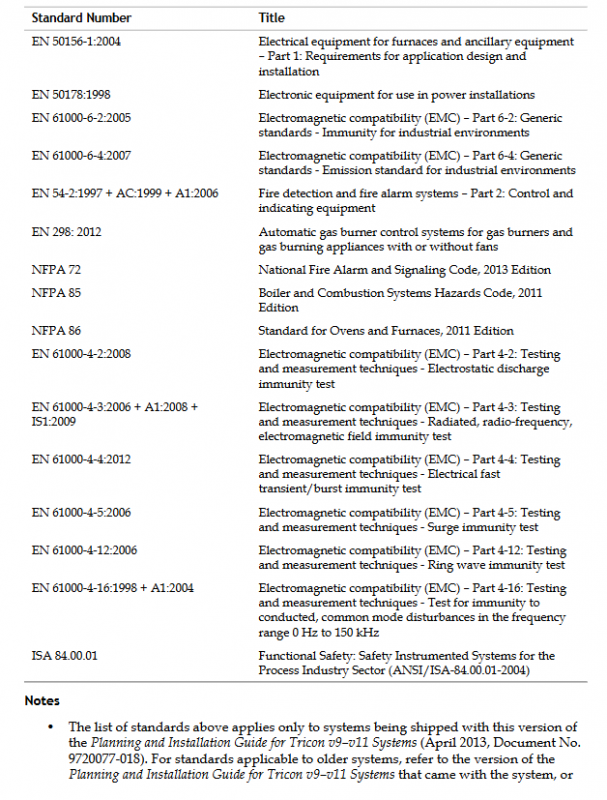
International certification: Passed CSA, T Ü V Rheinland, NRC, CE and other certifications, compliant with IEC 61508 (SIL 1-3), ATEX, NFPA and other standards, suitable for safety requirements in multiple regions around the world.
Detailed Description of Hardware Components
(1) Chassis Rack: System Installation Carrier
Type, Model, Core Parameters, Adaptation Scenarios
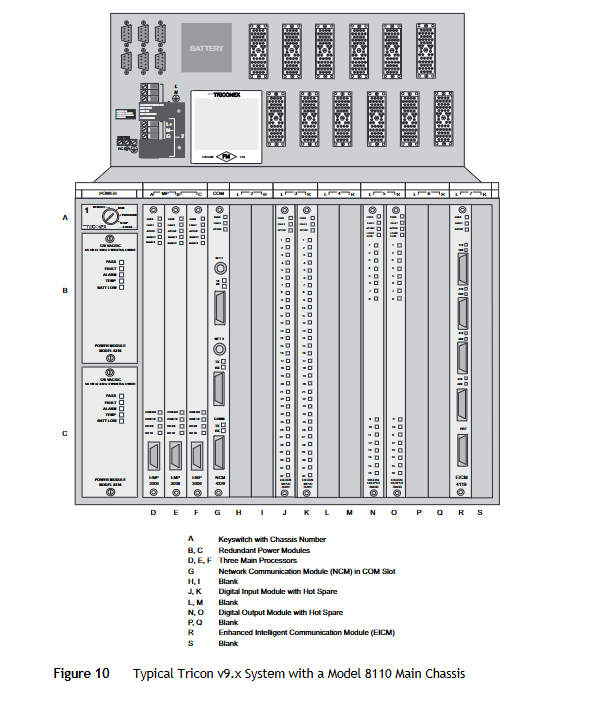
Host rack 8110 supports 6 sets of I/O modules, TriBus speed 25Mbps standard system core installation
Enhanced host rack 8120E supports 5 sets of I/O modules, TriBus speed 1000Mbps v11. x system, requires 3009 MP
Expansion rack 8111 supports 8 sets of I/O modules, with a maximum distance of 30 meters from the host rack for local I/O expansion
Low density expansion rack 8121 supports 5 sets of I/O modules and is compatible with HART interfaces in scenarios where the HART protocol is required
Remote rack 8112 supports 6 sets of I/O modules, paired with RXM module for remote I/O expansion (up to 12 kilometers)
(2) Power module: Stable power supply core
Key characteristics of model input voltage output parameters
8310 120VAC/VDC 6.5VDC ± 1%, 27A supports over temperature and low battery alarm, online replacement
8311 24VDC 6.5VDC ± 1%, 27A reverse protection, suitable for ATEX scenarios
8312 230VAC 6.5VDC ± 1%, 27A does not support ATEX scenarios and requires a dedicated power supply
Commonality: Dual redundant configuration, single module can support the entire machine load, output power of 175W (at 60 ℃), with overvoltage and overcurrent protection.
(3) Main Processor (MP): System Computing Core
Model compatible system version core configuration TriBus speed
3006/3007 v9.0-9.5. x NS32GX32 processor, 2MB/1MB SRAM 4Mbps
3008 v9.6-10. x MPC860 processor, 16MB DRAM, 25Mbps
3009 v11. x P1021 dual core, 256MB DRAM 1000Mbps (8120E rack)
Key features: Supports sequence of events (SOE) recording, with a time drift of ± 2 seconds/day, and has independent I/O processors and communication processors.
(4) Communication module: Cross system interconnection core
Module type, model, core function, adaptation protocol/interface
TCM 4351B/4352B/4353/4354 Ethernet+serial communication Modbus, OPC, TCP/IP
UCM 4610 docking with Foxboro Evo system fiber optic Ethernet Modbus
EICM 4119/4119A connects Modbus devices/printers RS-232/485 at a speed of 19.2Kbps
NCM 4329/4329G Ethernet cross system communication 10Mbps network port, supporting GPS timing
SMM 4409 docking with Honeywell UCN network 5MB/s UCN port
(5) I/O module: signal input/output core
Digital Input Module (DI)
|Model | Voltage Specification | Number of Points | Type | Core Characteristics|
|3501E/T | 115VAC/VDC | 32 | TMR | Optical isolation, non common ground|
|3503E | 24VAC/VDC | 32 | TMR | Self testing function, shared ground at 8 o’clock per group|
|3564 | 24VDC | 64 | Single module | Low cost, supports hot standby|
Digital Output Module (DO)
|Model | Voltage Specification | Number of Points | Type | Core Characteristics|
|3604E | 24VDC | 16 | TMR | Optical isolation, non common ground|
|3624 | 24VDC | 16 | TMR (monitoring type) | Voltage/current loop back detection|
|3664 | 24VDC | 32 | Dual redundancy | 32 point common ground, self-protection|
Analog Input Module (AI)
|Model | Signal Type | Points | Accuracy | Core Characteristics|
|3700A | 0-5VDC | 32 |<0.15% FSR | Differential input, DC coupling|
|3703E | 0-5/0-10VDC | 16 |<0.15% FSR | Isolated input, supports over range detection|
|3708E | Thermocouple (J/K/T/E) | 16 | ± 3.0 ° F | Cold junction compensation, automatic calibration|
Analog Output Module (AO)
|Model | Current Range | Points | Accuracy | Core Features|
|3805E/H | 4-20mA | 8 |<0.25% FSR | Common ground return, supports HART|
|3806E | 4-20mA/20-320mA | 6+2 |<0.25% FSR | High current output, driving servo|
|3807 | ± 60mA | 4 |<0.25% FSR | Bipolar, suitable for motion control|
Pulse/Accumulation Module
|Model | Type | Points | Frequency Range | Core Characteristics|
|3511 | Pulse input | 8 | 20-20000Hz | Differential input, AC coupling|
|3515 | Pulse Accumulation | 32 | 0-1KHz | 31 Bit Counter, Supports Zeroing|
(6) HART interface module
Model type compatible with I/O module core functions
2770H AI interface 3700A, 3721 stacked with HART protocol for 4-20mA signal
2870H AO interface 3805E, 3805H support HART protocol communication, compatible with v10.4+system
Software and Configuration Tools
Configuration software: TriStation 1131 v4. x, supports three IEC 61131-3 standard languages including Function Block Diagram and Ladder Diagram, and can download programs and configure variables.
Diagnostic software: Enhanced Diagnostic Monitor v2. x, used for system fault diagnosis and status monitoring.
Programming support: TriStation MSW supports relay ladder logic and optional CEMPLE (causal matrix) language.
Environmental and Physical Specifications
Environmental parameters:
Working temperature: 0-60 ℃ (32-140 ° F), storage temperature: -40-75 ℃ (-40-167 ° F)
Relative humidity: 5% -95% (no condensation)
Anti vibration: 2G (10-150Hz), anti impact: 15G (6-11ms)
Corrosion level: Complies with ISA S71.04 G3 level (harsh industrial environment)
Physical specifications:
Rack size: 48.3cm (width) x 57.8cm (height) x 45.1cm (depth)
Weight: The main/expansion rack weighs approximately 24.5kg, the power module weighs 3.3kg, and the I/O module weighs 2.1-2.7kg
Key points for installation and maintenance
Installation requirements:
Rack spacing: Vertical spacing ≥ 4.45cm, ventilation gap ≥ 13.3cm to ensure heat dissipation.
Grounding: Triple grounding (protective ground, signal ground, shielding ground) is used to avoid ground loop interference.
Cable: The I/O bus cable is up to 30 meters long and uses optical fiber for remote expansion, complying with ANSI/TIA/EA-568-B.3 standards.
Maintenance features:
Module replacement: supports online hot plugging, and does not affect on-site wiring during replacement.
Battery maintenance: The mainframe has dual redundant lithium batteries with a range of 6 months. It is recommended to replace them after 8-10 years.
Fault diagnosis: The module comes with PASS/AULT/CTIVE indicator lights and supports remote logging and alarm.
Application restrictions:
Dangerous area: It needs to be installed in an IP54 level protective enclosure to avoid operating the module with electricity.
Nuclear level applications: Only specific models (with N suffix) support nuclear 1E level scenarios.