Woodward MicroNet ™ Simplex/Plus digital controller
Basic Information
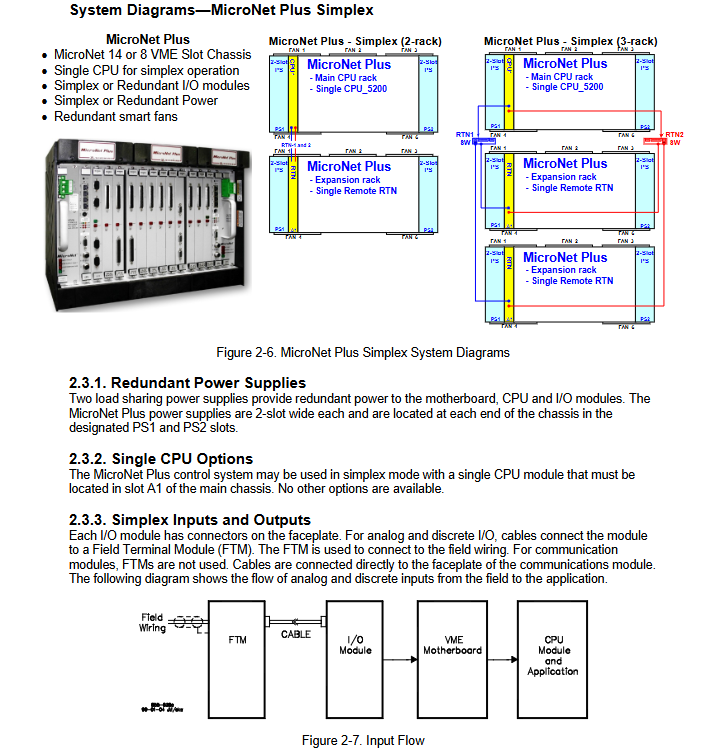
Product series MicroNet Simplex (single CPU), MicroNet Plus (dual CPU redundancy)
Core positioning: full lifecycle control of the prime mover (start-up, operation, monitoring, shutdown)
Suitable for gas turbines, steam turbines, diesel engines, gas engines, and water turbines
Certification qualifications UL/cUL, CE, CSA, EAC, ABS (Classification), LR (Classification) ATEX Zone 2
System hardware configuration
(1) Chassis specifications
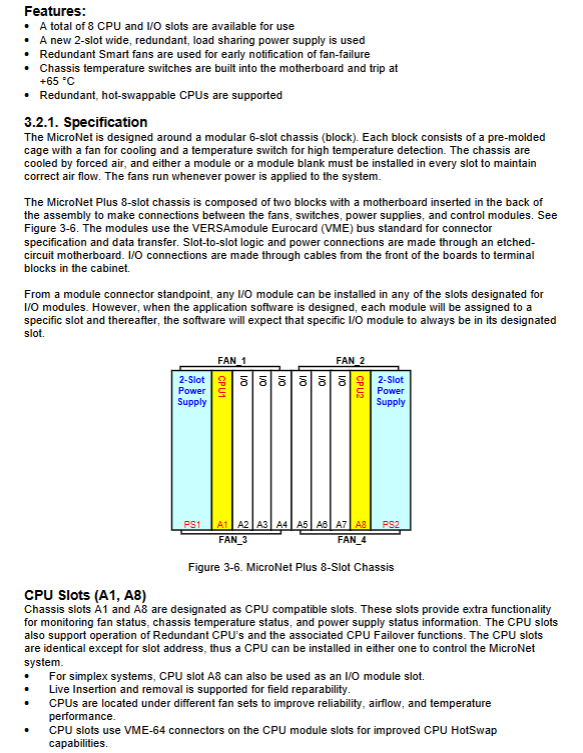
Specification: 14 slot chassis, 8 slot chassis
Slot distribution: 2 power slots+2 CPU slots+10 I/O slots, 2 power slots+2 CPU slots+4 I/O slots
Size (W × H × D) 356 × 340 × 178mm, suitable for small installation scenarios
Redundant intelligent fans for heat dissipation (6/14 slots, 4/8 slots), redundant intelligent fans for 65 ° C over temperature alarm (4), 65 ° C over temperature alarm
Grounding of chassis PE, installation of screw grounding (M4/# 8-32) is the same as 14 slot chassis
(2) Core module parameters
① CPU module
Model P1020 PowerPC CP5-200 (Motorola)
Processor 800MHz dual core MPC5200
Storage 512MB RAM+768MB Flash 128MB DDR RAM+64MB Flash
Communication interfaces: 4 Ethernet (2 × 1000Mbps), 5 CAN, 1 USB, 2 Ethernet, 2 CAN, 1 RS-232/485
Working temperature: 0 ° C~55 ° C -40 ° C~85 ° C
Redundancy Support (Slot A1/A14) Support (Slot A1/A8)
② Power module
Input specifications 24Vdc (18-36Vdc) 110Vac/dc (88-132Vac/100-150Vdc) 220Vac (180-264Vac)
Output power 600W 1250VA (AC)/600W (DC) 1250VA
output voltage 24V@12A The 5V@32A 、 5V pre charge @ 3A same left same left
Redundancy feature dual module load sharing, supporting cold plugging with same left and same left
Protection function: Input overvoltage/undervoltage, over temperature, and output short circuit protection are the same as left and left
③ I/O module
Key parameters of module type
Discrete I/O (48/24 Combo) with 48 DI (optically isolated, 18-32Vdc) and 24 DO (relay output), update time 5ms
Discrete DI (48Ch) 48 channel optically isolated input, supporting internal/external 24V power supply, input current 3mA@24Vdc
Discrete DO (64Ch) 64 channel open drain output, compatible with 16Ch/32CH relay modules, maximum load 2A@250Vac
Speed sensor module with 4 inputs (optional MPU/Eddy/Prox), frequency range 1Hz~25kHz, accuracy 0.01%
Analog I/O (24/8) with 24 channels of AI (4-20mA/0-5V) and 8 channels of AO (4-20mA), with a resolution of 16 bits and an accuracy of 0.1%
④ Communication module
Module type functional parameters
Remote RTN supports rack expansion, copper cable 30m/fiber optic 2km, up to 8 racks interconnected
SIO module with 4 serial ports (2 x RS-232, 2 x RS-232/422/485), baud rate of 110Bd~57.6kBd
Core functions and features
(1) Control function
Core control: speed control, load distribution, sequence control, surge control, auxiliary system control
Monitoring and alarm: over temperature/over pressure/over speed monitoring, module fault alarm, trend recording
Redundancy guarantee: CPU redundancy (automatic fault switching), power redundancy (load sharing), I/O redundancy (dual sensors/dual modules)
(2) Communication and Expansion
Communication protocols: TCP/IP, Modbus RTU, Modbus TCP, CANopen, DeviceNet
Scalability: Supports 7 expansion racks, copper cable transmission for 30m, fiber optic transmission for 2km (multimode)
Remote access: Supports PLC/DCS access via Modbus TCP, supports USB/Ethernet local configuration
(3) Safety and Compliance
Safety features: IOLOCK fault safety (output power loss), requirement for independent overspeed protection device, ESD protection
Environmental compliance: ATEX Zone 2 (explosion-proof), Class I Division 2 (hazardous area)
Electromagnetic compatibility: Complies with EN 61000 and needs to be installed in a metal cabinet
Software and Configuration
Development environment: Woodward GAP (graphical programming) Ladder Logic, Support rate group scheduling (minimum 5ms)
Configuration tools: AppManager (firmware upgrade, network configuration, fault monitoring), ToolKit (visual debugging)
Diagnostic functions: module LED fault codes, real-time status monitoring, historical fault records, remote diagnosis
Installation and maintenance
Installation requirements: The chassis should be installed vertically, with 8cm of heat dissipation space reserved above and below, and shielded cables should be grounded
Module replacement: Supports hot swapping (CPU/Remote RTN module needs to be reset first)
Maintenance cycle: The module undergoes health checks every 6 years, with an increased frequency of checks every 20 years or more