Woodward MicroNet TMR ® 5009 Digital Control System
Basic Information
Product series MicroNet TMR ® five thousand and nine
Core positioning: High reliability prime mover control (focusing on fault tolerance and safety control)
Suitable for gas turbines, steam turbines, generators, and various types of prime movers
Certification qualifications UL/cUL (Class I Division 2), CE (EMC/LVD), Lloyd’s (ENV1/ENV2)
System hardware configuration
(1) Chassis specifications
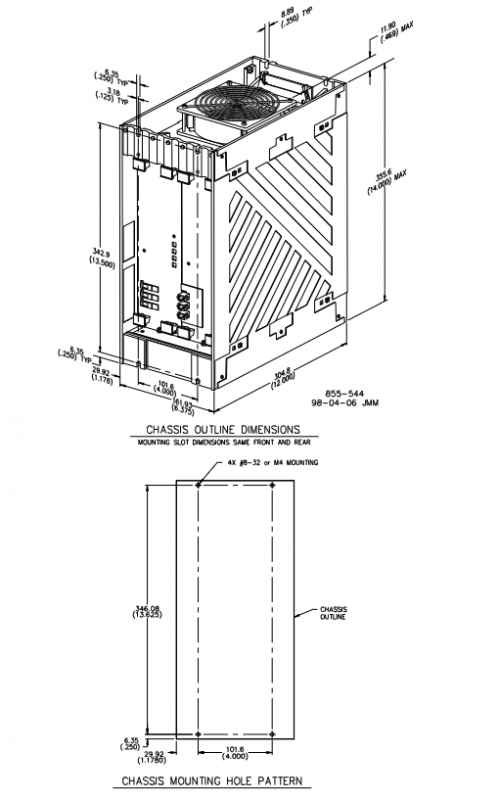
Chassis Type: Main Control Chassis, Power Chassis
The core function supports the control module and I/O module to provide redundant power output
Module capacity: 3 core areas (each area contains 6 slots), 2 main power module slots
Size Weight 22kg (48lb) Weight 8kg (17lb)
Cooling method: Top forced air cooling fan (1 per 6 slots) with dual cooling fans on top and bottom
(2) Core module parameters
Module type key specifications
CPU module processor: Motorola 68040; Memory: Built in RAM/Flash; Redundancy quantity: 3; Real time clock: NiCd battery (non user replaceable, 16 hours of charging, 3 months of battery life)
Main power module input specifications: 18-36Vdc/88-132Vac/180-264Vac, etc; Output: 24Vdc x 6 channels (6A per channel); Redundancy features: load sharing, hot swapping
Core power module input: 24Vdc; Output: 5VDC (10A)+5V pre charge; Function: Power supply for single core area modules
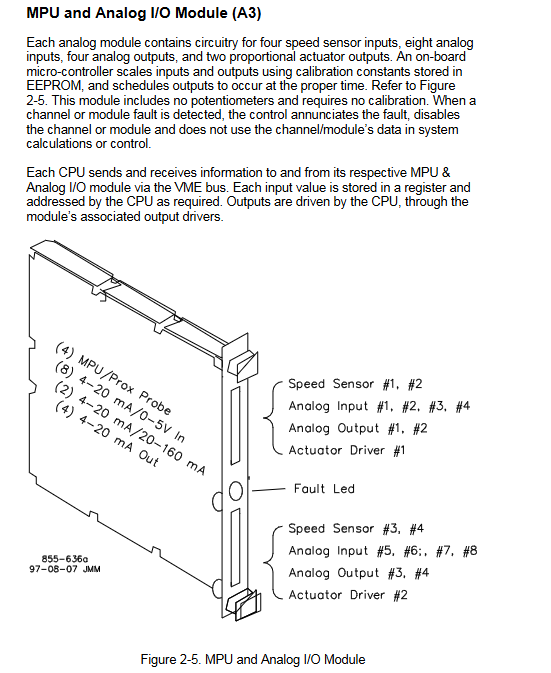
Analog I/O module speed input: 4 channels (MPU/proximity probe, 0.5-25kHz); Analog input: 8 channels (4-20mA, accuracy 0.1%); Analog output: 4 channels (4-20mA, load 600 Ω); Output of actuator: 2 channels (4-20mA/20-160mA, software optional)
Discrete I/O module discrete input: 24 channels (optically isolated, 18-32Vdc/100-150Vdc, input current) 13mA@24V ); Discrete output: 12 channels (relay, Form-C contact, 3A resistive load)
SIO communication module serial port quantity: 4; Supporting protocols: RS-232 (1/2 port), RS-232/422/485 (3/4 port); Transmission distance: RS-232 (15m), RS-485 (1219m)
(3) Terminal module configuration
Number of terminal module types and core functions
ATM (Analog Terminal Module) 2 analog signal/speed signal wiring conversion; Built in 100mA fuse; Support MPU/proximity probe wiring
DTM (Discrete Terminal Module) 4 discrete signal/relay output wiring conversion; Support internal/external 24V power supply; Integrated potential fault detection circuit
Core functions and features
(1) Control function
Speed control: Supports input from MPU (100-25000Hz) and proximity probe (0.5-25000Hz), with an accuracy of 0.03%
Analog control: 8 channels of 4-20mA analog inputs (supporting two-wire/three wire sensors), 4 channels of 4-20mA analog outputs (accuracy 0.2%)
Actuator driver: 2-channel PWM output (4.88kHz), supports single coil/double coil actuators, configurable jitter current (25Hz)
Discrete control: 24 discrete inputs (including 4 preset functions: emergency stop/reset/speed up/down), 12 relay outputs (including 2 dedicated outputs: stop/alarm)
(2) Redundancy and Fault Protection
The third mock examination Redundancy (TMR): three CPU modules work in parallel, two out of three signals vote, and single module failure does not affect system operation
Potential Fault Detection (LFD): Relay outputs are configured in series parallel with 6 relays, periodically detecting contact status to avoid potential fault accumulation
Fault safety state: When the I/O Lock function is triggered, the discrete output loses power and the analog output returns to zero, ensuring equipment safety
Redundant power supply: load sharing of two main power modules, seamless takeover of the other module in case of single power failure
(3) Communication and Compatibility
Communication protocol: Supports Modbus ASCII/RTU, DDE (PCI engineering station docking)
Interface types: CPU with built-in RS-232 ports (3), SIO module serial ports (up to 8)
Compatible products: DSLC synchronous load controller, RPS active power sensor (4-20mA power signal input), OCP operation panel
Installation and environmental specifications
(1) Environmental parameters
Category specifications
Working temperature: 0 ° C~55 ° C (without external heat source)
Storage temperature -20 ° C~70 ° C
Relative humidity 5%~85% (no condensation)
Vibration protection Lloyd’s ENV2: 13-150Hz @ 1.0G (10 frequency sweeps)
Impact protection US MIL-STD-810C: 15g 11ms half sine pulse
(2) Power supply and wiring specifications
Power type, input range, fuse specifications, wire specifications
Low voltage DC 18-36Vdc 40A slow melting 10mm ² (8AWG)
Medium voltage AC/DC 88-132Vac/100-150Vdc 20A slow melting 4.0mm ² (12AWG)
High voltage AC/DC 180-264Vac/200-300Vdc 10A slow melting 2.5mm ² (14AWG)
(3) Maintenance cycle
Maintain project cycle
Cooling fan replacement for main/power chassis fan: 50000 hours; Cabinet fan: 60000 hours
Air filter cleaning for 60 days to 18 months (depending on environmental dust concentration)
Regular CPU battery inspection (no fixed cycle, replacement in case of leakage/damage)