Watlow ANAFAZE 12LS type 1/8 DIN multi loop PID controller
1. Product Overview
Core positioning: ANAFAZE 12LS is a high-performance multi loop PID controller with 1/8 DIN specifications. It supports 12 independent control loops and can be directly connected to various industrial sensors. It is suitable for process control such as temperature, pressure, and flow, and supports single machine operation or computer monitoring mode.
Core Features:
Control function: 12 channel dual output PID control (heating/cooling independent parameters), supporting three output types: ON/OFF, time proportional (TP), and distributed zero crossing (DZC).
Input interface: compatible with J/K/T/B/S/R thermocouples, RTDs, 4-20mA current signals, 0-11V voltage signals, 12 bit resolution, sampling rate of 1 time/second.
I/O configuration: 9 digital inputs (triggers), 11 digital outputs (alarms/events), supporting global alarm output.
Communication and Storage: RS-232 (single device, up to 50ft)/RS-485 (32 devices, up to 6000ft), 8 job file storage, 12 Ramp/Soak configuration files.
Power supply specifications: 10-30VDC input, typical power consumption of 3W, comes with a 110VAC adapter.
2. Installation process
2.1 Installation Preparation
Environmental requirements:
Environmental parameter specification requirements
Working temperature 0-40 ℃ (32-104 ° F)
Relative humidity ≤ 80% (below 31 ℃), drops to 50% at 40 ℃ (non condensing)
Altitude ≤ 2000m (6560ft)
Installation location: Indoor vertical installation, away from high temperature/corrosion/strong electromagnetic interference
Hardware and Tools:
Wire: 18-20AWG multi strand shielded wire, thermocouple requires dedicated extension wire.
Recommended cables: Belden 9154 (analog input), Belden 9729 (communication), Belden 8451 (analog output).
Tools: M5 bolt, crimping tool, 0.1% metal film resistor (for input calibration).
2.2 Key installation steps
Mechanical installation: The panel opening is 46mm × 92mm, and the controller is fixed with upper and lower fixtures after embedding. The distance between adjacent devices is ≥ 20mm to ensure natural heat dissipation.
Electrical connection:
Power supply: 10-30VDC connected, with positive and negative terminals corresponding to each other, to avoid reverse connection.
Sensor: Thermocouple connected to CH+IN/- IN COM, 4-20mA signal needs to be connected in series with a 3k Ω resistor to convert to 12-60mV, RTD needs external signal conditioning.
Communication: RS-232 is connected to a PC through a 9-pin D-type interface, RS-485 requires shielded twisted pair, and the end node is connected to a 200 Ω terminal resistor.
Noise suppression: When driving relays with digital outputs, parallel RC buffers (0.01 μ F+47 Ω) are required, and the power and signal lines are routed in separate slots.
3. Operation and Configuration
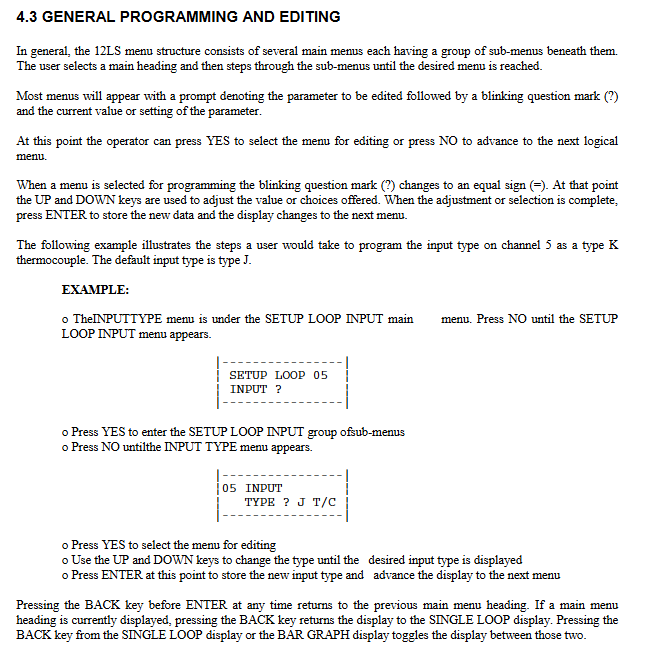
3.1 Front panel operation
Display mode:
Bar chart display: Overview of 12 circuit status, including deviation alarm indication.
Single loop display: single loop process value, set value, output percentage, status.
Scan display: Automatically display all circuits in a loop (1 second per circuit).
Alarm display: flashing to indicate the alarm circuit and type (high/low process value, deviation).
Core operation:
Basic operations: setting value modification (CHNG SP key), manual/automatic switching (MAN AUTO key), alarm confirmation (ALARM ACK key).
Advanced configuration: Enter the password (ENTER → ALARM ACK → CHNG SP) to enter the settings menu, configure PID parameters, input calibration, and Ramp/Soak programming.
3.2 Core Function Configuration
PID parameter tuning:
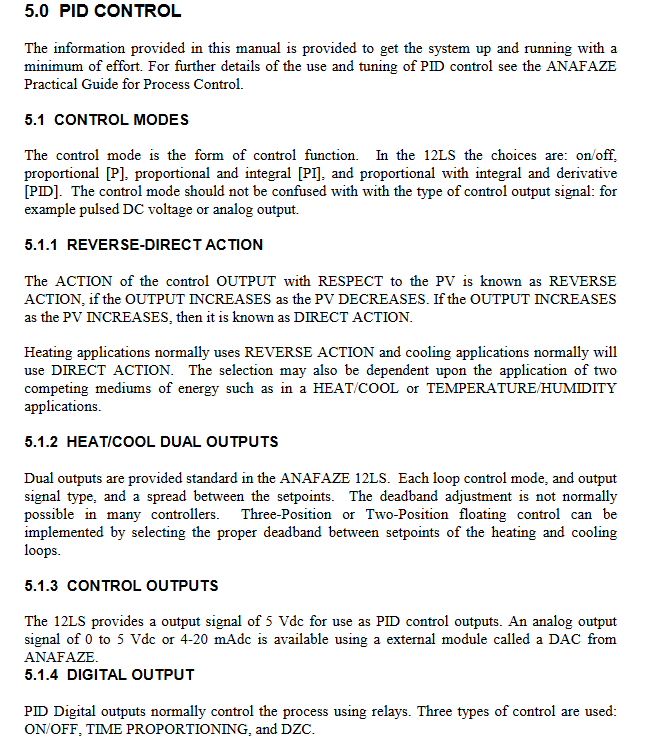
Control mode: Supports three modes: P (proportional), PI (proportional integral), and PID (proportional integral derivative).
Typical parameter range: proportional band (PB) 3% -200%, integration time (TI) 30-600 seconds, differentiation time (TD) 3-60 seconds.
Adjustment method: First adjust PB to the critical oscillation, and then set TI (PB × 1.2) and TD (TI × 0.15) according to the empirical formula.
Input calibration: Use the “two-point calibration method” to input the process values and readings corresponding to the high and low ranges of the sensor, and automatically scale linearly.
Alarm settings: Each circuit supports high/low process value alarms and deviation band alarms, which can be allocated to 9 digital outputs. It also supports dead zone settings to avoid false alarms.
3.3 Advanced Features: Ramp/Soak Batch Control
Function positioning: Suitable for temperature/pressure curve control in mass production, with 12 independent configuration files (A-L) and a maximum of 20 segments per file.
Key parameters: Each segment can be set with a target value, duration, trigger (digital input), event output (digital output), and over tolerance protection time.
Loop setting: Supports 1-99 loops or continuous loops, and supports external reset triggering.
4. Troubleshooting and Safety Standards
4.1 Common fault handling
Troubleshooting direction
Display ‘BATTERY DEAD’ internal memory battery failure, needs to be replaced and parameters input again
Control output unresponsive check output type configuration, manual/automatic mode, wiring for short circuit
Measurement drift sensor grounding failure, environmental temperature fluctuation, input calibration failure (recalibration)
Communication failure baud rate mismatch (2400/9600 optional), RS-485 terminal resistance not connected, address conflict
4.2 Safety Regulations
Mandatory requirement: It must be equipped with an external independent safety device to prevent danger caused by controller failure resulting in full on/off output.
Operation taboos: Disconnect the load power supply before cutting off the power, and avoid plugging and unplugging sensors while they are live; Thermocouples need to be non grounded to prevent interference from grounding loops.
Anti static: Wear an anti-static wristband during installation to avoid touching circuit board components.
5. Summary of Technical Specifications
Category key parameters
Input characteristics: 12 analog inputs, resolution of 12 bits, accuracy of 0.1% (25 ℃), support for thermocouples (J/K/T, etc.), 4-20mA, 0-11V
Output characteristics: 11 digital outputs (5VDC/10mA), supporting ON/OFF, TP, DZC three types, dual outputs (heating/cooling)
Communication interfaces RS-232 (57600 baud rate), RS-485 (500Kbit/s, 32 devices)
Environmental parameters: Operating temperature 0-40 ℃, humidity ≤ 80%, altitude ≤ 2000m
Physical parameters 1/8 DIN specification (48 × 96mm panel), depth 155mm, power supply 10-30VDC (3W)