Honeywell IPC 620-06 Programmable Controller
Product Infrastructure
Core positioning: IPC 620-06 is the core model of the 620 series programmable controller, designed specifically for industrial automation scenarios, with functions such as logic control, data acquisition, and equipment linkage, suitable for centralized or distributed control needs of small and medium-sized industrial devices.
hardware architecture
Rack type: processor rack (full rack: 620-0090/0091, 8 I/O slots; Half rack: 620-0092/0093, 4 I/O slots), I/O rack (full rack: 621-9990/9992, 12 I/O slots; Half rack: 621-9991, 6 I/O slots)
Installation specifications: Full rack compatible with 19 inch instrument rack (8 inches deep), half rack suitable for narrow spaces (10 inches wide), supports bidirectional installation of rack/panel
Core processor: Motorola 68B09E microprocessor, paired with 2K memory, supports EPROM optional expansion (27128 model)
Environment and Power Supply
|Category | Specification Parameters|
|Power supply type | AC (115/230VAC ± 10%), DC (24VDC ± 20%)|
|Frequency range | 47-63Hz|
|Working temperature | Industrial standard environment (unspecified, default 0-60 ℃)|
|Data backup | 3V lithium battery (AA lithium dry battery), backup for ≥ 6 months|
|Protective features | Rack mounted design, dust-proof modules, and anti misoperation terminal blocks|
Core Component Details
1. Processor module (PM: 620-0636)
Core configuration: 2K memory, including 768 bit output status table (0-191 actual I/O, 192-767 control relay), 256 16 bit registers (4096-4351)
Operation control: 3-position key switch (Program/Disable/RUN/Program), 4 status LEDs
RUN LED: Scan running indicator
FORCE LED: Command Force Status Indication
PASS LED: self-test pass indicator
BATTERY PASS LED: Battery normal indication
Backup and Expansion: Built in lithium battery compartment (front replaceable), supports EPROM program backup (U32 slot)
Communication interface: 9-pin D-type connector (RS4229600 Baud), connected to programming terminal/Loader
2. Power module (PSM)
Divided into processor rack power supply and I/O rack power supply, the core parameters are as follows:
Module Model Applicable Scenarios Input Specifications Output Specifications Key Features
620-0041 processor rack 115/230VAC+5VDC (8A), ± 15VDC (600mA) 95VA power consumption, 2A/1A fuse
620-0083 processor rack 85-132/170-250VAC+5VDC (15A), ± 15VDC (1.16A) 90W total power, switch selection
620-0046 processor full rack 20-28VDC+5VDC (8A), ± 15VDC (600mA) 96VA power consumption, 8A fuse
621-9932 I/O rack/processor half rack 20-28VDC+5VDC (8A), ± 15VDC (600mA) 96VA power consumption, 40A cold start current
621-9933 I/O rack 85-132/170-250VAC+5VDC (10-15A), ± 15VDC (1.3-2A) 110VA power consumption, 4A/2A fuse
621-9934 I/O rack/processor half rack 115/230VAC+5VDC (8A), ± 15VDC (600mA) single width module, 2A/1A fuse
3. I/O system
Rack configuration: The full rack supports 12 I/O modules, 1 PIOM, and 1 PSM; Half rack supports 6 I/O modules+1 PIOM+1 PSM
Module type:
Digital I/O: 8/16/32 points, voltage covers 5/12/24/48/115/230VAC/DC, supports Sink/Source type
Analog I/O: 8-point 4-20mA/0-10V input, 4-point 4-20mA/0-10V output, isolated design
Special features: thermocouple/mV input, high-speed counter, pulse input, ASCII communication, absolute encoder interface
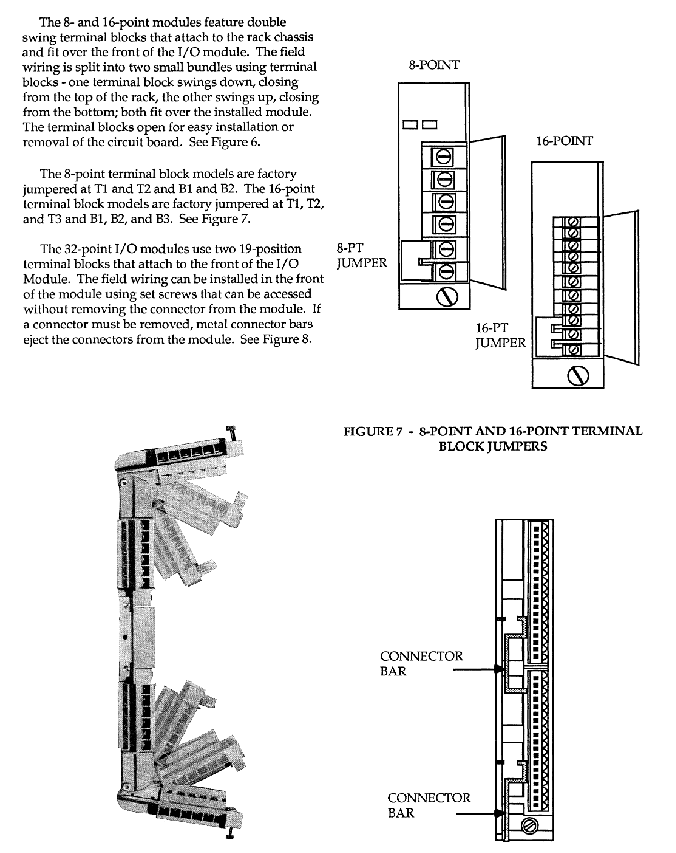
Terminal block design: The 8/16 point module adopts dual swing terminal blocks, and the 32 point module adopts dual 19 position terminal blocks, supporting on-site wiring with screw fixation
4. Expansion module
Module type, model, function positioning, key parameters
Control Network Module (CNM) 620-0038: Multiple PLCs can be interconnected up to 8 units, with 32/64 bit I/O status transmission
Communication Interface Module (CIM) 620-0043/0044/0048/0052 supports Modbus RTU, DMCS/ABC protocols for serial communication
Hiway Interface Module (HIM) – connects to TDC-3000 system to provide access interface for upper level devices
Operator Panel Interface (OPI) – Connect button/keyboard display single coaxial cable transmission
I/O Expansion Module (IOEM) 620-0053 Expansion I/O Rack 50 Pin D Connector, daisy chain topology
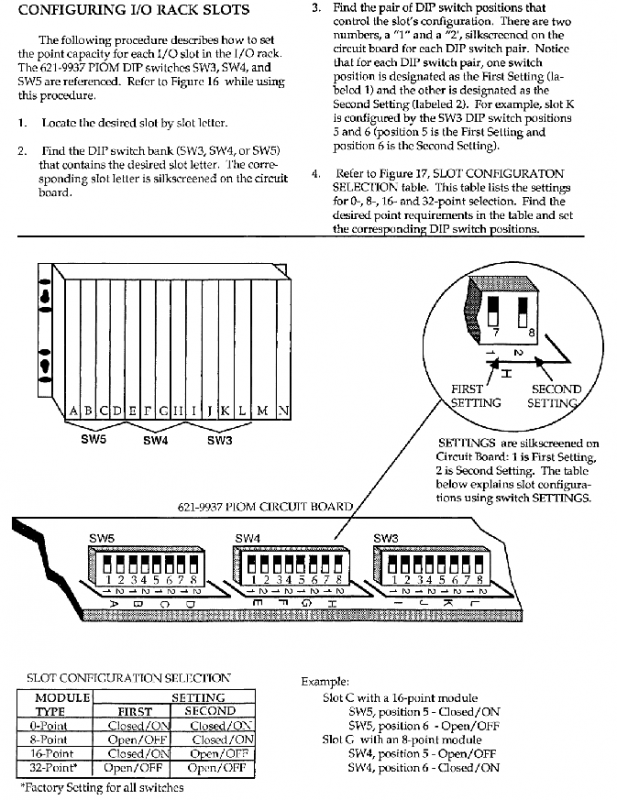
Parallel I/O module (PIOM) 621-9937 I/O rack controls 2 50 pin interfaces, with DIP switches configured for address configuration
Communication and Network
Parallel I/O link
Topology: daisy chain, processor rack IOEM → I/O rack PIOM → expansion I/O rack PIOM
Transmission distance: maximum 50 feet (multi conductor cable)
Capacity limit: Up to 2 external I/O racks, total system I/O points ≤ 192
Control Network
Transmission medium: twisted pair cable (up to 4000 feet), dual axis cable (up to 8000 feet)
Communication characteristics: High speed peer-to-peer communication, each PLC can transmit 32/64 bit I/O status and receive 256 bit I/O status
Response time: 8 PLCs with full service ≤ 18ms
Topology structure: multi-point configuration, supporting interconnection of 8 620 series PLCs
serial communication
Protocol support: CIM module provides Modbus RTU (620-0044), Honeywell DMCS (620-0048), ABC (620-0052) protocols
Interface standard: RS422/RS232, supports communication with 627 LOS and third-party smart devices
Operation mode and programming features
Three operation modes | Mode | Core function | Status indication | Key operation|
|Program | Program editing/uploading/downloading, do not scan program | RUN LED off | Clear/modify program, force command|
|DISABLE | Execute program without updating actual output | RUN LED stays on | Program testing, output status monitoring|
|RUN/PROGRAMME | switchable RUN/PROGRAMME, default RUN | RUN LED always on | normal control, online programming (ARMP)|
Programming Core Features
Instruction set: covering relay logic (NO/NC contacts, output, latch/unlock), timer/counter (ON/OFF delay, hold type), arithmetic operations (addition, subtraction, multiplication, division, comparison), data operations (Bring In/Send Out, PUSH/PULL), sequence control, etc., with a total of 30+instructions and execution time of 5.49-506.30 microseconds
ARMP online programming: firmware version ≥ 48 supported, program modification during operation, scan time increase ≤ 20ms, online programming DIP switch needs to be enabled
EPROM backup: supports writing RAM programs into EPROM, automatically restores when powered on (cold start/low battery), RAM programs cannot be modified
Mandatory function: Supports command enforcement, FORCE LED indication, requires activation through processor DIP switch
Data backup and recovery
Lithium battery backup: 3V AA lithium dry battery, backup memory/register data for ≥ 6 months, front replaceable
Cold start recovery: EPROM program → RAM, output status table reset, register data recovery
Hot start recovery: RAM program retention, output/register data retention, jump table not transferred
Diagnosis and safety features
Diagnostic function
Power on self-test (POST): microprocessor, ROM checksum, RAM read-write, I/O bus testing
Program checksum: Calculate the checksum for every 24 words scanned during operation, and compare it with the initial value to detect program errors
Online check: Check ISS instruction position, EOM instruction integrity, scan timeout (150-200ms)
Fault monitoring: The system status table (address 2413-2432) records scan loss, battery status, I/O fault count, and address
safety protection
Output fault handling: configured through PIOM DIP switch, output reset or hold in case of fault
Power protection: AC power undervoltage detection (115VAC ≤ 83V, 230VAC ≤ 166V), DC power undervoltage detection (24VDC ≤ 19V)
Static protection: Module insertion and removal require anti-static measures, as RAM data may be lost when the module is removed
Lithium battery safety: Do not charge, burn, short circuit, avoid high temperature storage
Address configuration and deployment
Address configuration rules
Rack start address: set through PIOM SW1, range 0-184, subsequent rack start address=previous rack end address+1
Slot address: Set through PIOM SW3/SW4/SW5, each slot can be configured with 0/8/16/32 points
Address example: Processor rack (0-127) → I/O rack # 1 (128-191), supports 8/16/32 point module hybrid configuration
Deployment requirements
Installation space: Reserved maintenance space around the full rack, half rack suitable for narrow environments such as motor control centers
Grounding requirements: The protective grounding and signal grounding should be separated, and the grounding resistance should be ≤ 4 Ω
Cable specification: Control Network uses shielded twisted pair cables, parallel I/O cable length ≤ 50 feet