DEIF Delomitic-3 High Flexibility Multifunctional Generator Set Control and Protection System
Product Basic Positioning
Delomitic-3 is a multifunctional generator control and protection system developed by DEIF, with the core advantages of high flexibility and customization. It can configure precise functions according to user needs, integrate all the protection and control functions required for generator applications, and adapt to distributed power control scenarios. It is mainly used in various power plants such as ships, power stations, local combined heat and power generation, and comprehensive thermal and power generation. The system provides complete documentation, factory acceptance testing, and technical support before, during, and after debugging. It can seamlessly communicate with other systems and optional graphical user interfaces, making operation and interaction convenient.
Overall System Architecture
The system is a modular distributed architecture, consisting of a DEIF generator unit (DGU) and a control panel (CP). Communication between the components is achieved through an ARC network (Token Ring Local Area Network). The core architecture rules are as follows:
Only one DGU is configured for a single generator set, and each DGU can connect up to three CPs at most;
CP is the slave unit of DGU, and even if CP fails, all parameter settings of DGU remain valid;
In a single ARC network, up to 8 DGUs and their corresponding CPs can be connected, with a total of no more than 24 CPs;
The system can interface with the upper alarm/monitoring system through the CM-2 module to achieve protocol conversion and data exchange.
Core Component Functions
Control Panel (CP)
CP serves as the operator’s human-machine interaction interface, with all functions based on LCD display screens and hardware peripherals. The core functions include:
The display screen displays all alarm information, measurement/calculation data, and supports parameter setting and modification;
Equipped with 16 LED indicator lights for device status and alarm display;
Up to 16 instruments can be connected to expand data collection and display capabilities.
DEIF Generator Unit (DGU)
DGU is the core control unit of the system, which is a standardized rack equipped with various functional modules. It is the hardware carrier that realizes all control, protection, and acquisition functions. Its core features include:
Rack design: manufactured according to the German Federal Railway standard BN 411002/411003, with a communication bus equipped with flat cables and 64 terminal connectors on the backplane, each connector corresponding to a set of PCB rails;
Rack specifications: available in two sizes, 60 TE and 84 TE, supporting base installation and embedded installation. Unused slots require cover plates to ensure protection level;
Additional accessories: Shock absorber kit is standard in ship applications, and can be selected as needed for other scenarios. Shock absorber kit will increase the weight of the frame;
Material and Protection: All plastic parts comply with UL94-V0 self extinguishing standards, and the protection level of the fully assembled rack is IP20 (front and rear ends);
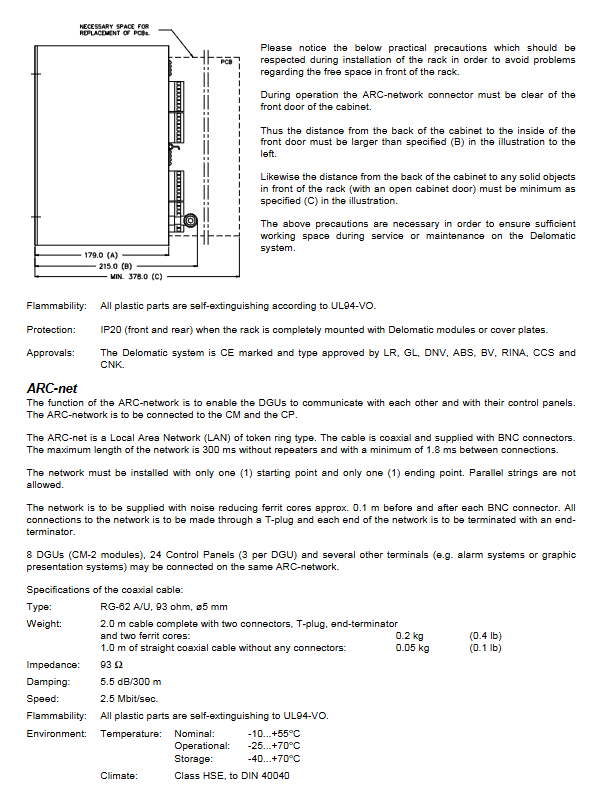
Installation requirements: The cabinet should reserve sufficient operating space, and the ARC network connector should avoid the cabinet door to ensure ease of operation during maintenance.
DGU rack core parameter table
Rack specifications Available space A Size B Size C Basic weight Shock absorber kit weight
60 TE 304.8 mm 343.2 mm 361.1 mm 3.0 kg(6.6 lb) 0.9 kg(2.0 lb)
84 TE 426.7 mm 465.1 mm 483.0 mm 3.5 kg(7.7 lb) 1.2 kg(2.6 lb)
Function module configuration
DGU consists of multiple specialized functional modules, all of which are equipped with detachable connectors and are divided into mandatory modules and optional modules. There are clear limitations on the number of modules that can be installed in a single DGU. The module functions and configuration rules are shown in the table below:
Delomatic-3 Core Function Module Parameter Table
Module Model Core Function Single DGU Maximum Load Quantity Module Positioning
PSM-1 supplies power to all modules within DGU, and some modules require external power supply for safety functions. One must be equipped (power module)
CM-2 controls DGU according to the application program to achieve protocol conversion between ARC network and RS232/422/485 (MODBUS RTU), and interfaces with one necessary configuration (main control/communication module) of the upper system
IPM-1 16 channel input module, each channel can be configured with 8 optional current/voltage/binary inputs (digital/analog inputs)
8 optional OPM-1 16 channel relay output modules (relay output)
AOM-1 8-channel analog output module, each channel can be configured as dual/single polarity, voltage/current output with 8 optional options (analog output)
CRM-1 current relay module, with 4 optional options for short circuit/ground fault/differential current protection (current protection)
SCM-1 multifunctional module, including generator protection, circuit breaker control, three-phase electrical parameter measurement, precision synchronizer (with engine speed output), 1 optional (generator measurement/synchronization/protection)
SCM-2 multifunctional module, including shaft generator protection, circuit breaker control, three-phase electrical parameter measurement, and bus tie circuit breaker synchronization with 3 optional options (shaft generator/bus tie measurement/synchronization/protection)
PRM-1 advanced protection relay module, providing grid protection functions (positive sequence low voltage, over/under frequency, over/under voltage, negative sequence overcurrent, etc.) with 2 optional options (grid protection)
ARC network communication network
The ARC network is the core communication link of the system, which is a token ring local area network (LAN) that enables bidirectional communication between DGUs and between DGUs and CPs. It can also be extended to the upper system through the CM-2 module. The core parameters and deployment requirements are as follows:
Physical specifications: RG-62 A/U-shaped coaxial cable (93 Ω, diameter 5mm) is used, equipped with BNC connector, and the connection method is T-shaped plug. Terminators need to be connected at both ends of the network, and ferrite cores need to be installed about 0.1m before and after each BNC connector to reduce interference;
Communication parameters: communication rate of 2.5 Mbit/sec, maximum transmission distance of 300m without repeaters, minimum distance between connection points of 1.8m;
Network capacity: A single ARC network can access up to 8 DGUs (CM-2 modules), 24 CPs, and other terminals such as alarm systems and graphic display systems;
Deployment rule: The network only allows 1 starting point and 1 ending point, and parallel branching is prohibited;
Cable weight: 2.0m finished cable (including 2 connectors, T-shaped plugs, terminators, and 2 magnetic cores) weighs 0.2kg; 1.0m unconnected straight cable weighs 0.05kg;
Transmission loss: The damping of a 300m cable is 5.5 dB.
ARC Network Environment Parameter Table
Environmental indicators, nominal values, operating values, stored values, climate levels
Working temperature -10~+55 ℃ -25~+70 ℃ -40~+70 ℃ DIN 40040 HSE level
Product Certification and Environmental Characteristics
Certification qualifications: The system has passed CE certification and obtained type certification from multiple classification societies such as LR, GL, DNV, ABS, BV, RINA, CCS, CNK, etc., suitable for professional scenarios such as ships;
Temperature adaptation: The overall operating temperature of the system is -25~70 ℃, and the storage temperature is -40~70 ℃, meeting the harsh environmental requirements of industry and ships;
Flame retardant properties: All plastic components comply with UL94-V0 self extinguishing standards, enhancing equipment safety level;
Protection level: After the DGU rack is fully assembled with modules/covers, the protection level at both the front and rear ends is IP20.