EATON IQ500 modular intelligent multifunctional power meter
Product Foundation and Model Description
Product positioning: The IQ series is Eaton’s digital energy meter, and the IQ500 is a multifunctional meter designed specifically for medium and low voltage systems. It integrates data acquisition, processing, and statistics, and is the core terminal for intelligent power monitoring and energy management;
Model specification: The model code for IQ500 is A2, and the official order number is I0500A2001;
Compliance certification: fully meets the standards of GB/T 22264.1-2022, IEC61010, IEC62053-22/24, etc., has AK, CB, CE certificates, anti-interference and measurement accuracy meet international general requirements;
Product features: Compact and expandable, tool free installation, intuitive operation, compact size (DIN96 × 96 standard), seamless integration with existing energy management/remote terminal systems, and high cost-effectiveness.
Core hardware parameters and installation specifications
(1) Basic hardware parameters
Category key parameters
Working power supply 85~265VAC/85~265VDC wide power supply, power consumption * * ≤ 2W**
Protection level panel IP52, shell IP20
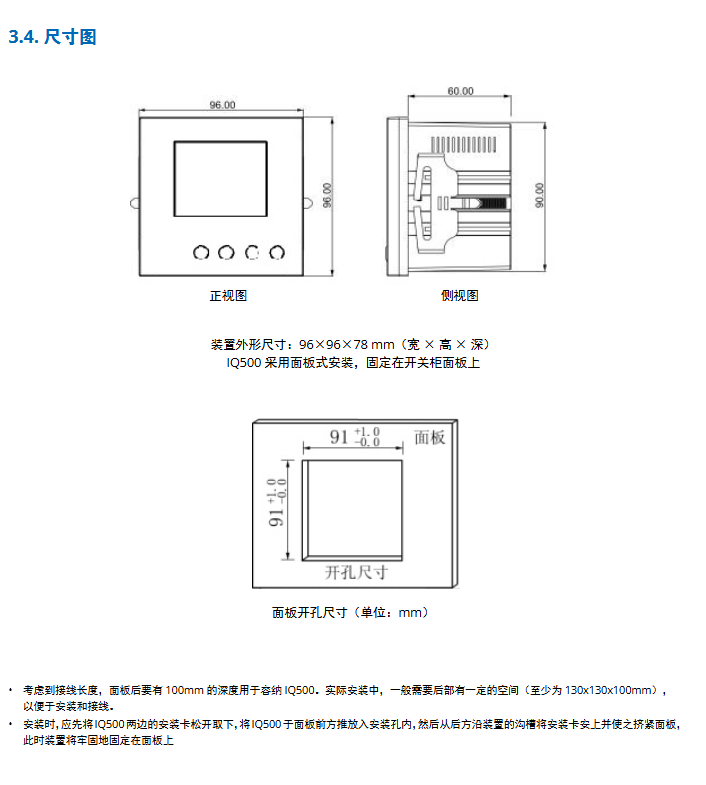
Appearance/Hole Size Appearance 96 × 96 × 78mm (width × height × depth), Panel Hole 91 × 91mm
Installation method: self-locking panel type, detachable installation slots on both sides, no need for screws, quick fixation
Working/storage environment: -25 ℃~+70 ℃, 95% non condensing; Storage: -40 ℃~+85 ℃
Segmented LCD display with backlight for clear reading in low light conditions
(2) Input/output characteristics
Electrical input
Voltage: rated 220VAC, measurement range 20VAC~264VAC;
Current: rated 1A/5A, corresponding measurement range 0.01~1.2A/0.05-6A, continuous overload 1.2In, instantaneous overload 20In (Tmax<1s);
Frequency: rated 50/60Hz, measurement range 45~65Hz;
Switching input: 4-channel passive node optically isolated input, isolation voltage 1500VDC.
Electrical output
Relay output: 2 channels, rated at 250V/5A AC or 30V/5A DC;
Transmission output: 4~20mA, load resistance * * ≤ 600 Ω * *, isolation voltage 500VDC.
Communication interface: 1 RS485 interface, supporting MODBUS-RTU/DLT645-2007 protocol, with optional communication rates of 1200/2400/4800/9600/19200/38400bps.
(3) Wiring specifications
Supports three wiring methods: three-phase four wire 3CT (3P4W 3CT), three-phase three wire 3CT (3P3W 3CT), and three-phase three wire 2CT (3P3W 2CT);
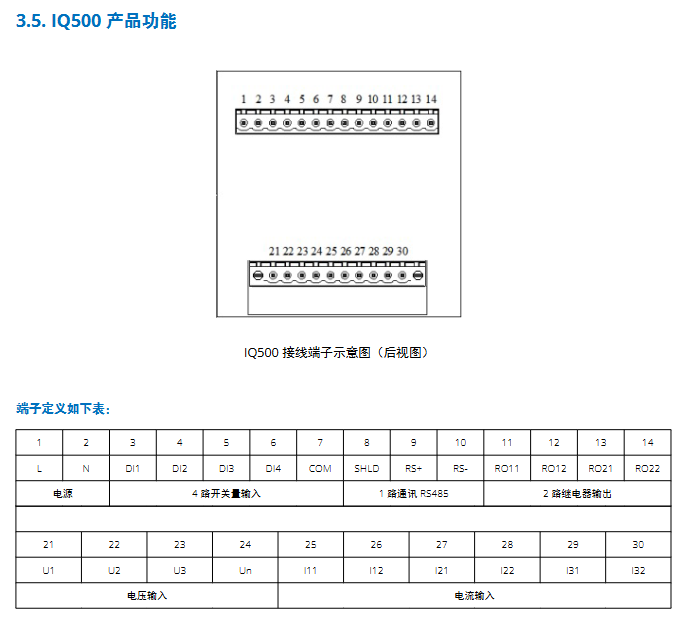
Terminal layout: divided into 6 major areas: power supply, switch input, communication, relay output, voltage input, and current input. The rear view clearly divides the terminals for convenient wiring.
Core functional characteristics
IQ500 has comprehensive functions, covering all scenarios such as power parameter monitoring, electricity measurement, power quality analysis, statistical analysis, alarm control, etc. Some data only supports communication reading. The core functions are as follows:
Full power parameter monitoring: real-time measurement of three-phase phase/line voltage (and average value), three-phase current/zero sequence current, three-phase active/reactive/apparent power, three-phase/system power factor, and system frequency;
High precision electrical measurement
Basic measurement: total active/reactive/apparent electricity measurement, active/reactive/apparent electricity measurement of each phase (apparent only for communication reading);
Fine measurement: positive and negative total active/reactive energy, four quadrant reactive energy (all only for communication reading);
Data retention: It can record electrical measurement records for 12 transfer cycles, only for communication reading.
Flexible time-division multiple rate billing
Parameter configuration: Supports up to 4 rates, 12 time periods, 8 daily time period tables, 12 annual time zones, 90 public holidays, and can set weekly holiday time period tables;
Execution priority: Public holiday schedule>Weekly holiday schedule>Annual time zone schedule;
Dual table switching: equipped with two sets of time zone tables, two sets of daily time period tables, and two sets of public holiday tables, which can automatically switch at the set time point.
Power quality analysis: supports three-phase voltage/current imbalance detection, monitoring of 2-31st harmonic components of voltage/current, calculation of total harmonic distortion rate, and can also measure the fundamental effective value of voltage/current, fundamental power/power factor/active/reactive energy. The accuracy of harmonic measurement is S-level;
Demand and Extreme Value Statistics
Demand statistics: Real time statistics of three-phase current and total power (active/reactive/apparent) demand, recording the maximum demand for the current settlement cycle and time stamps (under different rates), and can retain 3 transfer cycle records (only for communication reading);
Extreme value statistics: Record the maximum/minimum values and occurrence time of each phase/line voltage, current, and power, and can retain records for 3 transfer cycles.
Multi mode data freezing: The frozen content includes total active/reactive power and active/reactive power of each phase, supporting 3 freezing methods and recording up to 12 freezing records (only for communication reading):
Timed Freeze: Automatically freeze on a monthly/daily/hourly basis;
Instantaneous freeze: freeze immediately upon receiving a communication command;
Agreed freeze: Freeze triggered when switching time zone/day/public holiday schedule.
Over limit alarm and event recording
Alarm Monitoring: Supports 10 sets of over limit alarms (both upper and lower limits can be set), with monitoring objects including voltage, current, power, power factor, and frequency (only for communication reading and writing);
Alarm linkage: triggering SOE events (out of limit/return) when the limit is exceeded, and can also be linked with relay actions;
Event retention: Record up to 32 out of limit alarm events (including out of limit, return, and reset operations).
Switching quantity and output control
Switch quantity acquisition: 4-channel passive DI, capable of recording 32 switch quantity SOE events;
Relay output: 2-channel DO, supporting scenarios such as alarm linkage and remote control.
Technical performance indicators
(1) Measurement accuracy (core indicator)
Measurement parameter accuracy level measurement range
Voltage level 0.2 0~42000V
Current level 0.2 0~6000A
Power factor 0.5 level 0 ≤ COS Φ ≤ 1
Active/reactive/apparent power level 0.5 0~756000 kW/kvar/kVA
Electricity measurement level 0.5 0~9999999.9kWh
Frequency 0.02Hz 45~65Hz
Harmonic S level 2-31st order
(2) Electromagnetic compatibility performance
IQ500 adopts multiple anti-interference designs and operates stably in complex power environments. The core anti-interference levels are as follows:
Anti interference type execution standard level
Electrostatic discharge immunity GB/T 17626.2-2018 Level 4
Electrical Fast Transient Pulse Group Immunity GB/T 17626.4-2018 Level 4
Surge immunity GB/T 17626.5-2019 Level 4
Power frequency magnetic field interference immunity GB/T 17626.8-2006 Level 4
Damping oscillation magnetic field interference immunity GB/T 17626.10-2017 Level 4
Radio frequency electromagnetic field radiation immunity GB/T 17626.3-2016 Level 3
Radio frequency conducted immunity GB/T 17626.6-2017 Level 3
Typical Applications and Customer Value
Typical application areas: Widely applicable to infrastructure, data centers, healthcare, multi tenant venues, building construction, industrial enterprises, commercial venues, municipal units, power operation and maintenance departments, etc;
Core customer value
Industrial enterprises: Comprehensive monitoring and analysis of electricity usage, optimization of electricity usage plans, ensuring stable and safe electricity usage;
Commercial premises: meet the needs of time of use billing, electricity statistics, equipment energy consumption monitoring, and adapt to load fluctuations;
Municipal units: achieve refined management of public electricity and improve the efficiency of electricity resource utilization;
Power operation and maintenance: remote monitoring+fault warning, improve operation and maintenance efficiency, and reduce operation and maintenance costs;
Universal value: Improve energy efficiency, reduce energy costs, optimize equipment utilization efficiency, achieve power data recording, anomaly perception, and system collaboration.