



KONGSBERG’s RMP420 Remote Multifunctional I/O Module
Core advantages and features
Safety protection features
Overvoltage protection
Short circuit protected I/O loop power output
Soft and hard fail safe
Dual watchdog
Intrinsic Safety Certification: Suitable for use in Hazardous Area Zone 2 (Certified for use in Hazardous Area Zone 2)
Flexible configuration and functional features
32 software independently configurable multifunctional solid-state channels, supporting AI (analog input), AO (analog output), DI (digital input), DO (digital output)
Supports 2-wire or 3-wire heating resistor (RTD) signals
Two channels can be configured as pulse/frequency/encoder inputs
I/O channels online configurable
Communication and reliability characteristics
Redundant I/O bus interface (Dual Remote I/O process BUS), realizing redundant communication with the host
Galvanically isolated communication ports from other circuits in the module
Loop monitoring per channel
Automatic recovery protection: Automatic start of faulty channels
Convenient operation and maintenance features
Easy installation and replacement
Simple and safe firmware upgrade
Status LED indicator light
Extensive module diagnostics
RIO module and I/O circuit share the same power supply
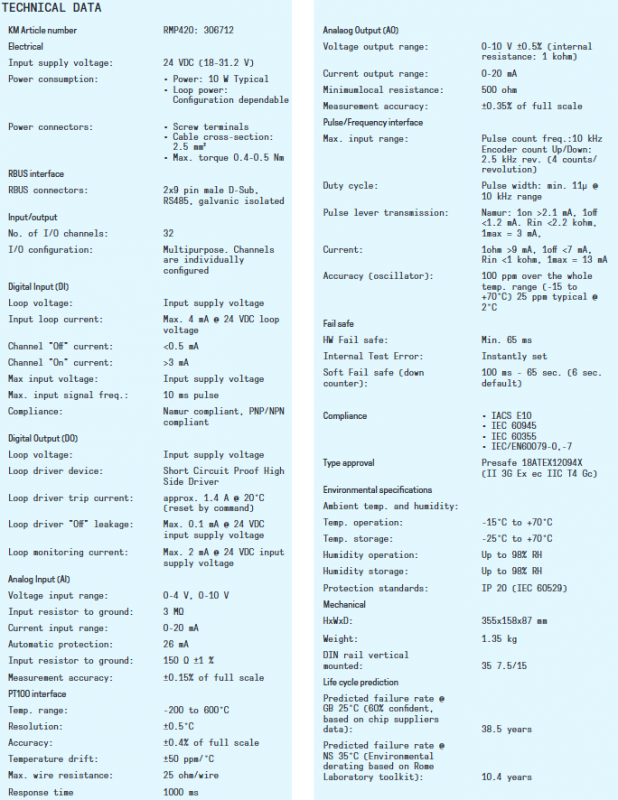
Technical specifications and parameters
Category specific parameters
Electrical parameter input power supply voltage: 24 VDC (18-31.2 V); Typical power consumption: 10 W; Loop power consumption: depends on configuration; Power connector: screw terminal (cable section 2.5 mm ², maximum torque 0.4-0.5 Nm)
Communication interface (RBUS) connector: 2 9-pin male D-Sub connectors; Type: RS485; Feature: Galvanic Isolation
Environmental parameters operating temperature: -15 ° C~+70 ° C; Storage temperature: -25 ° C~+70 ° C; Working/storage humidity: up to 98% RH; protection level: IP 20 (IEC 60529)
Mechanical parameter size (HxWxD): 355x158x87 mm; Weight: 1.35 kg; Installation method: 35 7.5/15 DIN rail vertical installation
Life prediction GB 25 ° C (60% confidence, based on chip supplier data): 38.5 years; NS 35 ° C (environmental downgrade based on Rome laboratory toolkit): 10.4 years
Compliance and certification comply with standards: IACS E10, IEC 60945, IEC 60355, IEC/EN60079-0/-7; Intrinsic Safety Certification: Presafe 18ATEX12094X (II 3G Ex ec IIC T4 Gc)
Details of Key Parameters for I/O Channels
Key parameters of signal type
Digital input (DI) circuit voltage: input power supply voltage; Maximum input circuit current: 4 mA@24 VDC; Off state current:<0.5 mA; On state current:>3 mA; Maximum input voltage: Input power supply voltage; Maximum input signal frequency: 10 ms pulse; Compatibility: Namur compatible, PNP/NPN compatible
Digital output (DO) circuit voltage: input power supply voltage; Driver components: short-circuit protection high side driver; Trip current: approximately 1.4 A @ 20 ° C (command reset); Leakage current in “off” state: maximum 0.1 mA@24 VDC; Circuit monitoring current: maximum 2 mA@24 VDC
Analog input (AI) voltage input range: 0-4 V, 0-10 V (ground input resistance 3 M Ω); Current input range: 0-20 mA (automatic protection threshold 26 mA, ground input resistance 150 Ω± 1%); Measurement accuracy: ± 0.15% of full scale
RTD temperature range: -200~600 ° C; Resolution: ± 0.5 ° C; Accuracy: ± 0.4% of full scale; Temperature drift: ± 50 ppm/° C; Maximum wire resistance: 25 ohms per wire; Response time: 1000 ms
Analog output (AO) voltage output range: 0-10 V ± 0.5% (internal resistance 1 kohm); Current output range: 0-20 mA; minimum local resistance: 500 ohm; Measurement accuracy: ± 0.35% of full scale
Maximum input range for pulse/frequency input: pulse count frequency of 10 kHz, encoder count of 2.5 kHz rev. (4 counts/revolution); Duty cycle: minimum pulse width of 11 µ s in the range of 10 kHz; pulse level transmission: Namur standard (1on>2.1 mA, 1off<1.2 mA, Rin<2.2 kohm, 1max=3 mA); Current standards (1ohm>9 mA, 1off<7 mA, Rin<1 kohm, 1max=13 mA); Oscillator accuracy: 100 ppm over the full temperature range (-15~+70 ° C), typical 25 ppm at 2 ° C
Fault safety hardware fault safety: minimum 65 ms; internal test error: instant trigger; Software fail safe (countdown counter): 100 ms -65 sec (default 6 sec)


