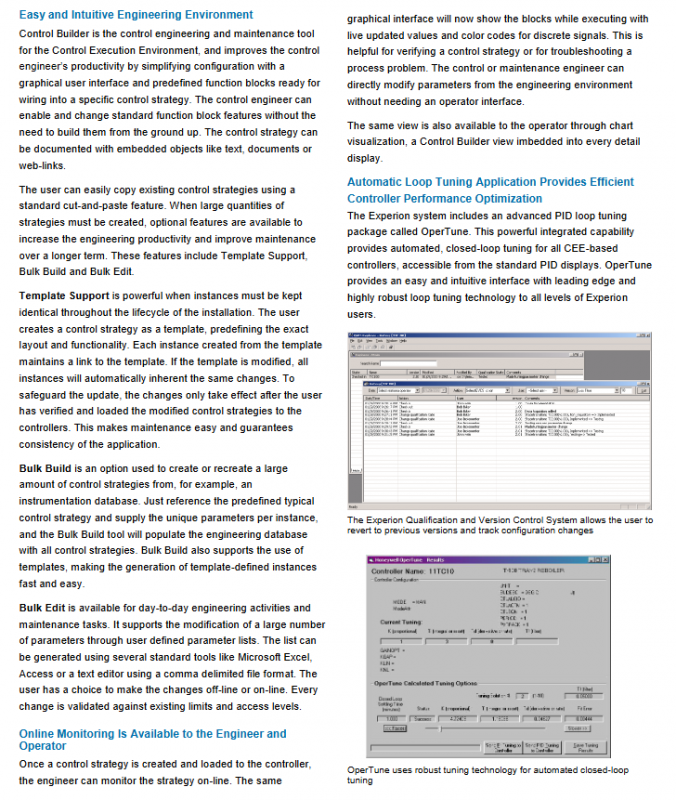
HONEYWELL Expert C300 Controller
Core positioning and design philosophy of the product
The C300 controller is an Expert ® The core of the PKS platform is equipped with Honeywell’s on-site validated Control Execution Environment (CEE) deterministic control execution environment, which realizes four core functions: deterministic execution of control strategies, batch processing operations, various I/O docking, and direct running of custom programmable applications.
Adopting the exclusive vertical design of Series C, it combines the advantages of space saving installation and optimized heat dissipation reliability. High density components maintain a high channel/module ratio while reducing the size of the board.
Supports full redundancy configuration, only requiring the addition of the same hardware module without any additional configuration, significantly reducing the engineering complexity of redundant deployment.
Core values: Improve engineering productivity, reduce maintenance costs, maximize process running time, reduce production costs, and achieve efficient and stable control of industrial processes.
Core performance and execution capability
Fast execution feature: Supports a wide range of execution cycles and enables high-speed scan rate applications on a single integrated control platform, such as turbine control strategies, compressor anti surge control, and other scenarios that require high response speed.
Rich Function Block Library: CEE’s function blocks fully support continuous control, logical control, sequential control, model-based control, and batch control. Each function block has pre-defined features (alarm settings, algorithm selection, maintenance statistics), which are combined into control modules (CM)/sequential control modules (SCM) through soft wiring to achieve efficient strategy engineering.
Batch control standard: fully supports ISA S88.01 batch standard, independently executes 4-layer program models within the controller without server dependency; Support class based batch concepts, reduce project and lifecycle costs for batch applications, and seamlessly integrate with the Expert platform to form a unified batch execution platform.
Model prediction optimization: Equipped with the patented Profit Loop algorithm (single input/single output model prediction function block), it combines the simplicity of PID with the optimization of model based control, and can improve process stability by up to 30%. Through single knob tuning, control actions are reduced to extend valve life, and computational resources are comparable to standard PID, making it suitable for large-scale deployment in complex circuits.
Engineering Tools and Efficiency Optimization (Control Builder)
Control Builder is CEE’s exclusive control engineering and maintenance tool, which simplifies configuration through a graphical interface. Its core functions to improve engineering efficiency include:
Basic operation: Pre define functional blocks for direct wiring, support cutting/copying existing control policies, policies can be embedded in text/document/webpage links to achieve standardized document management.
Efficient engineering functions:
Template support: After creating a template policy, instances are linked to the template, and all instances can be synchronized with one click after template modification (verified and loaded), ensuring consistency throughout the entire lifecycle;
Batch construction: Generate a large number of control strategies from the instrument database, support template reuse, and quickly fill the engineering database;
Batch editing: Define parameter lists through Excel/Access/Text Editor (CSV format), batch modify parameters, support offline/online operations, and all modifications are validated according to limits and access levels.
Seamless policy migration: Supports drag and drop migration of policies between different control environments, allowing seamless switching between simulated execution (policy verification) and online controller deployment, without interrupting the operation of other control policies when modifying/adding policies.
Online capability: After the strategy is loaded, it supports real-time monitoring online, with a graphical interface displaying the running status of functional blocks, real-time values, and discrete signal color codes. Engineers can directly modify parameters in the engineering environment without the need for an operator interface; The operator can visually view the same interface through the charts in the detail display.
Data communication and time synchronization
Unified data access: Secure access to application information within the controller is achieved through named parameters. With the help of the Expert global database, engineers do not need to know the location of data, and the system automatically manages deterministic communication and data delivery. Parameters are protected according to security access levels to prevent accidental modifications.
Communication optimization: Based on the Report by Exception and Publish Subscribe mechanisms, continuous optimization of communication is achieved by accessing data only when needed, avoiding redundancy and efficiently utilizing bandwidth.
Accurate time synchronization:
Simultaneously supporting IEEE 1588 Precision Time Protocol (PTP) and standard NTP protocol, directly connected to Level 2 network, achieving precise time synchronization across controllers, independent of system size, supporting docking with any PTP master clock source and displaying PTP statistical data;
Support automatic daylight saving time (DST) adjustment without manual intervention. The controller periodically calibrates the time, and newly added controllers automatically synchronize to the correct time.
Standardized display: CEE supports detail/group display templates, which can be assigned according to control policies. It supports standard display/custom display. After referencing the display name in the policy configuration, operators can interact with the control policy through the corresponding display interface. Group display can be used as a panel for custom graphics.
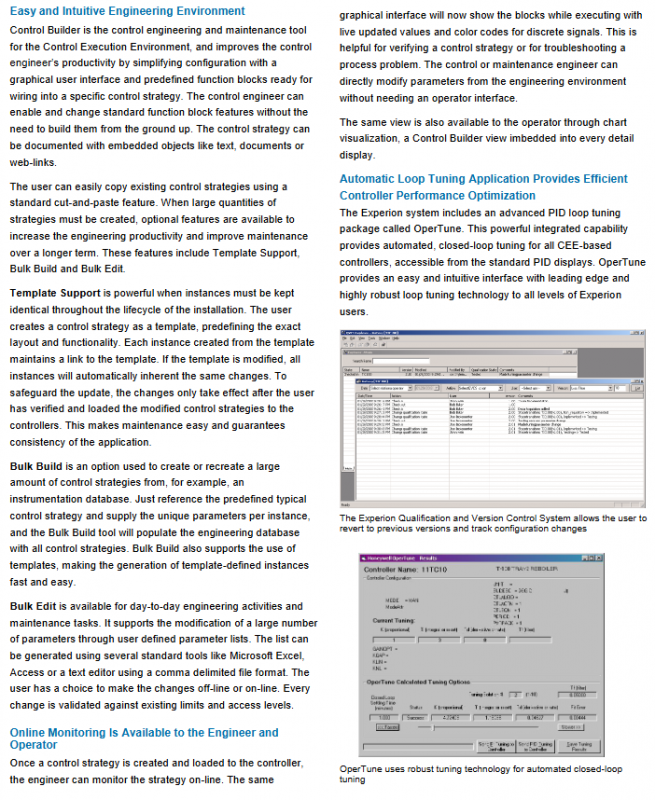
Equipment integration and compatibility
The C300 controller achieves transparent integration of various industrial field devices, compatible with existing Honeywell products, and ensures investment protection. Its core integration capabilities are as follows:
Integration type supports device/protocol integration features
Fieldbus Equipment FOUNDATION ™ Fieldbus、HART ®、 Profibus ® Through seamless integration of fieldbus interface module/Profibus gateway module, intelligent device diagnosis and on-site data can be utilized, and HART digital information can be synchronized to the operator interface and asset management application (Field Device Manager/Asset Manager)
Wireless device ISA100 is directly integrated with wireless field devices, and the wireless device parameters are consistent with traditional I/O for control strategies. The wireless module and device are uniformly configured through Control Builder to achieve wireless data monitoring/operation and alarm/event viewing
Honeywell I/O Series C I/O and Process Manager TM I/O are connected through a dedicated dual redundant I/O communication network, allowing for fully redundant deployment of I/O and complete transparency to user applications
Honeywell control nodes C200, C200E, and ACE have seamless peer-to-peer communication, compatible with existing control node investments
Maximizing high availability and process runtime
C300 achieves maximum system and process runtime through multi-layer design, with core features including:
Uninterrupted system expansion/upgrade: New function block libraries can be expanded while the controller is running online; Support On Process Migration under redundant deployment, seamlessly upgrade to new software versions without interrupting control and operator interfaces.
High reliability hardware design: Under redundant deployment, the hardware has a high mean time between failures (MTBF), comprehensive diagnostic coverage, and enables bumpless failover in the event of a main/backup controller failure. User applications do not require any modifications, and the system automatically synchronizes.
Network Security and Redundancy:
Based on Honeywell’s patented Fault Tolerant Ethernet (FTE), equipped with Control Firewall, only process control related information is allowed to access the controller, blocking network attacks;
Equipped with dual redundant I/O communication network as standard, each controller supports 2 I/O networks to enhance network reliability.
Power failure protection: Equipped with battery backup RAM and checkpoint function, the controller can be quickly restored in case of sudden power failure. It supports both warm and cold restart methods to quickly restore process control.
Heat dissipation optimization: The vertical design evenly distributes heat on the Series C module, reducing hotspots and improving product reliability.
Compliance support and customization capability
Compliance: Paired with the Qualification and Version Control System (QVCS) option, it meets the requirements of FDA 21 CFR Part 11 validation and GAMP guidelines, providing full configuration version control, version rollback, version comparison, and current configuration comparison functions, generating a complete audit trail including username, operation, and timestamp; QVCS also supports lifecycle management, allocating dedicated users/user groups for each stage and controlling configuration progress.
Custom Algorithm: Supports Custom Algorithm Blocks (CABs). Users can develop custom algorithms and data structures in Control Builder using Visual Basic syntax, generating reusable blocks (consistent with predefined function block properties) that run directly in the embedded real-time execution environment within the controller, significantly reducing the development cost of complex control strategies.
Additional optimization tools and core values
PID tuning tool: comes standard with the OperTune advanced PID closed-loop tuning package, accessed from the standard PID display interface, providing automated closed-loop tuning for all CEE controllers. The interface is simple and intuitive, suitable for users at all levels.
Summary of Core Values:
Engineering end: Improve engineering productivity, simplify configuration/maintenance, support batch operations and template reuse;
Running end: Maximize process running time, improve process stability (up to 30%), and achieve undisturbed operation/upgrade/fault switching;
Cost side: Vertical design reduces installation costs, high-density components improve hardware utilization, reduce control actions, extend equipment lifespan, and lower production/maintenance costs;
Investment side: CEE platform independence, can reuse existing user applications on new hardware platforms, compatible with Honeywell’s existing I/O and control nodes, fully ensuring investment protection.