Rockwell Automation SLC 500 Series Programmable Logic Controller
Processor file structure and address system
1. Core file types and characteristics
Example of file type identification, purpose, element structure, address format
Output file O0: Store external output signal 1 word/element (16 bits) O: 3/15 (slot 3, bit 15), O: 5.1 (slot 5, word 1)
Input file I1: Store external input signal 1 word/element (16 bits) I: 7/8 (slot 7, bit 8), I: 2.1/3 (slot 2, word 1, bit 3)
Status file S2: Storage system status and status bit 1 word/element (16 bits) S: 1/15 (element 1, bit 15, first scan bit)
Bit file B3: Relay logic, shift register 1 word/element (16 bits), maximum 256 elements B3:3/14 (element 3, bit 14), B3/62 (62nd bit in the file)
Timer file T4: Timing control (TON/TOF/RTO) 3 words/element (status+preset+accumulation) T4:0/EN (enable bit), T4:0. PRE (preset value)
Counter file C5: Count Control (CTU/CTD/HSC) 3 words/element (Status+Preset+Accumulate) C5:0/CU (Add Count Enable), C5:0.ACC (Accumulate Value)
Control file R6: Shift/sequence/ASCII instruction controls 3 words/element (status+length+position) R6:2/LEN (length value), R6:2.POS (position value)
Integer file N7: Integer data storage and operation 1 word/element (16 bits) N7:2 (element 2), N10:36 (custom integer file 10, element 36)
Floating point file F8: Floating point data storage and operation 2 words/element (32-bit) F8:2 (element 2), only supported by SLC 5/03 and above
2. Address coding rules
Common format: File identifier: Slot number Font size/bit number (e.g. T4:0.1/0 represents timer file 4, element 0, character 1, bit 0)
Simplification rule: When the font size is 0, it can be omitted (e.g. O: 5/0=O: 5.0/0)
Extended configuration: File 9-255 can be customized through programming as bit/timer/counter/integer/floating point and other types to meet the needs of extended storage
Detailed classification and functions of core instructions
1. Basic instructions (13)
The core is used for bit operations, timing, and counting, and is the most fundamental logical unit in industrial control:
Bit operation instructions: XIC (check closed), XIO (check open), OTE (output Energize), OTL (output latch), OTU (output unlock), OSR (rising edge single trigger)
Timing instructions: TON (power on delay), TOF (power off delay), RTO (hold type timing), support 0.01 second time base, preset/accumulated value range 0-32767
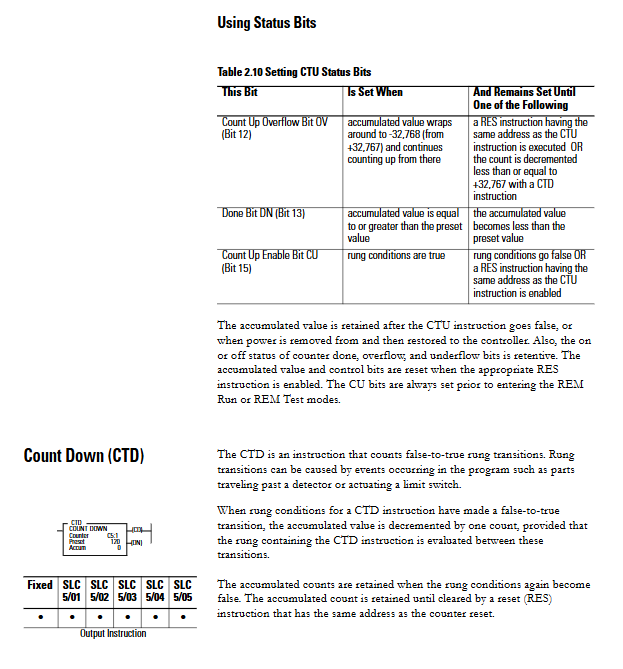
Counting instructions: CTU (up counting), CTD (down counting), HSC (high-speed counting, only fixed controller 24VDC input), counting range -32768 to 32767
Reset instruction: RES (Reset timer/counter, not available for TOF instruction)
2. Comparison instructions (8 items)
Used for data logic judgment and controlling program flow:
Command function supports parameter types
EQU is equal to comparing source A (address) and source B (address/constant)
NEQ does not equal comparing source A (address) and source B (address/constant)
LES/LEQ/GRT/GEQ less than/equal to/greater than/equal to source A (address), source B (address/constant)
MEQ mask is equal to the comparison source, mask (hexadecimal/address), and reference value
LIM range testing low limit, test value, high limit (address/constant)
3. Mathematical Instructions (22 pieces)
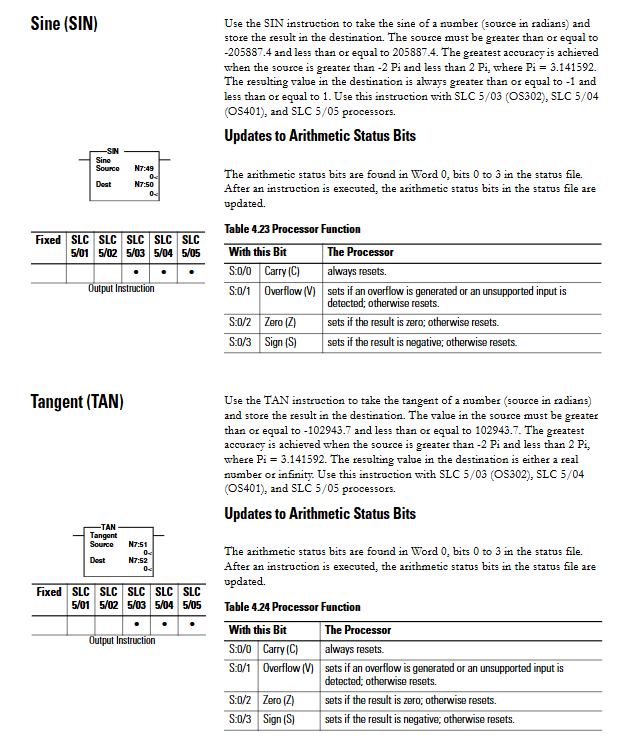
Covering arithmetic operations, data scaling, trigonometric functions, etc., supporting integer/floating-point operations:
Basic operations: ADD (addition), SUB (subtraction), MUL (multiplication), DIV (division), DDV (double word division)
Data processing: CLR (reset), SQR (square root), ABS (absolute value), NEG (reverse), SWP (byte swapping)
Scaling instructions: SCP (with parameter scaling), SCL (data scaling), supporting 4-20mA/0-10V analog signal conversion
Advanced operations: RMP (slope generation), CPT (expression calculation), ASN/ACS/ATN (inverse trigonometric function), etc., only SLC 5/03 and above support
4. Data processing instructions (20 pieces)
Used for data format conversion, transmission, and storage:
Format conversion: TOD (integer to BCD), FRD (BCD to integer), DEG (radians to angles), RAD (angles to radians)
Encoding and decoding: DCD (4-bit decoding with 16 options), ENC (16 bit encoding with 4 bits)
File operation: COP (file copy), FLL (file fill), maximum length 128 words (1 word/element) or 42 elements (3 words/element)
Data transmission: MOV (move), MVM (mask move), AND/OR/XOR/NOT (bit logic operation)
Stack operations: FFL/FFU (FIFO in/out), LFL/LFU (LIFO in/out), supporting 128 word stack
5. Program flow instructions (10 items)
Control program execution sequence and optimize scanning efficiency:
Jump command: JMP (jump)+LBL (tag), supports forward and backward jumps, avoids dead loop triggering watchdog timeout
Subroutine instructions: JSR (call)+SBR (subroutine)+RET (return), nesting depth: fixed/SLC 5/01 at level 4, others at level 8
Control area instruction: MCR (main control reset), turn off non hold output in designated area
Debugging instructions: TND (Temporary End), SUS (Pause), used for program debugging and fault location
I/O refresh instructions: IIM (immediate input mask), IOM (immediate output mask), REF (I/O refresh), interrupt scan to update I/O
6. Apply specific instructions (10)
Design for specific industrial scenarios:
Shift instruction: BSL (left shift), BSR (right shift), supports up to 2048 bit array
Sequencer instructions: SQO (sequence output), SQC (sequence comparison), SQL (sequence loading), control sequential machine operations
Timestamp instruction: RHC (read high-speed clock), TDF (calculate time difference), 10 μ s accuracy, supports event timing
Diagnostic instructions: FBC (File Bit Comparison), DDT (Diagnostic Detection), monitoring equipment faults, recording unmatched bits
Verification instruction: RPC (Read Program Checksum), verifies program integrity
7. Block transfer instructions (2)
Used for remote I/O device data transmission (only supported by SLC 5/03 and above):
Command function key parameter error code
BTR reads data files, buffer files (M0/M1), control block-6 (illegal length), -9 (timeout), etc. from remote devices
BTW writes data files, buffer files (M0/M1), control block-7 (communication error), -11 (invalid device), etc. to remote devices
Transmission capacity: up to 32 block transmission buffers, 1-64 words per transmission, supporting RIO links
8. PID instruction
Used for process control of temperature, pressure, liquid level, etc.:
Control modes: Timer mode (custom update rate), STI interrupt mode (synchronized with STI interval)
Core parameters: proportional gain (Kc), reset time (Ti), rate time (Td), dead zone (DB), output limit (CVL/CVH)
Input and output: process variables (PV), set values (SP), control variables (CV), support 0-16383 scaling range
Functional features: anti integral saturation, manual/automatic switching, Feed Forward/Bias offset
Instruction Execution and Status Bit Mechanism
1. Core status bit (stored in S: 0/0-3)
Status bit identification function
When the carry bit S is generated by arithmetic operation 0/0, set it to 1
Overflow bit S: When the result of 0/1 exceeds the data range, set it to 1 (such as integer operation>32767)
Zero position S: When the result of the 0/2 operation is 0, set it to 1
When the sign bit S is 0/3 and the result is negative, set it to 1 (the highest bit is 1)
2. Dedicated status bit
Command universal bits: EN (enable, set to 1 when run is true), DN (complete, set to 1 when operation ends), ER (set to 1 when error, exception)
Timer specific: TT (during timing, accumulate<preset time set to 1)
Counter specific: CU (up count enable), CD (down count enable), OV (overflow), UN (underflow)
3. Error handling mechanism
Overflow trap bit: S: 5/0, detected mathematical overflow or zero division set to 1, must be reset through OTU instruction to avoid major errors (code 0020)
Block transmission error: Control block word 2 to store error codes (-6 to -12), such as -9 indicating transmission timeout
Fault clearing: supports automatic clearing (such as power on errors) and manual clearing (such as program download errors)
Programming Limitations and Compatibility
1. Compatibility of processor models
Instruction type support model restriction explanation
The entire HSC series of basic instructions only supports fixed controller 24VDC input
Advanced Mathematical Instructions (SCP/RPM/CPT, etc.) SLC 5/03 and above require OS302/OS401/OS501 and above firmware
The block transfer instruction SLC 5/03 (OS302) and above requires RSLogix 500 v4.10+
The PID instruction series STI mode only supports SLC 5/02 and above
2. Operational restrictions
Address range: bit numbers 0-15, element numbers 0-255, maximum file length 2048 bits (bit array)
Scanning requirement: The timer command should be scanned every 2.5 seconds to avoid timing errors; HSC instructions need to run unconditionally to avoid counting loss
Regional restriction: prohibit JMP commands from jumping into the MCR area; MCR area cannot be nested
Data type: Floating point operations only support SLC 5/03 and above, negative numbers are stored as binary complement
Troubleshooting and Maintenance
1. Common types of faults
Power on error: If the power supply is abnormal or the module is not recognized, the hardware connection needs to be checked
Running errors: such as instruction parameter errors, address out of bounds, located through error logs
I/O errors: such as I/O module failures or wiring errors, detected through the I/O table error flag (A261)
Program errors: such as nested subroutine overflow, MCR instruction mismatch, compile time prompt
2. Maintenance points
Firmware upgrade: OS300/OS400/OS500 series firmware supports feature expansion and needs to match CX Programmer version
Battery maintenance: Key data (DM/EM/HR) are backed up by the battery, and the battery status needs to be checked regularly
Data backup: backing up program, parameter, and annotation data through memory card execution
Fault log: The system can store up to 20 error records, including error codes and occurrence times