YOKOGAWA CENTUM CS 3000 Integrated Production Control System
Technical Overview Manual for Yokogawa Electric’s CENTUM CS 3000 Integrated Production Control System and Supporting ProSafe-RS Safety Instrumented System, covering system architecture, hardware configuration, control functions, operation monitoring, engineering maintenance, and safety compliance; Supporting control of large-scale factories in multiple industries such as petroleum, chemical, and pharmaceutical, it can connect up to 256 sites and monitor 1 million tags. It has a V net/Ethernet dual network architecture, dual redundancy design, and SIL3 safety certification, integrating conventional control, advanced control, batch management, and other functions. At the same time, it provides open interfaces and multi system compatibility, providing efficient, safe, and flexible solutions for the full lifecycle operation of factories.
System core architecture and hardware configuration
1. Hardware composition and classification
Key types/functions of core devices at the hardware level
Operation monitoring layer human-machine interface station (HIS) console type (closed/open display), desktop type; Support multiple displays and touch operation
Engineering PC (ENG) system configuration, maintenance and management; Can share one PC with HIS
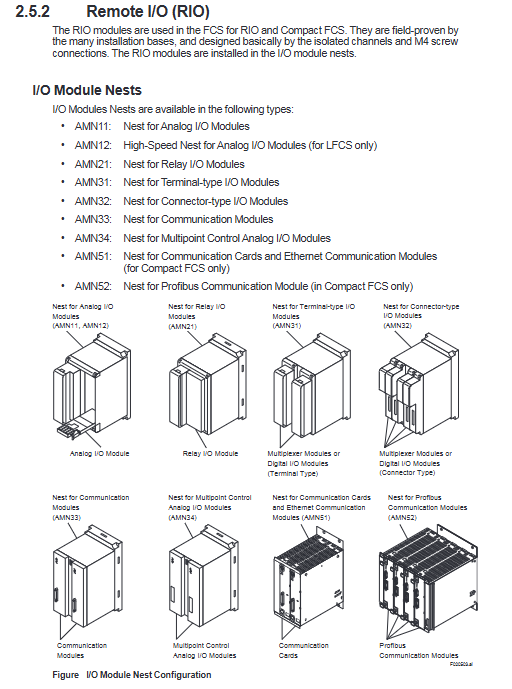
Control layer field control station (FCS) FIO type (Fieldnetwork I/O), RIO type (Remote I/O), compact type; Support dual redundancy
Safety Control Station (SCS) ProSafe RS core equipment; Single configuration up to SIL3, dual redundancy improves availability
Network layer V net 10Mbps real-time control bus; Dual redundancy, maximum expansion of 20km
Ethernet connects HIS, ENG and upper computer; Used for data file transfer and database synchronization
Fieldbus supports FOUNDATION Fieldbus; Replacing 4-20mA analog signals to achieve bidirectional communication between devices
Expansion Device Bus Converter (BCV) connects different domains or old Yokogawa systems (such as CENTUM-XL)
Communication Gateway (CGW) connects V net and Ethernet; Support remote wide area communication
I/O module FIO (compact), RIO (screw terminal); Including analog/digital/communication modules
2. System scale and redundancy design
Upper limit of system size:
Number of domains: up to 16, each domain supports 64 sites (HIS up to 16/domain)
Monitoring tags: basic 100000 points, expandable to 1 million points
FCS Expansion: A single FCS can connect up to 9 I/O nodes and support long-distance expansion (RIO up to 20km)
Redundant design:
Core redundancy: CPU, power module, V net/Ethernet bus, ESB/ER bus dual redundancy
Fault switching: active/standby mode, switching without control interruption
Data protection: ECC (Error Correction Code) memory to prevent data damage
Core functional characteristics
1. Control function
(1) Conventional control functions
Adjustment control: Supports PID, PI-HLD sampling control, ON/OFF control, etc., providing self-tuning function
Sequential control: Implement process control through sequence tables, logic diagrams, SFC (Sequential Function Diagram), and SEBOL language
Computational functions: arithmetic operations, analog processing (filtering, integration), logical operations, general computing blocks
Unit management: Control equipment groups (such as reactors and furnaces) as units to support batch production processes
(2) Advanced control functions
Advanced Control Station (APCS): PC based advanced process control to optimize production efficiency
Batch Management (CS Batch 3000): Compliant with ISA S88 standard, supports multi product and variable batch production
Process Resource Management (PRM): Equipment status monitoring, maintenance plan development, and fault warning
ProSafe RS safety control:
Safety functions: Emergency Shutdown (ESD), Interlock Control, Fire and Gas Protection (F&G)
Safety level: SIL3 certification (IEC 61508), PFD (probability of failure when required) ≥ 10 ⁻⁴ to<10 ⁻³
Independent design: physically/logically separated from the control system, while sharing the operating environment
2. Operation and monitoring functions
(1) Windows and Visualization
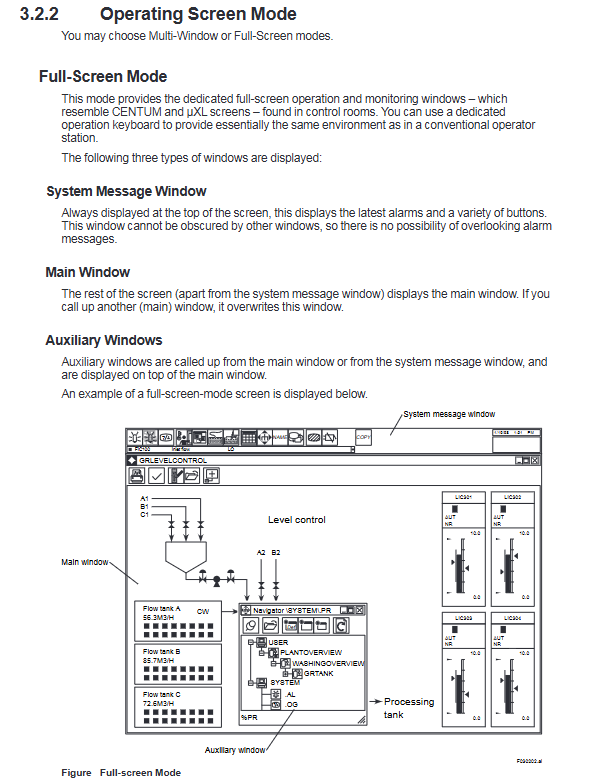
Multi window operation: Supports full screen/multi window mode, displaying up to 5 operation monitoring windows simultaneously
Dynamic window group: can register commonly used window combinations and be called with one click; Support Panel Set cross HIS display
Navigation function: Navigator window (similar to Windows Explorer), quickly locate devices/tags
Data display
Graphic Window: Device Process Diagram, Dashboard (Full/Half Size), Overview Objects
Trend window: up to 8 color tracks, supporting short-term (48 minutes) and long-term (20 days) data
Alarm processing: 5-level priority alarm, supporting alarm filtering, historical query, and voice prompt
(2) Auxiliary functions
Multi monitor support: Connect 2 monitors to a single PC and set full screen/multi window modes separately
Remote operation: Windows Remote Desktop, Web Monitoring (HTML/Java Applet), VTSPortal portal
Data export: supports Excel report generation, historical data archiving, and external recorder output
3. Engineering and maintenance functions
(1) Engineering configuration
Concurrent Engineering: Multiple engineers share databases over the network for parallel development
Virtual testing: No need for FCS hardware, simulate control logic and processes on PC
Data Reuse: Engineering data can be reused across projects/sites, supporting standard templates
Automatic document generation: Automatically output system configuration reports, label lists, and graphical window documents
(2) Maintenance and Diagnosis
Equipment management: PRM tool provides equipment navigation, maintenance plan, and fault location
Remote maintenance: Connect to Yokogawa server through public network to achieve remote diagnosis
Troubleshooting: System alarm window, FCS/SCS status display, error logs (up to 20 entries)
Online maintenance: supports online modification of control logic without affecting the operation of other functions
4. Communication and compatibility
Open interface:
OPC DA/A&E: Supports upper computer (ERP/MES) access to process data and alarms
Web service: Monitor graphics/trend windows through a browser
Third party compatibility: Supports Modbus, PROFIBUS-DPV1, FOUNDATION Fieldbus
System integration
Connected to Yokogawa’s old systems such as CENTUM CS, CENTUM-XL, μ XL, etc. via BCV/CGW
With third-party devices: PLC (OMRON, Siemens, Rockwell), analyzer, ITV camera
Data transmission: supports cross domain communication (up to 8 levels), long-distance expansion (fiber/bus repeaters)
Key technical parameters
1. FCS Core Performance
Performance index specification range
I/O point count FIO type: up to 5120 points; RIO type: supports remote distributed deployment
Scan cycle Basic control cycle: minimum 10ms; Advanced control: configurable
Maximum program capacity of 250K steps (by model)
Data memory DM area 32K words+EM area 32K words x 13 (maximum 448K words)
The communication port is equipped with RS-232C and peripheral ports; Expandable to 36 serial ports
2. Network parameters
V net: 10Mbps speed, dual redundancy, maximum transmission distance 185m (YCB141 cable)/500m (YCB111 cable), expandable to 20km through repeaters
Ethernet: Supports 10BASE-T/100BASE-TX for HIS upper computer data transmission and file sharing
Fieldbus:FOUNDATION Fieldbus H1(31.25kbps), Supports 32 devices/segments
3. Environmental and safety parameters
Working temperature: Standard type 0~55 ℃, Wide temperature type -20~70 ℃
Humidity: 10% -90% (without condensation)
Safety certification: CE (EMC/LVD), C-Tick, T Ü V SIL3, ABS/BV classification society certification
Power requirements: AC 100-240V, DC 24V (some modules)
Safety and Compliance
1. Security mechanism
Hardware security: dual redundancy design, automatic fault switching; Support output hold/preset value in case of I/O module failure
Software security: User permission classification (S1/S2/S3/U1-U7), supporting function block level/window level permission control
Safety circuit: The safety circuit of ProSafe RS is independent of the control circuit and supports fault detection (disconnection/short circuit)
Operation protection: Critical operations need to be confirmed, operation logs are recorded throughout the process, and audit tracking is supported
2. Compliance requirements
Functional safety: ProSafe RS complies with IEC 61508 (SIL3), IEC 61511, ISA S84.00.01
Data Compliance: Supports FDA 21 CFR Part 11, providing electronic signatures, data integrity protection, and permanent preservation of historical records
Electromagnetic compatibility: Complies with EN 55011 Group 1 Class A and EN 61000 series standards
Low voltage command: Complies with EN 61010-1 to ensure the safety of operators