NetTest TUNICS series tunable external cavity laser
(1) Overall Overview of Product Family
The TUNICS series is a tunable external cavity laser product line launched by NetTest (formerly Photonetics), specifically designed for component testing, system validation, and R&D experimental design in the field of fiber optic communication. The core goal is to meet the stringent requirements of DWDM (Dense Wavelength Division Multiplexing) systems for high stability and high-precision tuning. The product is based on a patented design of a self-aligning laser cavity (a 180 ° folding prism forming a “1D corner prism”), effectively avoiding power and spectral purity degradation caused by mechanical drift. At the same time, a unique scanning mechanism is used to achieve full tuning range without mode hopping, ensuring the continuity and reliability of test data.
The entire series covers the spectral range of 1260-1640nm (including S/C/L band), supporting a maximum output power of * *+10 dBm, with power stability of ± 0.01 dB * * (1-hour constant temperature), edge mode suppression ratio>45dB, relative intensity noise>145dB/Hz, and a tuning resolution of 1pm, which can meet diverse needs from basic testing to high-precision research and development.
(2) Detailed classification of product family
1. Benchtop Instruments
Model Core Positioning Key Features Tuning Range (Typical) Output Power Wavelength Accuracy
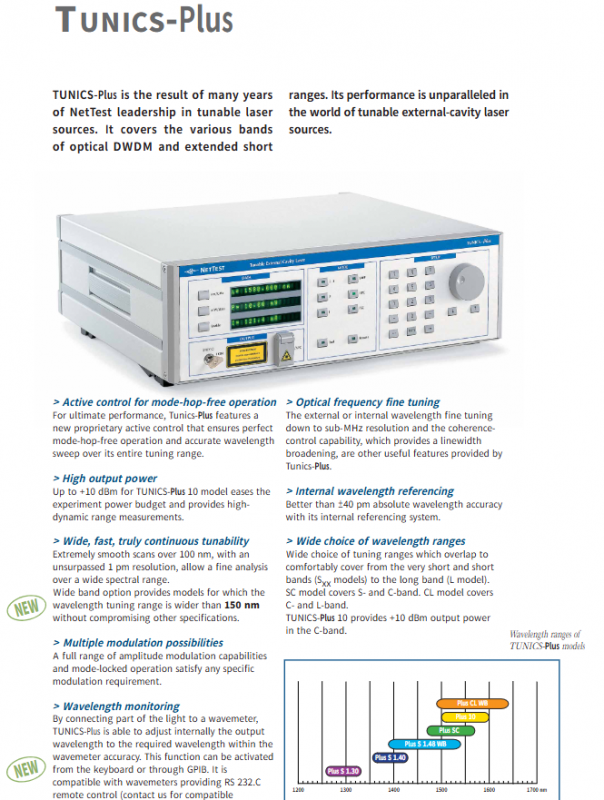
TUNICS Plus flagship high-performance model with no mode hopping (>150nm), internal wavelength reference, active control 1260-1625nm (different models) 0-+10 dBm ± 0.04 nm
TUNICS Purity ASE noise free intracavity filtering, pure single-mode output, high dynamic range 1430-1625nm (S/C/L band) 0-+3 dBm ± 0.05 nm
TUNIS-BT High Cost Effective Basic Model Compact Design, High Power Optional 1440-1640nm (by model) 0-+10 dBm (optional) ± 0.2 nm
Core differences among desktop models
TUNICS Plus: Flagship model, supporting wideband options (>150nm no mode hopping), optical frequency fine-tuning (± 2GHz), and mode locking operation (5GHz), suitable for high-precision system testing and research and development;
TUNICS Purity: focuses on ASE noise free output (signal to spontaneous emission ratio>90dB), without the need for additional filters, suitable for direct spectral measurement of components such as filters and multiplexers;
TUNIS-BT: streamlined functionality, compact design (7.5kg), affordable price, suitable for routine laboratory testing and production line basic verification.
2. Modular Sources
Model Core Positioning Key Features Tuning Range (Typical) Output Power Module Quantity
TUNIS-OM manual tuning multi-channel 8-channel integration, knob tuning, low-cost 1500-1600nm (by model) 0-+10 dBm (optional) up to 8
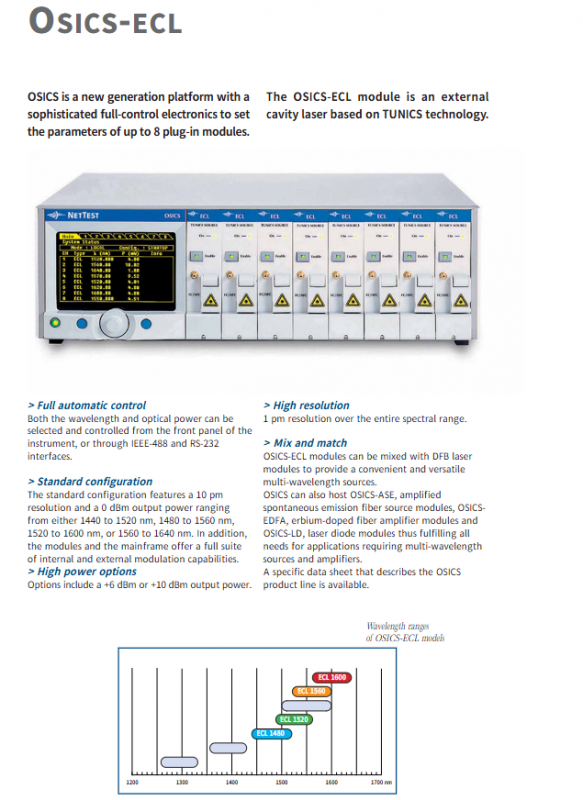
OSICS-ECL automatic control multi module platform hybrid matching module, full parameter automatic control 1440-1640nm (by model) 0-+10 dBm (optional) up to 8
Core differences among modular models
TUNIS-OM: Manually adjust wavelength and power, supports 10KHz-1GHz intensity modulation, suitable for multi wavelength testing scenarios with occasional wavelength changes;
OSICS-ECL: Can be mixed with DFB, EDFA, ASE and other modules, supports front-end panel or remote control of power/wavelength, suitable for building complex multi-channel testing systems.
(3) Detailed explanation of core technical characteristics
1. Optical design and stability
Self aligning laser cavity: using a patented 180 ° folding prism to form a “1D corner prism”, it can maintain resonance even if the optical components are slightly misaligned, ensuring long-term power and spectral stability, and meeting the standard without temperature control;
Non mode hopping technology: The scanning mechanism maintains the cavity length as a fixed multiple of the wavelength (with active control added to the Plus model), and the full tuning range (minimum 100nm) has no sudden wavelength shift, ensuring scanning continuity;
ASE noise free design: TUNICS Purity adopts a patented intracavity filtering scheme, with a filtering full width at half maximum of only 0.15nm, and residual ASE noise is almost negligible (signal to spontaneous emission ratio>90dB).
2. Key performance parameters
Tuning characteristics: tuning resolution of 1pm (optional for some models), tuning speed of 1s/100nm (Plus/Purity), 10s/70nm (BT), and repeatability accuracy of ± 0.005nm;
Output characteristics: power stability ± 0.01dB (1-hour constant temperature), output isolation 35dB, return loss 60dB, output fiber SMF-28 ™, The connector is FC-APC;
Modulation capability: Supports low-frequency modulation (10KHz-8MHz), high-frequency modulation (30KHz-1GHz), and some models support 5GHz mode locking operation.
3. Control and Interface
Remote control: Supports IEEE-488.1/488.2 (GPIB) and RS-232 C interfaces, and can achieve automation control through Labview driver;
Analog interface: Provides external analog input/output, supports wavelength fine-tuning, amplitude modulation, and spectral scanning recording;
Auxiliary function: Some models are equipped with a built-in wavelength reference system (Plus/Purity), which ensures accuracy without the need for an additional wavelength meter.
(4) Environmental and Physical Specifications
Specification: Desktop Instruments (Plus/Purity/BT) Modular Light Source (OM/OSICS-ECL)
Working temperature 15-30 ° C (60-85 ° F) 15-30 ° C (60-85 ° F)
Power supply requirements 100-240V AC, 50-60Hz 100-240V AC, 50-60Hz (automatic adaptation)
Dimensions (W x H x D) Plus/Purity: 448 x 133 x 370mm; BT: 340 x 133 x 308mm Module: 35-50 x 128-130 x 167-250mm; Host: 448 x 133 x 370mm
Weight Plus/Purity: 12.5kg; BT: 7.5kg 8 module platform: 15.1kg (OM), 16.1kg (OSICS)
(5) Optional Features and Accessories
1. Optional features
Power upgrade: P6 (+6dBm), P10 (+10dBm);
Special design: M (polarization maintaining output fiber, slow axis TE orientation), WB (wideband, Plus CL/S1.48 model), R (high-resolution 1pm, OSICS-ECL);
2. Standard accessories
Fiber optic jumpers: FC-APC/FC-APC, FC-APC/FC-PC (including polarization maintaining version);
Software driver: Labview driver (fully compatible);
Portable storage: 2U field carrying case.