How to install NI SCXI chassis?
1. Product Overview
This document covers three SCXI signal conditioning chassis used to provide power supply, backplane communication, heat dissipation, and mechanical support for SCXI modules.
SCXI-1000:4 slot, AC power supply
SCXI-1000DC: 4 slots, DC 9.5-16V power supply
SCXI-10001:12 slot, AC power supply
2. Front and rear panel structure
Front panel components (table)
Component Function
Power switch for the whole machine on/off
Power on status indicator light
Reset key to reset Slot 0 and all modules
Address switch/jumper setting chassis address (0-31)
Module rail positioning SCXI module connected to backplane
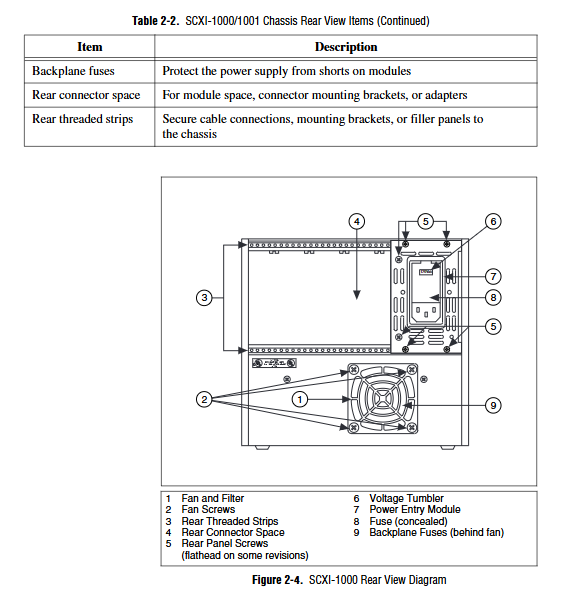
Rear panel components
AC model: power input module, voltage selection knob, main fuse, fan, backplane fuse
DC model: DC power interface F1(6.3A)、F2(3.15A)、 Backboard fuse
3. Core configuration
(1) Chassis address setting
Supports 32 addresses (0-31), multiple chassis systems must be distinguished
SCXI-1000/1001: Front panel 5-position DIP switch (1/2/4/8/16 weighted)
SCXI-1000DC: Internal 3 sets of jumper wires (0/8/16 weighted)
Default address: 0
(2) Voltage and fuse configuration
The AC model supports 100/120/220/240V, and the rear knob switch must be matched with the corresponding fuse. SCXI-1000/1001 Voltage Fuse Comparison Table (Key)
Model voltage main fuse backboard fuse
SCXI-1000 120V T0.5A 1.5A
SCXI-1000 240V T0.25A 1.5A
SCXI-1001 120V T3.0A 4A
SCXI-1001 240V T1.6A 4A
SCXI-1000DC: Input 9.5-16VDC, F1=6.3A, F2=3.15A, backplane 1.5A
4. Installation steps
Set the chassis address (default 0 for single chassis)
Place the chassis and leave a heat dissipation space of ≥ 10cm at the rear
Confirm voltage/fuse, connect to power supply
Install SCXI module and wiring
Install filler panels
Power on and configure in MAX
5. Maintenance and upkeep
Fan filter: Regular water washing and dust removal to prevent overheating
Fuse replacement: The same specification delay fuse must be used
The module does not support hot plugging, and live plugging can easily burn fuses/backboards
6. Technical specifications
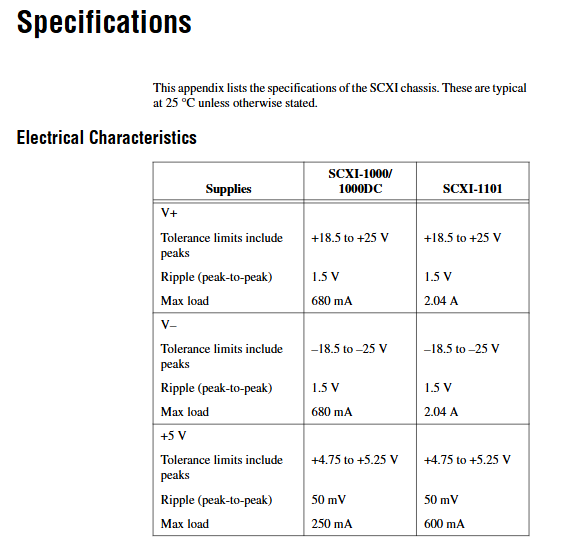
Electrical Characteristics
Analog power supply: ± 18.5~25V, ripple ≤ 1.5V
Digital power supply:+4.75~5.25V, ripple ≤ 50mV
Power consumption per slot: 7W
SCXI-1000DC maximum current: 5.5A@9.5V
Physics and Environment
Weight: SCXI-1000DC (3.3kg), 1000 (3.9kg), 1001 (6.8kg)
Working temperature: 0-50 ℃
Safety standards: IEC 61010-1, UL 1244, CSA C22.2 No.61010-1
EMC:EN 55011、FCC Part 15A
7. Software support
Driver: NI DAQmx/Traditional NI DAQ
Development environment: LabVIEW, LabWindows/CVI, Measurement Studio
Working modes: reuse mode (shared DAQ channel), parallel mode (dedicated channel)
Key questions and answers
Question 1: What is the purpose of the SCXI chassis address? How to set the address for 1000/1001 and 1000DC respectively?
Answer: The chassis address is used to distinguish devices in multi chassis systems and supports up to 32 cascaded devices.
SCXI-1000/1001: Front panel 5-digit DIP switch, weighted values of 1/2/4/8/16, and the sum is the address.
SCXI-1000DC: Three sets of jumper wires (0,+8,+16) are added together to obtain the address.
The default value is 0, and there is no need to modify the single box.
Question 2: What is the most common reason for SCXI chassis not booting up? How to troubleshoot and repair?
Answer: The most common reason is that the live plug-in module causes the fuse to melt or the voltage/fuse to not match. Troubleshooting steps:
Power off, check the power cord and voltage selection knob
Check if the main power fuse is blown
Check the simulated power fuse on the lower back panel of the fan
Replace the delay fuse with the same specifications and power it on again
Prohibiting module hot plugging can prevent this malfunction.
Question 3: What are the core differences between SCXI-1000DC and AC models? What are the differences in applicable scenarios?
answer:
Power supply difference: 1000DC is DC 9.5-16V (battery/vehicle); The AC model operates between 100-240VAC.
Fuse: DC model dual external fuse (6.3A/3.15A); The AC model is equipped with voltage matching delay insurance.
Scenario: 1000DC is suitable for in car, outdoor, and non mains environments; AC models are suitable for fixed measurement and control in laboratories and production lines.