BENDER Isolated Power Panels
Product Overview
BENDER isolated power panel is a safe power supply solution designed for critical medical areas. The core goal is to achieve equipotential power supply through isolation transformers and precise monitoring technology, avoiding the risk of electric shock caused by grounding faults. The product is divided into three categories: standard type, dual output voltage type, and dual system type. It can expand sockets, grounding components, and fault location systems according to the needs of medical scenarios, and is equipped with communication gateways and remote indicators to form a “power supply monitoring positioning monitoring” full chain safety system. It strictly follows the electrical standards of the medical industry and is suitable for scenarios such as operating rooms and intensive care units that require extremely high reliability and safety of power supply.
Comparison of core models and configurations
Model Series Core Features Power Range Voltage Output Key Configuration Applicable Scenarios
Standard Type (IP) Single Isolation System 3kVA~25kVA Single Voltage (120V/208V/240V, etc.) 1 LIM2010, 8-way Branch Circuit Breaker (expandable 16 ways) General Intensive Care Unit, Diagnosis and Treatment Room
Dual output voltage type (ID) single transformer dual secondary 25kVA 120V+208V/240V 2 LIM2010, dual grounding bars, independent branch circuits with limited space and multiple voltage scenarios required
Dual system type (IX) with two independent isolation systems, each with a voltage output of 3kVA~10kVA. Each system has two independent voltage outputs, including two isolation transformers and two LIM2010 operating rooms with high reliability requirements
Core component specifications
(1) Isolation transformer
Power specifications support voltage (primary/secondary) adaptation model series
3kVA/5kVA 120V~480V/120V~240V IP series
7.5kVA/10kVA 120V~480V/120V~240V IP/IX series
15kVA/25kVA 120V~480V/120V~240V IP/ID series
(2) LIM2010 Line Isolation Monitor
Display mode: digital+analog dual display
Response value options: 2mA, 5mA
Alarm function: overvoltage/undervoltage, overload, overheating, grounding fault
Core features: self checking and self calibration, support for EDS fault location expansion
Communication interface: compatible with RS-485, can be connected to centralized monitoring system
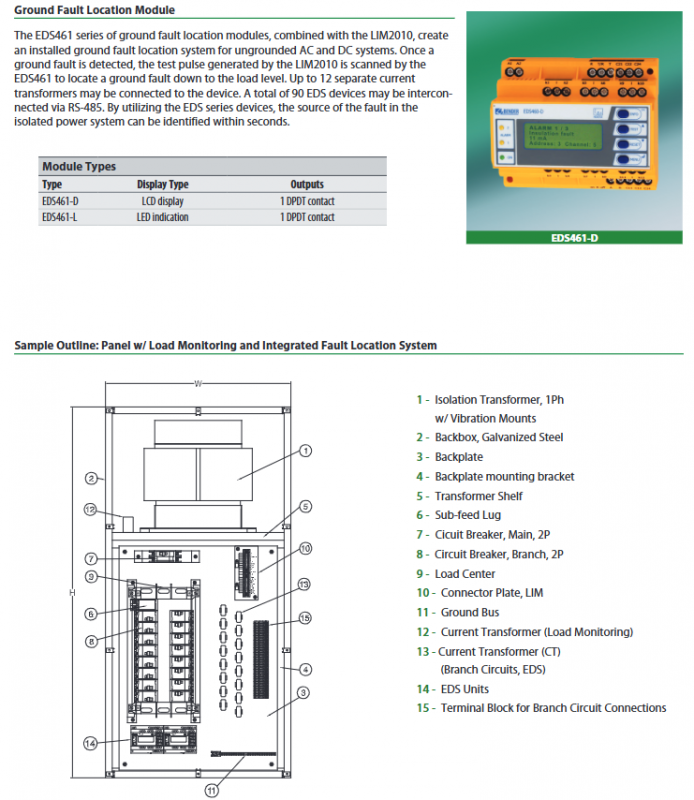
(3) Fault location system (EDS461 series)
Module model, display type, output interface, core parameters
EDS461-D LCD displays 1 DPDT contact supporting 12 current transformers, RS-485 interconnection
EDS461-L LED indicates 1 DPDT contact supporting 12 current transformers, RS-485 interconnection
Scalability: up to 90 EDS modules interconnected, supporting 708 sub loop monitoring
Positioning method: Receive LIM2010 test pulses and identify faulty circuits through current transformers
Installation and Extension Options
(1) Installation method and size
Installation type, bottom box material, size example (height x width x depth), compatible model
Embedded 14GA galvanized steel 43 “× 24” × 6 “(3/5kVA) IP/ID/IX series
Surface mounted 14GA galvanized steel (ivory white baked paint) 43 “× 24” × 6 “(3/5kVA) IP/ID/IX series
Panel Material: 14GA 304 Stainless Steel (# 4 brushed) Embedded Panel 1 “Larger than Bottom Box, Full Series
(2) Extension function options
Distribution Expansion:
Circuit breaker types: Plug On (Square D/Cutler Hammer/GE), Bolt On
Current specifications: 20A/30A/50A/60A, supports 2P configuration
Socket and grounding:
Socket type: direct insertion single/double (red/ivory white), twist lock type (black)
Grounding components: Hospital grade grounding socket, HGC series grounding cable (10/12/15 feet)
Control extension:
PLC control module: supports 12 channels of X-ray/laser equipment power supply, including threshold switch and “in use” indicator light
Load monitoring: STW series current transformers achieve transformer overload monitoring
Communication and Remote Monitoring
(1) Communication gateway
Model Communication Protocol Core Functions
COM460IP Ethernet, Modbus/TCP web monitoring, email/SMS alarm, remote access
FTC470XMB Modbus/RTU connects 10 BENDER devices and integrates them into the building management system
FTC470XDP Profibus/DP is compatible with industrial bus systems and supports device control
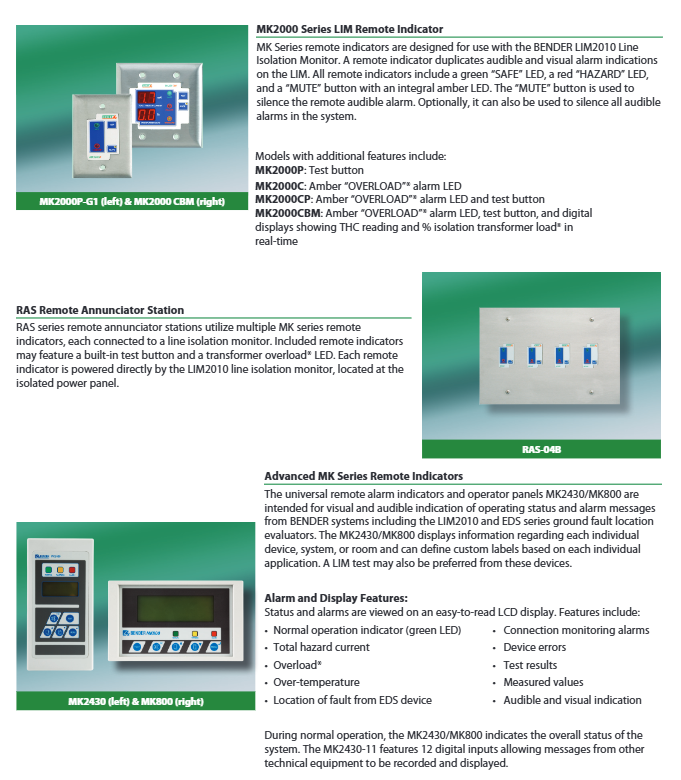
(2) Remote indicator
Series Core Features Featured Models
MK2000 sound and light alarm, mute function MK2000CBM (with digital display and overload indication)
MK2430/MK800 LCD displays fault location and testing function MK2430-11 (12 channel digital input)
RAS series multi-channel centralized indicator RAS-04B (integrated with 4 indicators)
Key issues
Question 1: What are the core differences among the three core models of BENDER isolated power panels (standard type, dual output voltage type, dual system type)? How to choose based on the scenario?
Answer: The core differences are concentrated in the power supply system architecture and voltage output capability. The selection logic is as follows: ① Standard type (IP series): single isolation system+single voltage output, power 3kVA~25kVA, suitable for most intensive care units, diagnosis and treatment rooms and other single voltage demand scenarios; ② Dual output voltage type (ID series): single 25kVA transformer+dual secondary winding, simultaneously outputting 120V and 208/240V, equipped with dual LIM2010 monitors, suitable for space limited scenarios that require power supply for both ordinary medical equipment (120V) and high-power equipment (208/240V); ③ Dual system type (IX series): Two independent isolation systems, each equipped with transformers and monitors, supporting seamless switching in case of faults, suitable for critical scenarios such as operating rooms that require extremely high power supply reliability.
Question 2: What is the core function of LIM2010 line isolation monitor? How to quickly locate grounding faults?
Answer: The core function of LIM2010 is: ① Real time monitoring of the insulation status of the isolated power supply system, supporting 2mA/5mA response value setting, with digital and analog display; ② Equipped with self checking and self calibration functions, it can monitor faults such as overvoltage, undervoltage, overload, and overheating and trigger sound and light alarms; ③ Support linkage with EDS461 series fault location module. Rapid positioning process for grounding faults: ① LIM2010 triggers an alarm after detecting a grounding fault; ② EDS461 module automatically activates and receives test pulses sent by LIM2010; ③ The current transformers distributed in each branch circuit capture pulse signals; ④ EDS461 analyzes signals through RS-485 interconnection and displays the fault circuit location on LCD/LED; ⑤ Remote indicator synchronous alarm, supporting up to 708 sub loop monitoring.
Question 3: What are the expansion capabilities of BENDER isolated power panels reflected in? How to achieve centralized management of communication monitoring system?
Answer: The expansion capability is mainly reflected in three aspects: ① Distribution expansion: Standard 8-way branch circuit breakers can be expanded to 16 ways, supporting Plug On/Bolt On two types, with current specifications covering 20A-60A; ② Function extension: Can add hospital level sockets, grounding sockets, PLC control modules (up to 12 device controls), EDS461 fault location system; ③ Monitoring Expansion: Supports MK series remote indicators and sound and light alarms, and connects to a communication gateway for centralized management. Centralized communication management method: ① Hardware level: Connect all devices through COM460IP (Ethernet/Modbus/TCP) or FTC470XMB (Modbus/RTU) gateway; ② Functional aspect: Real time viewing of device status and fault location on the web page, supporting email/SMS alarm push; ③ System integration: Compatible with OPC servers and SCADA/BMS building management systems, achieving unified monitoring of medical area power supply systems.