Watlow 1/4 DIN specification 8-loop independent PID controller
Core specification parameters
Enter relevant information
Analog input: 8-channel solid-state differential input, optically isolated (120Vac between inputs, 175Vac to ground), A/D converter with integral voltage frequency conversion
Sensor support: thermocouple (J/K/T/B/S/R/N, range -450~3210 ° F), RTD (2 ranges, RTD1: -100~300 ° C, RTD2: -120~840 ° C), 4-20mA current input, infrared non-contact sensor, etc
Resolution: 0.02% (>12 bits), Accuracy: 0.05% (at 25 ° C), Update Frequency: 2 times per second/per input channel
Control and output related
Control circuit: 8 independent circuits, dual outputs (main output/secondary output)
Control modes: On/Off, P, PI, PID, supporting reverse (heating)/forward (cooling) actions
Digital output: 31 channels (1 global alarm+30 alarm/event outputs)
Digital input: 12 channels (for Ramp/Soak triggering)
Pulse input: 1 channel/unit, open collector, frequency 1-20KHz
communication-related
Interface type: RS-232 (1 controller) or RS-485 (4 wires, up to 32 controllers), jumper selection
Baud rate: 2400 or 9600 (menu optional), protocol: ANSI X3.28-1976 compatible, error check: BCC or CRC
Installation Guide
Installation preparation
Panel opening size: 96mm × 96mm (1/4 DIN specification), heat dissipation space needs to be reserved
Safety requirements: Disconnect the power supply before installation and use external safety devices (such as high and low temperature protection) to avoid dangerous working conditions
Wiring specifications
Wire gauge requirements: Priority should be given to using 20/22 AWG stranded wire, allowing 16/18/24 AWG and prohibiting wires that are too thin or too thick
Shielded wire usage: Input/output wires need to be shielded and grounded at one end (at the 8LS panel or sensor end)
Cable recommendations: Special extension cords for thermocouples, Belden # 9154/8451 for analog inputs, Belden # 9729/9842 for RS-485, etc
Noise suppression: When driving electromagnetic relays with digital outputs, an RC absorption network (0.01 μ F capacitor+47 Ω resistor) or MOV device should be added
terminal connection
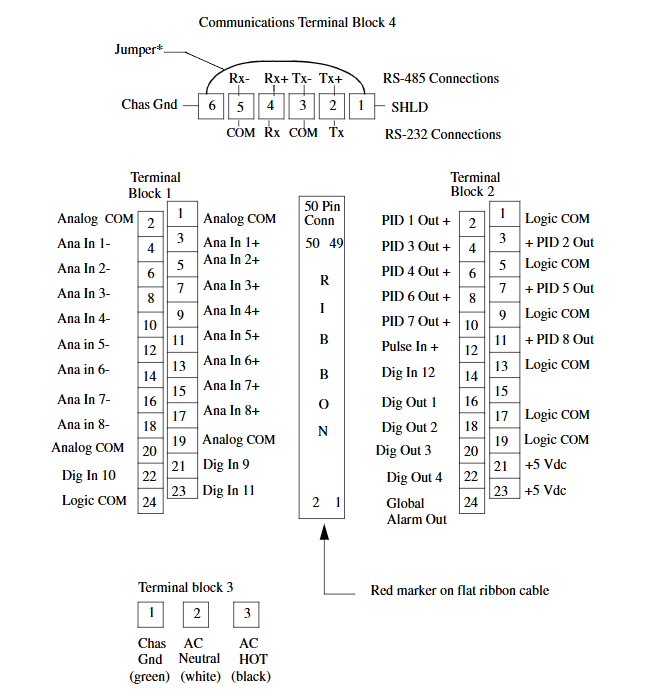
Main output: TB terminal block (supports analog 0-5V/4-20mA or digital output)
Secondary output: 50 pin ribbon cable (supports distributed zero crossing trigger DZC output)
Communication terminal: TB4 terminal block, with clear definition of RS-232/RS-485 wiring and attention to polarity
Operation and Settings
Front panel operation
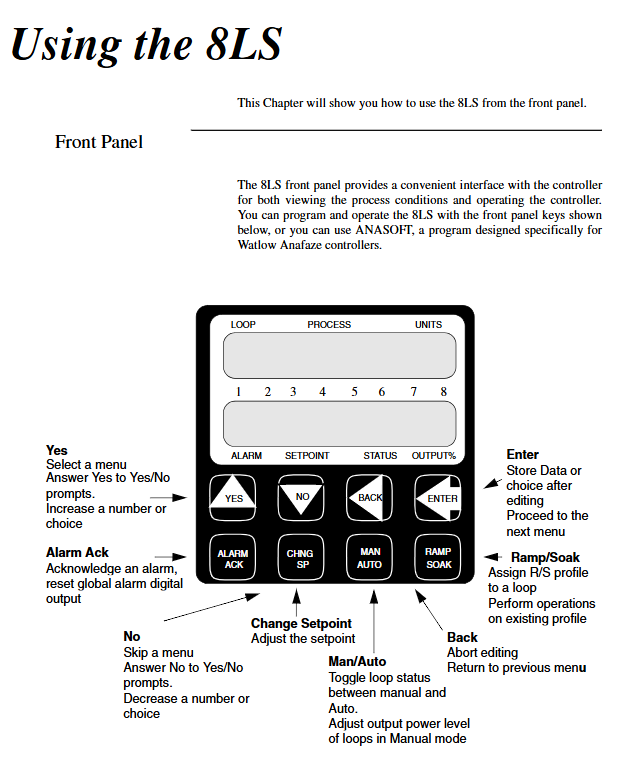
Key functions: YES/NO (menu selection), ENTER (confirm storage), BACK (return), ALARM ACK (alarm confirmation), CHNG SP (modify set value), etc
Display mode: default bar chart display (8-loop deviation), single loop display, scan display, alarm display (flashing prompt)
Basic operations: setting value modification, manual/automatic mode switching, Autotune self-tuning (automatic calculation of PID parameters)
Core Settings Menu
Global parameters: Store/restore 8 job programs, panel lock, controller address (1-32), AC line frequency (50/60Hz)
Input settings: Sensor type selection, pulse sampling time (1-20 seconds), linear scaling (automatic calibration of 2 measurement points input), input offset (-300~+300)
Control settings: proportional band of hot/cold output (PB), integration time (TI: 0-5000 seconds), differentiation time (TD: 0-255 seconds), output filtering, hot/cold output interval
Output settings: Output type (TP/DZC/O/F/ANA), cycle (1-255 seconds), output limit (0-100%), output action mode
Alarm settings: high/low process alarm, deviation band alarm (0-255), alarm dead zone (0-255), alarm delay (0-255 seconds), alarm output allocation (0-30)
Advanced features
Ramp/Soak program
Ability: 8 programs, up to 20 segments per program, supporting hour/minute or minute/second time benchmarks
Function: Segment triggering (up to 2/segment), segment events (up to 4/segment), program repetition (1-99 times or continuously)
Operation: Program allocation, start/pause/reset, tolerance alarm (0:00~9:59)
8LS-CP Carbon Potential Control
Application: Control the carbon potential (0.10~1.40%) or dew point (-40~300 ° F/C) of the hardening/sintering furnace
Configuration: 1-4 carbon potential circuits, each requiring 2 standard circuits (1 reference thermocouple+1 carbon probe input)
Special functions: probe ablation (with an interval of 1-255 hours or contact activation, ablation time of 1-45 minutes), trim gas temperature alarm (1400-2400 ° F)
Cascade control
Principle: The main circuit output serves as the slave circuit set value, with 0% corresponding to the slave circuit low set value and 100% corresponding to the slave circuit high set value
Configuration: Select the main circuit and set the high and low end settings of the slave circuit (adapted to the input type range of the slave circuit)
Troubleshooting
Independent system issues
No display: Check 120Vac power supply
Abnormal control output: Test output in manual mode, verify with LED or multimeter
Digital I/O fault: Check the input status (1=high/0=low) and test the output switch status through the Test I/O menu
Computer monitoring system issues
Communication failure: Check cable connection, baud rate/protocol matching, controller address uniqueness
ANASOFT software issues: Verify installation path, file integrity, memory (requires 640K free memory), software key installation
Multi controller conflict: Ensure that each controller has a different address (1-32), and reload the job program after replacing the controller