HIMA H41q and H51q series programmable electronic systems (PES)
Core Differences of Product Family
Comparison Dimension H41q Series (Compact) H51q Series (Modular)
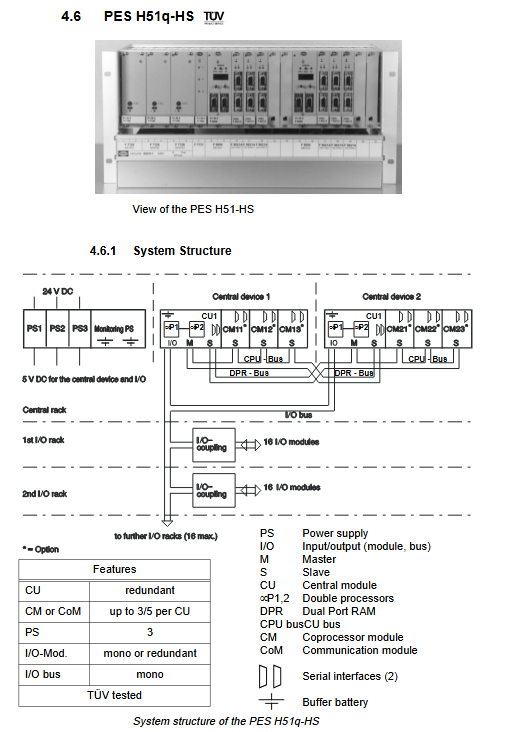
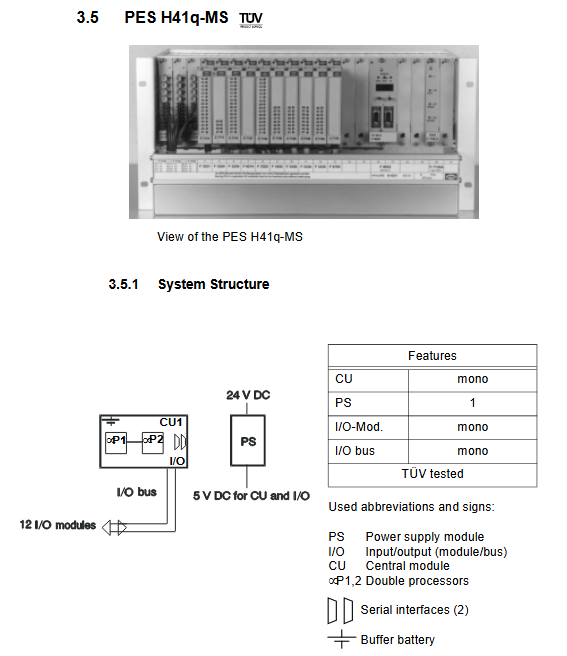
Architecture form: The central module and I/O module are integrated into one 19 inch 5U sub rack, one central rack (5U), and up to 16 I/O sub racks (4U) in a distributed layout
Maximum number of I/O modules 12, 256 (16 subracks x 16/subrack)
Expansion capability without additional expansion subracks, only supports internal module expansion, supports I/O subrack expansion, up to 8 redundant I/O bus subracks
Central module types F 8653 (non safety), F 8652 (safety), F 8651 (non safety), F 8650 (safety)
The coprocessor/communication module does not support a maximum of 3 coprocessors and 5 communication modules per central module
Suitable for small systems with I/O channel count ≤ 192, medium to large systems with I/O channel count>192 or requiring multi rack linkage
Product Model Classification and Core Features
1. Model naming rules (taking H41q as an example, H51q follows the same procedure)
Model suffix architecture type security certification core configuration availability level
-M single channel has no central module, single I/O bus is normal
-H redundancy without 2 central modules, high single I/O bus
-HR high redundancy without 2 central modules, dual I/O bus extremely high
-MS Single Channel T Ü V Certification (AK 1-6): 1 dual processor central module, single I/O bus normal+safe
-HS redundant T Ü V certified (AK 1-6) 2 dual processor central modules, single I/O bus high+safety
-HRS high redundancy T Ü V certification (AK 1-6) 2 dual processor central modules, dual I/O bus extremely high+safe
2. Detailed explanation of core modules
Central module
Non secure type (F 8653/F 8651): Intel 386 EX processor (25 MHz), Flash EPROM program storage (≥ 100000 writes), 2 RS 485 interfaces, battery backup sRAM and real-time clock.
Safe type (F 8652/F 8650): Dual clock synchronous processor, real-time data and reverse data dual path operation, hardware comparator fault detection, integrated fault safety watchdog, compatible with AK 6 highest safety level.
I/O module
Module type represents model, key parameters, safety characteristics
Digital input F 3223 supports proximity switch, line monitoring, 4TE width non safety type
Digital output F 3331 24V DC, ≤ 0.5A, 4HE highly safe type (AK 1-6), integrated safety shutdown
Analog input F 6214 4-20mA/0-10V, safety isolation safety type (AK 1-6)
Intrinsic safety F 3236 (Ex) i certification, digital input intrinsic safety circuit adaptation
extension module
Coprocessor module (F 8621A): HD 64180 processor (10 MHz), 2 RS 485 interfaces, supports PLC master station function, only available for H51q.
Communication modules: F 8625 (Ethernet, 10 Mbit/s), F 8626 (Profibus DP, up to 12 Mbit/s), only available for H51q.
Key technical parameters
Category specific parameters
Power supply specification working voltage: 24V DC (± 10%); Microprocessor voltage: 5V DC; Support redundant power supply
Working temperature under environmental conditions: 0-60 ℃; Storage temperature: -40-85 ℃ (without battery)/-40-75 ℃ (with battery); Humidity: 93% RH (no condensation)
Communication interface RS 485: up to 57600 bps, 2/central module (H51q can be expanded to 8); Ethernet: 10 Mbit/s (up to 10 for H51q); Profibus DP: up to 12 Mbit/s (H51q up to 10)
Storage feature program storage: Flash EPROM (512 kbyte user program); Data storage: sRAM (lithium battery backup, lifespan of 2.5 years)
Response performance single channel system basic cycle: 5 ms; redundant system basic cycle: 25 ms
Mechanical specification 1 unit (TE)=5.08 mm (width); 1 unit (HE)=44.45 mm (height); H41q subrack: 19 inches x 5U; H51q I/O subrack: 19 inches x 4U
Core functions and security features
1. Safety features
Fault safety shutdown: Supports three-level shutdown at module level, group level, and system level. The safety output module is equipped with three series connected semiconductors, which automatically switch to a power-off safety state in case of a fault.
Dual path verification: The secure central module adopts a dual processor architecture, which compares the calculation results in real time and triggers the watchdog to turn off when there is a difference.
Intrinsic safety support: The (Ex) i module is designed with safety isolation to adapt to explosive hazardous environments (Zone 2), and the cable plug is coded to prevent accidental insertion.
2. Availability features
Redundant design: The redundant model supports dual central modules, dual I/O buses, and dual power supplies, ensuring uninterrupted switching in case of failure.
Hot swappable: All modules support online plugging and unplugging, and replacement does not affect system operation (redundant system).
Fault diagnosis: The central module is equipped with a 4-digit alphanumeric display and 2 LEDs, which provide real-time prompts for faults in the central module, I/O bus, and I/O module. It supports exporting fault logs through ELOP II.
Installation and maintenance specifications
1. Installation requirements
Grounding: L – Single point grounding, grounding resistance ≤ 2 Ω; Multi cabinet interconnection requires connection through a 25 mm ² grounding strip.
EMC protection: The power end needs to be equipped with an H 7013 filter (non CE certified power supply), signal cables and power cables should be routed in separate slots, and the shielding layer should be grounded at one end.
Wiring: It is recommended to use shielded cables for 24V DC cables, and the power supply for the I/O module is provided through the F 7133 distribution module (with fuse monitoring).
2. Maintenance points
Regular replacement: Lithium batteries are replaced every 2.5 years (CR 2477N/CR-1/2 AA-CB); The power electrolytic capacitor is replaced every 5 years.
Module replacement: The faulty module can be hot swappable, and the replacement of the safe module requires confirmation by pressing the ACK button. The replacement of redundant modules does not affect system operation.
Fault handling: When the central module fails, the redundant system automatically switches to the backup module; When the I/O module fails, the system prompts the specific channel number and supports online replacement.
Selection and Component Kit
1. Core component kit (some key models)
The maximum number of I/O modules included in the system series model includes components
H41q-M B 4230 1 × F 8653, 1 × F 7130A power supply, 3 × F 7133 power distribution module 12
H41q HRS B 4233-2 2 × F 8652, 2 × F 7130A power supply, 3 × F 7133 distribution module 2 × 6
H51q-M B 5230 1 × F 8651, 2 × F 7126 power supply, 1 × F 7131 monitoring module 256 (16 sub racks)
H51q-HS B 5233-1 2 × F 8650, 3 × F 7126 power supply, 1 × F 7131 monitoring module 256 (16 subracks)
2. Selection process
Determine the safety level (whether T Ü V certification is required, AK 1-6);
Calculate the number of I/O channels and choose between compact (H41q) or modular (H51q);
Determine the architecture type (single channel/redundant/high redundancy);
Select expansion modules (communication interface, coprocessor);
Match component kits and auxiliary modules (such as intrinsic safety modules, filters).