HIMA HIQuad X Series Safety Programmable Electronic System (PES)
Core technical specifications
1. Safety and environmental parameters
table
Category specifications
Safety certification SIL 3 (IEC 61508/61511/62061), PL e (EN ISO 13849), EN 54-2/NFPA 72 (Fire Alarm Systems)
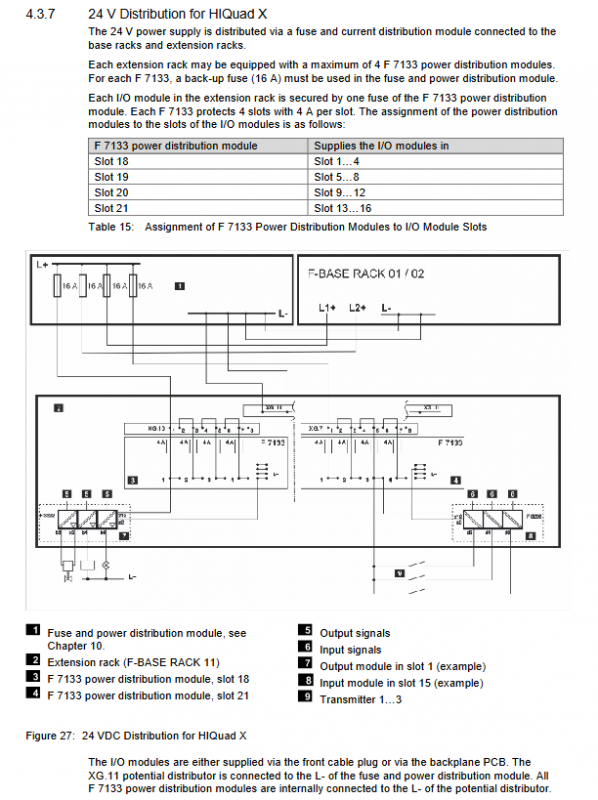
Power supply requirements: Main power supply: 24 VDC (-15%~+20%), ripple ≤ 5%, SELV/PELV safe low voltage; Auxiliary power supply: 5 VDC; Supporting redundant power supply, requiring an external 16A fuse
Environmental conditions: working temperature of 0~+60 ℃, storage temperature of -40~+70 ℃, pollution level II, altitude<2000m, protection level IP20 (IP54 enclosure is required for use in hazardous areas)
EMC standard immunity: ESD 6kV contact/8kV air discharge, surge 2kV; emission: EN 55011 Class A
2. Architecture and performance parameters
table
Subseries basic frame+expansion frame, maximum number of I/O modules, maximum number of I/O channels, number of processor modules, number of communication modules
H51X 1+16 256 4096 1~2 0~10
H41X 1+1 28 224 1~2 0~2
Detailed explanation of core modules and functions
1. Core module specifications
table
Module model, functional positioning, key features
F-CPU 01 processor module 1oo2 dual processor architecture, supports multitasking (up to 32 user programs), with 6 operating system states including RUN/STOP
The F-IOP 01 I/O processing module connects the system bus to the I/O bus, providing I/O watchdog signals (24V) and monitoring 5V power supply
F-COM 01 communication module has 2 Ethernet interfaces and 1 fieldbus interface, supporting safeEthernet secure communication. The standard protocol requires authorization
I/O module signal input/output covers digital (DI/DO), analog (AI/AO), intrinsic safety (Ex) i types, supports SIL 3, up to 16 channels/module
F-PWR 01 power module 24 VDC to 5 VDC, 50W power, up to 5 parallel connections (H51X), supports redundant power supply
F-PWR 02 buffer module compensates for voltage drop (maximum>20ms) and supports I/O level redundant power supply
2. Core functions
Security function:
Following the dual principles of power-off tripping and power on tripping, the output module switches to a power-off safe state in case of a fault;
F-CPU 01 adopts a 1oo2 architecture, with dual processors for real-time data verification and an independent I/O watchdog shutdown mechanism;
Support module redundancy/channel redundancy, redundant I/O modules need to be installed in different racks.
Communication function:
SafeEthernet: Based on IEEE 802.3, supports SIL 3 secure data transmission, detects faults such as data corruption and address errors;
Standard protocols: Modbus, PROFIBUS, etc. (authorization required, activation code required after 5000 hours);
Supports up to 5 PADTs to connect simultaneously, with only 1 having write permission.
Expansion and optimization functions:
Multi tasking: Up to 32 user programs can run in parallel, with 3 operating modes (Mode 1 shortened cycle, Mode 2 high availability, Mode 3 fixed cycle);
Noise suppression: By configuring safe time and watchdog time to calculate the suppression time (maximum=safe time -2 x watchdog time), suppress transient interference;
Diagnostic function: Module LED indicator light (600ms/200ms dual flashing frequency), diagnostic log (F-CPU 01 long-term 2500/short-term 1500), online fault location (module status marked in red/yellow).
Programming and Configuration Process
1. Programming tools and variable management
table
Core operation variable types in programming tools
SILworX resource configuration, code generation, online debugging, user permission management global variables (shared across programs), local variables (valid within programs), system variables (state/parameter reading)
2. Core configuration steps
Resource parameter configuration: Set system ID (1~65535), security time (20~22500ms), watchdog time (6~7500ms), target cycle time, etc;
Module and I/O configuration: allocate rack IDs, bind I/O modules and channels, configure redundancy modes;
Code generation: Two rounds of generation and CRC consistency verification are required (mandatory for security related applications);
Download and start: Download configuration through Ethernet, supporting cold start (initializing variables) and hot start (retaining variable values).
3. User permission management
Divided into PADT user management (project access permission) and PES user management (controller access permission);
Permission level: Security administrator (modify permission), read-write permission (operation function), read-only permission (view);
Supports up to 10 user groups, default administrator account (empty password), requires strong password configuration (≥ 10 characters, including numbers/special characters).
Installation and maintenance specifications
1. Installation requirements
Mechanical installation: 35mm DIN rail horizontal installation, the distance between the base frame and the expansion frame needs to meet heat dissipation requirements (up and down ≥ 100mm), the system bus cable needs to be Cat.5e or above, with a maximum length of 50m;
Electrical installation:
Grounding: Single point grounding, grounding resistance ≤ 2 Ω, grounding wire cross-section ≥ 16mm ², control cabinet door/frame requires conductive connection;
Wiring: Signal cables and power cables are routed in separate slots, and analog signal cables are shielded at both ends to avoid electromagnetic interference;
Power supply: Redundant power supply needs to distinguish L1+/L2+, connect the positive and negative poles correctly, and install the H 7034 power filter to suppress interference.
2. Maintenance and lifecycle
Regular maintenance: Regular replacement of fans, safety verification testing (as required by the safety manual), operating system upgrades (SILworX online loading);
Fault handling: Preliminary identification of fault type through LED indicator lights, combined with diagnostic logs to locate the root cause, redundant modules support online replacement;
Lifecycle: Installation → Wiring → Configuration → Startup → Maintenance → Shutdown (Power off and disconnect → Ecological recycling).