HIMA Programmable Systems The H41q and H51q System Families
System core design and overall classification
Core positioning: H41q and H51q are HIMA’s third-generation PES, based on the same software and hardware, focusing on process engineering factory control, supporting digital/analog signal processing, and some modules are compatible with DIN 19234 proximity switches and intrinsic safety circuits;
Safety and availability: both meet the safety level requirements of DIN V 19250 AK 1-6, divided into three levels according to availability, with redundant design:
M (regular): Single channel central module/I/O bus/I/O module
H (High): Redundant central module, single channel I/O bus
HR (extremely high): redundant central module+redundant I/O bus
Safe version (MS/HS/HRS): Dual processor design with T Ü V certification, meeting the highest safety level requirements;
System architecture differences:
Characteristics H41q H51q
Architecture type Compact single rack modular distributed
Rack specification 5U 19 inch single rack, integrated with all components 1 5U central rack+up to 16 4U I/O racks
Maximum 12 I/O modules, 256 (16 I/O racks x 16 per rack)
Maximum I/O channels 192 (12 × 16) 4096 (256 × 16)
The number of interfaces is fixed at 2 RS485, 2 RS485+up to 6 extended RS485+Ethernet/Profibus DP
Control mode without PES master station supporting PES master station control
Programming and Operations: Configuration, compilation, and monitoring are completed on a PC through the ELOP II programming system. The PC is connected to PES through a serial interface/bus to achieve program download, testing, and status monitoring.
H41q Compact System Family
System features: 5U 19 inch single rack, integrating all components such as central module, power supply, distribution, I/O module, etc., with built-in cable tray, suitable for small point control scenarios;
Core models and hardware: divided into basic version (M/H/HR) and T Ü V safety version (MS/HS/HRS), with the following differences in core hardware:
Model Central Module Power Module I/O Bus Maximum I/O Module Assembly Kit
H41q-M F8653 (single) F71302 (1 piece) Single 12 B4230
H41q-H F8653 (dual) F7130A (2 pieces) Single 12 B4232-1
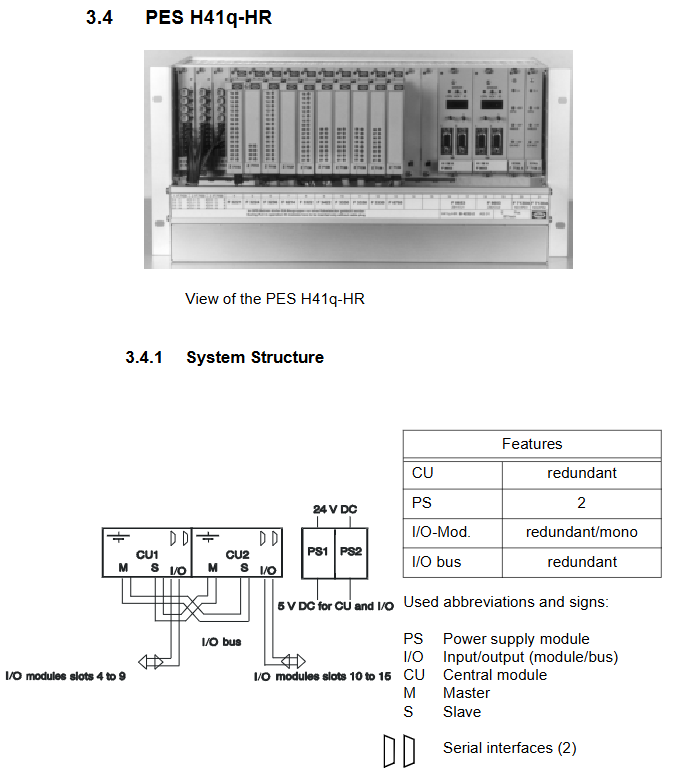
H41q-HR F8653 (dual) F71302 (2) dual 2 × 6 B4232-2
H41q-MS F8652 (single, dual processor) F7130A (1 unit) Single 12 B4231
H41q-HS F8652 (dual, dual processors) F71302 (2) Single 12 B4233-1
H41q-HRS F8652 (dual, dual processors) F7130A (2) dual 2 × 6 B4233-2
Key design:
Power supply: 24V DC input, converted to 5V DC through F7300A, redundant power modules connected in parallel, automatic switching in case of failure;
Central module: The basic version F8653 is a single processor, and the secure version F8652 is a clock synchronous dual processor (real data+inverse data operation, hardware comparator verification);
Safe shutdown: Integrated watchdog (WD) signal, triggering module/system shutdown in case of failure, supporting group shutdown (up to 10 modules/groups).
H51q modular system family
System features: Distributed architecture, consisting of one 5U central rack and up to 16 4U I/O racks. The central rack contains core control components, while the I/O racks are responsible for signal acquisition/output, suitable for large point count and distributed control scenarios;
Core models and hardware: divided into basic version (M/H/HR) and T Ü V safety version (MS/HS/HRS), with the following differences in core hardware:
Model Central Module Power Module I/O Bus Maximum I/O Module Assembly Kit
H51q-M F8651 (single) F7126 (2-3 pieces) single 256 B5230
H51q-H F8651 (Dual) F7126 (3 pieces) Single 256 B5232-1
H51q-HR F8651 (dual) F7126 (3) dual 2 × 128 B5232-2
H51q-MS F8650 (single, dual processor) F7126 (2-3 units) Single 256 B5231
H51q-HS F8650 (dual, dual processors) F7126 (3) single 256 B5233-1
H51q HRS F8650 (dual, dual processors) F7126 (3) Dual 2 × 128 B5233-2
Extended hardware:
Coprocessor module F8621A: up to 3 per central module, providing 2 RS485 extensions, supporting PLC master station function;
Communication module: F8625 (Ethernet) F8626(Profibus-DP), Each central module can have up to 5, and the redundant system can be expanded to 10;
I/O coupling module F7553: 1 per I/O rack, realizing I/O bus connection and watchdog signal shutdown;
Key design:
Power supply: 24V DC input, converted to 5V DC through F7126, 3 power modules connected in parallel, 5V DC supplies power to the back-end I/O rack through the central rack;
Central module: The basic version F8651 is a single processor, while the secure version F8650 is a dual processor with hardware comparator and T Ü V certification;
I/O bus: networked through BV7032 cable, matched with F7546 terminal module, redundant bus corresponds to independent I/O rack.
Detailed design of I/O hierarchy
Module types: covering digital input/output, analog input/output, (Ex) i intrinsic safety module, safety related output module, supporting 4TE/8TE specifications, some modules with line short circuit/open circuit monitoring (LS/LB);
Module features:
Hot swappable: All I/O modules support online plugging and unplugging. After plugging and unplugging the security module, press the ACK key to confirm;
(Ex) i module: divided into painted and unpainted versions. When the painted version is mixed with a non intrinsic safety module, the right side needs to be left blank or a partition plate M2214 needs to be installed;
Safety related output module: integrates safety shutdown of 3 series connected semiconductors, with no fault time limit, meets AK6 level, and can output in parallel without the need for external diodes;
Power distribution design:
24V DC: Distributed through the F7133 distribution module (4 fuses+fuse monitoring), H41q has 3 F7133s, H51q has 4 F7133s, and the fuses correspond one-to-one with the I/O module slots;
5V DC: generated by the central power module and distributed internally through the bus board. If the 5V requirement of H51q is greater than 18A, the power supply can be expanded through the B9361 kit;
I/O bus:
Physical layer: Connected through BV7032 data cable, F7546 terminal module completes bus matching;
Redundant design: HR/HRS versions have dual I/O buses, corresponding to independent I/O module slots/racks. In case of a fault, only the I/O module of the corresponding bus is turned off.
Core technical parameters
Mechanical specifications: 1TE (width)=5.08mm, 1HE (height)=44.45mm; H41q is a 5U single rack, H51q has a central rack of 5U, and I/O rack of 4U;
Processor and Storage:
Processor: INTEL 386 EX, 25MHz;
Storage: Flash EPROM (program storage, ≥ 100000 erasures), sRAM (data storage, lithium battery backup), user program capacity 512kbyte;
Basic cycle: 5ms for single channel system, 25ms for redundant system;
Interface parameters:
Interface type specification expansion capability
RS485 2-wire system, 9600-57600bps, photoelectric isolation H51q can be expanded to 8
Ethernet IEEE 802.3, 10BaseT (RJ45), 10Mbit/s H51q, maximum of 5 per central module
Profibus-DP RS485, Up to 12Mbit/s, with a maximum of 5 slave H51q per central module
Environment and EMC:
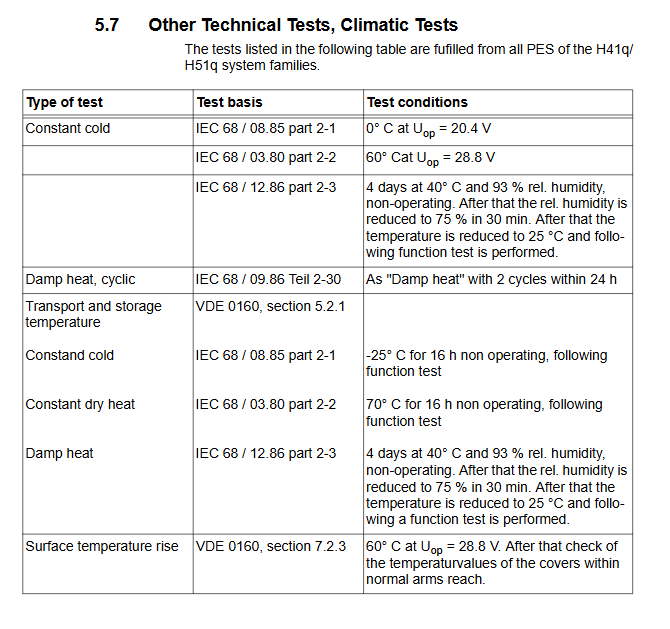
Working temperature: 0-60 ℃, storage temperature: -40-85 ℃ (without battery)/-40-75 ℃ (with battery);
Electromagnetic compatibility: meets EN50082-2 (anti-interference, ESD contact 6kV/air 8kV, surge 1kV, etc.), EN50081-2 (emission, industrial environment Class A);
Voltage sag: Complies with NAMUR NE21 and compensates for a voltage drop of 20ms/second;
Power supply parameters: 24V DC peripheral power supply (L+/L -), 5V DC microprocessor power supply, grounding resistance * * ≤ 2 Ω * *, supports floating/grounding operation.
Installation, start-up, and maintenance
Installation specifications:
ESD protection: Maintenance personnel need to discharge static electricity, and only qualified personnel can operate power/signal/data lines;
Grounding requirements: L – Single point grounding (grounding resistance ≤ 2 Ω), all components of the cabinet are connected to equipotential through a 16/25mm ² yellow green grounding wire;
Cable processing: Separate data/signal cables from power cables, single ended grounding of shielding layer, shielded wires for I/O cables, and coding plugs for (Ex) i module cables;
Electromagnetic compatibility: It is recommended to install H7013 filter on the 24V DC input terminal, and separate the wiring cables in the cabinet according to the specifications;
Start process:
Pre testing: Measure the I/O interface for no external high voltage or grounding faults, and check the polarity/voltage/ripple of 24V DC;
Module verification: Check the central/communication module switch settings and I/O rack coupling module address codes;
System power on: If there is no fault, it will automatically enter RUN mode, and the fault will display STOP. The fault will be checked through diagnostic display/programmer;
Maintenance and troubleshooting:
Maintenance cycle: Lithium batteries are replaced every 2.5 years (CR-1/2 AA-CB/CR2477N), and power electrolytic capacitors are replaced every 5 years;
Fault detection: The central module is equipped with a 4-digit alphanumeric diagnostic display and 2 LEDs. The I/O module indicates the status through the LEDs, and the fault log can be exported through the programmer;
Module replacement: All modules support hot swapping, and the central/power/communication modules have dedicated plugging and unplugging processes. It is recommended to return faulty modules to the factory for repair, and users are not advised to repair them themselves;
Common faults: Central module failure triggers watchdog shutdown, I/O module failure automatically shuts down/signal set to 0, bus failure triggers corresponding rack shutdown.
Accessories and module specifications
Assembly kit: 6 exclusive kits for H41q and H51q, including core hardware, power distribution, cables, etc. H51q is also equipped with I/O rack kit B9302 and 5V power expansion kit B9361;
Core modules: Central module (F8650/F8651/F8652/F8653), power module (F7126/F7130A), coprocessor (F8621A), communication module (F8625/F8626), I/O coupling module (F7553), power distribution module (F7133);
I/O module: covering digital/analog input and output, supporting intrinsic safety and safety related versions, key models such as digital input F3222, analog input F6208, and safety output F3330;
Cables and auxiliary components:
Cable: I/O bus BV7032, communication cable BV7040/BV7044, fiber optic cable BV7049/BV7050;
Auxiliary components: Surge protection module (Phoenix MTRS485), relay module (H4116/H4122), filter H7013, terminal module F7546.
Application and Configuration Tips
Software requirements: ELOP II version ≥ 1.31, operating system BS 41q/51q V7.0-7;
System Expansion: H51q can expand the I/O rack through the B9302 kit, and the expansion part is protected by T Ü V certification;
Old module compatibility: The old output module (such as F3311) cannot be used for safety related outputs. In case of a fault, the output will freeze and need to be manually turned off;
Central module replacement: When replacing the H41/H51 old system with the H41q/H51q central module, it is necessary to rewire according to the specifications.