KONGSBERG K-Chief Ship Automation System
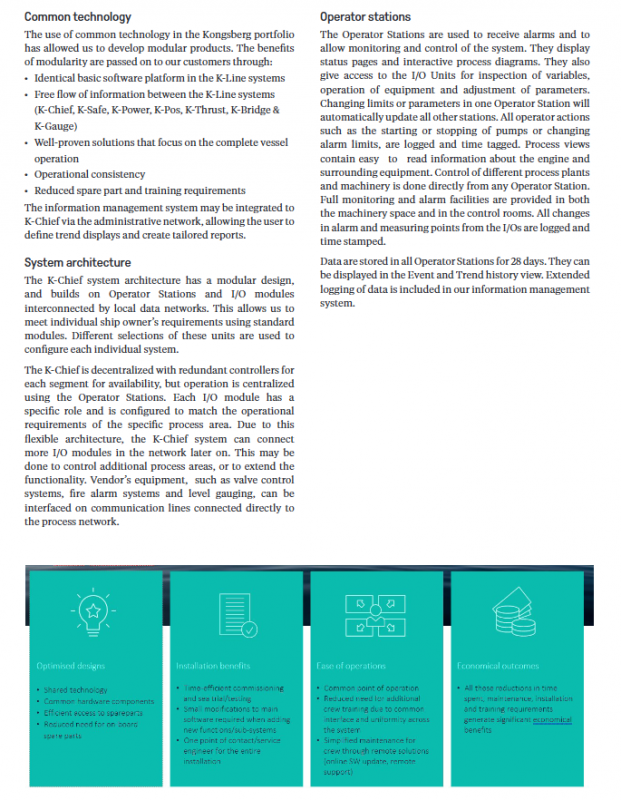
Kongsberg has launched the K-Chief ship automation system based on 50 years of experience in maritime automation. Its core advantages include modular design, high redundancy, full integration with K-Line products, and built-in configuration tools. It can cover 10-50000 I/O points and is suitable for various types of ships such as oil tankers and container ships. It integrates multiple subsystems such as alarm monitoring, power management, and propulsion control, and meets standards such as IMO and IACS, as well as certifications from mainstream classification societies such as DNV and CCS. It has the characteristics of easy installation, intuitive operation, and low maintenance costs, and supports remote support and information management functions.
Core advantages
Design and technological advantages
Modular design: supports flexible configuration from low complexity alarm systems to highly integrated control and monitoring systems, adapting to different ship requirements
High redundancy: Each link is equipped with redundant controllers to improve system availability
Easy to operate: intuitive interface, unified system interface, reducing crew training needs
Built in configuration tool: supports system modification, expansion, and upgrade throughout the entire lifecycle of the ship
Powerful control algorithm: ensuring efficient response and stable operation of the system
Integration and compatibility advantages
Fully integrated with K-Line products, including K-Safe, K-Power, K-Pos, etc., to achieve a unified user experience, open interoperability, and reduce total cost of ownership
Third party device adaptation: supports docking with supplier devices such as valve control systems and fire alarm systems, and directly connects to the process network
Economic and operational advantages
Efficient installation: Shorten debugging and sea trial time, reduce the amount of main software modifications
Convenient operation and maintenance: providing remote software updates and remote support services to simplify crew maintenance work
Efficient spare parts: sharing hardware components, reducing the need for spare parts reserves on board, and facilitating the acquisition of spare parts
Single point service: The entire system is managed by a single contact person/service engineer to improve service efficiency
Core functions and subsystems
Basic functions
Alarm and Monitoring: Real time reception of alarm information and monitoring of system status
Data management: Record all operational behaviors (including timestamps), I/O point alarms and measurement value change logs (stored locally for 28 days), support trend display and customized report generation
Typical subsystem
Alarm and monitoring system
Power Management System/Energy Control System
Propulsion and thruster control
Auxiliary control system and ship service systems
Gas management system
Fuel gas control system
Ballast control system
Cargo control system
Heating, Ventilation, and Air Conditioning System
Fire Monitoring and Suppression System (K-Safe)
Emergency Shutdown System (K-Safe)
Extended features
Energy Control: Deeply Integrated with K-Power Solution to Optimize Ship Power System Control
Information management: supports crew cabin monitoring, provides data analysis tools, historical data storage and export functions
Remote connection: achieve information exchange with shore based organizations and Kongsberg remote support through a dedicated global secure network
Technical parameters and compliance certification
Category specific information
Scalability supports 10-50000 I/O points, covering the full range from basic alarm monitoring to advanced automation control
Suitable for ship types such as oil tankers/LPG/LNG carriers, bulk carriers, container ships, cruise ships and ferries, yachts, nearshore vessels, drilling platforms, and other special-purpose vessels
Compliance standards comply with the requirements of IMO (International Maritime Organization), local maritime authorities, and IACS (International Association of Classification Societies)
Classification society certification DNV, LRS, BV, GL, ABS, KR, CCS and other mainstream classification society type approvals
System Architecture and Operating Station
System Architecture
Layout design: Distributed architecture, equipped with redundant controllers in each link (to ensure availability), with operations centralized in the operation station
Composition Unit: Composed of Operator Stations and I/O modules, interconnected through a local data network
Flexibility: Supports adding I/O modules in the later stage, expanding control areas or functions
Operation station function
Monitoring and Control: Display status page, interactive process diagram, able to check variables, operate equipment, adjust parameters
Synchronous update: Modify parameters/limits for a single operation station, and all stations will automatically synchronize
Logs and Storage: Stores 28 days of data, supports viewing of event and trend history
Multi scenario support: Both the cabin and control room provide complete monitoring and alarm functions