Honeywell HPM Series Particulate Matter Sensors
Product Fundamentals and Working Principles
Product type: Laser based particle sensor, based on the principle of laser scattering to achieve particle detection and counting, belongs to Class 1 laser products (compliant with IEC/EN 60825-1, laser wavelength 650nm).
Working principle: The fan sucks air into the detection chamber, and the laser light source shines on the particles. The reflected light from the particles is captured by a photodetector, and the light is analyzed and converted into an electrical signal. The particle concentration is calculated through a proprietary algorithm, and the corresponding concentration data is finally output.
Core value: Achieve high-precision and cost-effective monitoring/control of environmental particulate matter; 10 years of ultra long continuous service life; Heavy industry grade EMC performance adapted to harsh industrial environments; <6s fast response to achieve real-time environmental monitoring; Highly reliable and adaptable to harsh scenarios.
Compliance: Compliant with RoHS and REACH environmental compliance requirements, electromagnetic compatibility and anti-interference comply with IEC61000 series standards.
Core performance and key indicators
The core performance of HPM series sensors is designed uniformly for the entire series, with only some indicators slightly different depending on the model. The core key indicators are as follows:
Specific parameters of performance indicators
Detection concentration range 0~1000 μ g/m ³ (full series)
Response time<6s (full series)
Continuous service life of 10 years (continuous mode); Intermittent mode lifespan varies with duty cycle
Pre calibration full pre calibration (completed at the factory, no need for secondary calibration)
EMC Level IEC61000 Heavy Industry Grade (Full Series)
Measurement accuracy (25 ℃± 5 ℃) PM2.5:0-100 μ g/m ³ is * * ± 15 μ g/m ³ * *, 100-1000 μ g/m ³ is * * ± 15% * *; Compact PM1.0/4.0/10:0~100 μ g/m ³ ± 25 μ g/m ³, 100~1000 μ g/m ³ ± 25%
Anti interference ability ESD: ± 4kV contact/± 8kV air; Radiation immunity: 1V/m (80~1000MHz); Fast transient pulse: ± 0.5kV; Conducted immunity: 3V
Type classification and core differences
The HPM series is divided into two main types: standard and compact. The compact type is further divided into two types: same side and opposite side air inlet/outlet. The core differences are concentrated in detecting particle types, working/storage temperatures, and sizes. Specific parameters are shown in the table below:
Type and model detection, particle type, working temperature, storage temperature, external dimensions (L × W × H), air path characteristics
Standard HPMA115S0-XXX PM2.5, PM10-30 ℃~65 ℃ -20 ℃~70 ℃ 43 × 36 × 23.7mm standard
Compact HPMA115C0-003 PM1.0, PM2.5, PM4.0, PM10-20 ℃~50 ℃ -40 ℃~85 ℃ 44 × 36 × 12mm inlet/outlet on the same side
Compact HPMA115C0-004 PM1.0, PM2.5, PM4.0, PM10-20 ℃~50 ℃ -40 ℃~85 ℃ 44 × 36 × 12mm inlet/outlet on opposite sides
Note: The compact PM1.0/4.0/10 data are converted from PM2.5 detection data.
Hardware electrical parameters (unified across the entire series)
Power supply parameters: working voltage 5V ± 0.2V, maximum switching frequency 100kHz, maximum ripple amplitude 20mV, maximum RMS noise 1mV (noise bandwidth 10MHz); If the ripple/noise exceeds the standard, one 22 μ F decoupling capacitor and two ceramic capacitors (100nF, 10nF) need to be added.
Current parameters (25 ℃± 5 ℃): standby current * * < 20mA * *, working current * * ≤ 80mA * *, maximum surge current 600mA.
Output parameters: UART protocol, baud rate 9600, data bit 8, stop bit 1, no checksum; Other output options can be requested from Honeywell.
Temperature and humidity: The working/storage humidity ranges from 0 to 95% RH, with no condensation or differences in design.
Pin definition: The standard and compact models adopt different pin layouts, both providing power input/output UART TX/RX、 Grounding pins, some pins are reserved for the future, please refer to Table 3 in the document for details.
Communication Protocol and Instruction Set
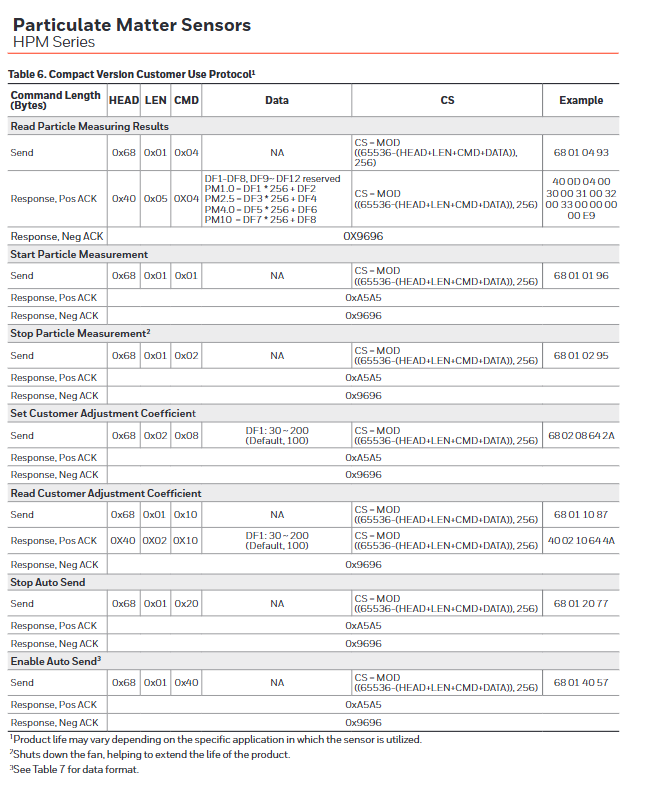
The entire series of sensors provides standardized customer usage protocols and supports various sensor operations through UART command sending. The standard and compact instruction sets are basically the same, with only the response data format for reading measurement results being different. The core supported instructions are as follows:
Core Instruction Function Description Key Features
Read the particle measurement results to obtain the current particle concentration data. Compact models return PM1.0/2.5/4.0/10, while standard models return PM2.5/10
Start particle measurement, activate sensor detection function, start fan and laser detection, enter working mode
Stop particle measurement, turn off sensor detection function, turn off fan, extend sensor lifespan
Set the customer calibration coefficient to customize the concentration calibration coefficient range from 30 to 200, with a default value of 100
Reading the customer calibration coefficient to obtain the current calibration coefficient can verify whether the calibration settings are effective
Stop automatic transmission and disable the automatic data push function. The sensor no longer actively outputs concentration data
Enable automatic transmission and enable automatic data push function. The sensor continuously outputs concentration data in protocol format
Note: All instructions contain a checksum (CS), calculated as MOD (65536- (HEAD+LEN+CMD+DATA), 256); The positive response is 0xA5A5, and the negative response is 0x9696.
Data format (32 byte fixed across the entire series)
The standard and compact UART output data are both 32 byte frame structures, including frame header, frame length, data segment, and checksum. The core difference lies in the particle concentration correspondence of the data segment. The specific core mapping is:
Standard version: Byte6-7 represents PM2.5 concentration, Byte8-9 represents PM10 concentration, and the rest are reserved spaces;
Compact: Byte4-5 represents PM1.0 concentration, Byte6-7 represents PM2.5 concentration, Byte8-9 represents PM4.0 concentration, Byte10-11 represents PM10 concentration, and the rest are reserved positions;
Checksum: It is the sum of the frame header, frame length, and all data segment bytes, accounting for the last 2 bytes.
Installation and usage requirements
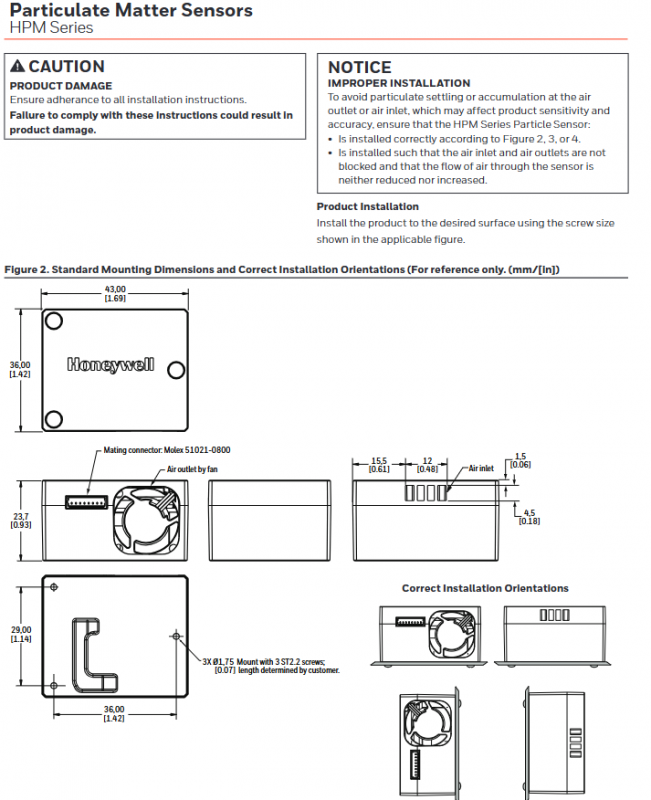
Core installation requirements: The sensor inlet/outlet must be unobstructed, and the airflow must not be increased or decreased to avoid the accumulation of particulate matter at the inlet/outlet, otherwise it will affect the sensitivity and measurement accuracy of the sensor; The installation should be fixed with screws according to the installation diagram of the corresponding model in the document (Figure 2/3/4).
Use safety warning: Do not use the product as a safety/emergency stop device, and do not use it in scenarios where product failure may cause personal injury, otherwise it may cause death or serious personal injury.
Working mode: Supports continuous mode (10-year lifespan) and intermittent mode (lifespan varies with duty cycle). Intermittent mode can be achieved by stopping the measurement command, effectively extending the lifespan of the fan.
Application scenarios
The HPM series sensors are suitable for air quality monitoring and control in multiple commercial/civilian scenarios, with core applications including:
Commercial/civil HVAC systems;
Indoor air quality monitoring device, handheld air quality monitoring device;
Commercial/civilian air purifiers;
Car cabin air purifier.