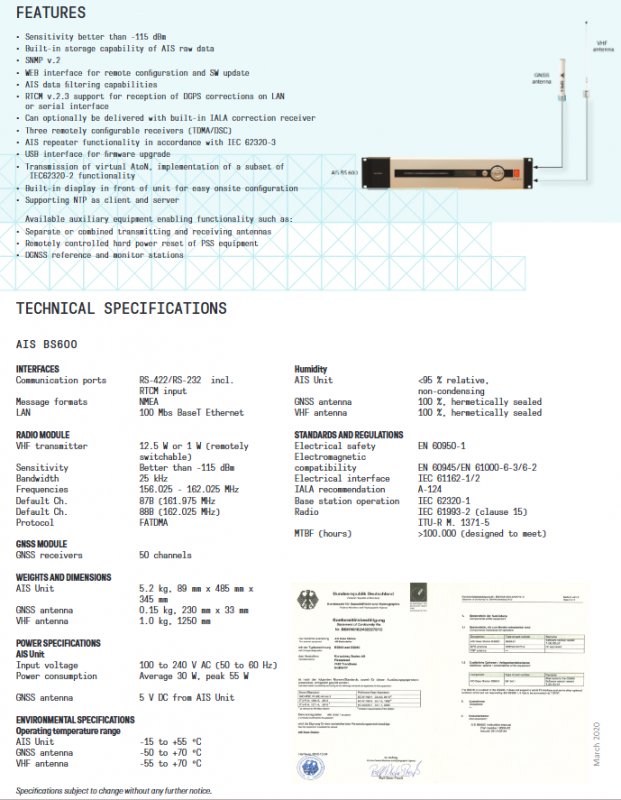
KONGSBERG AIS BS600 shipborne automatic identification system base station
Product foundation and core positioning
Product identity: Konigsberg Seatex fourth generation AIS (Automatic Identification System) base station, RoHS compliant, using Software Defined Radio (SDR) technology, designed as a 2U 19 inch rack mounted system with a simple appearance, built-in display screen and keyboard for easy on-site basic configuration.
Core positioning: As the core component of AIS Physical Shore Station (PSS), it is the most critical equipment in the coastal AIS network, capable of receiving data from all AIS sources within the VHF coverage area, including AIS mobile stations, other AIS base stations, navigation mark AIS units, search and rescue units, etc.
Standard compliance: The design and testing comply with all relevant international standards, including IEC 62320-1 (Base Station Testing Standard) ITU M-1371, Simultaneously compatible with electrical safety EMC、 International standards in various fields such as radio, interfaces, etc. (such as EN 60950-1, IEC 61162-1/2, etc.).
Working mode: Supports two AIS base station modes defined by IEC 62320-1: slave and independent, to meet the deployment requirements of different coastal AIS networks.
Product value: Enhance maritime situational awareness, operational efficiency, and navigation safety, significantly reducing the workload of ship tracking and monitoring operators.
Core functional characteristics
The AIS BS600 integrates core functions such as data transmission and reception, redundancy guarantee, remote management, and positioning correction. It is a highly integrated and available AIS base station with the following key functions:
High sensitivity signal reception: Incorporating the technology of the Konigsberg satellite AIS receiver, the reception sensitivity is better than -115 dBm, exceeding international standard requirements and significantly improving weak signal reception capability.
Hot standby redundancy high availability: supports dual unit hot standby redundancy configuration, no additional hardware required, and dual units run autonomously; When the redundant configuration is automatically switched, a notification will be sent to the control center to achieve uninterrupted service and ensure high network availability.
Remote configuration and operation: Equipped with multiple serial interfaces and 100Mbs Ethernet interfaces, it can easily connect to other devices/data networks; Support remote configuration and firmware upgrade through a web interface, and all base station functions can be configured and activated through this interface; Simultaneously supporting SNMP v.2 network management protocol, it can also remotely operate single/entire network base stations through AIS service management application suite.
Data storage and processing: Equipped with built-in AIS raw data storage capability, supports AIS data filtering, and can accurately filter the required data; Supports FATDMA 50 channels to meet the needs of multi-source AIS data transmission and reception.
DGNSS correction information broadcast: DGNSS correction information can be broadcasted through standardized AIS MSG 17, and all ships carrying AIS mobile stations in the coverage area can receive it; Supports RTCM v.2.3 protocol, can receive DGPS correction through serial port/LAN, and can also be equipped with a built-in IALA correction receiver.
Diversified expansion functions:
Support AIS relay function, compliant with IEC 62320-3 standard;
Capable of transmitting virtual navigation marks (AtoN) and implementing IEC62320-2 functional subsets;
Support NTP protocol (client+server mode) to achieve time synchronization;
Equipped with USB interface, firmware upgrade can be performed locally;
Equipped with 3 remote configurable receivers (TDMA/DSC) to meet different data reception requirements.
Core technical parameters
The AIS unit, GNSS antenna, and VHF antenna of AIS BS600 have their own dedicated parameters in terms of performance, power supply, environment, and physical dimensions. The core technical parameters are summarized in the following table:
Category Equipment/Module Key Parameters
Wireless module AIS unit transmission power: 12.5W/10W (remote switching); Sensitivity:>-115 dBm; Bandwidth of 25kHz; Frequency band 156.025-162.025 MHz; Default channel 87B (161.975MHz)/88B (162.025MHz); Supports FATDMA 50 channels
The GNSS module GNSS antenna is supplied with 5V DC by the AIS unit; Working temperature -50~+70 ℃; Weight 0.15kg, size 230 × 33mm
VHF antenna operating temperature -55~+70 ℃; Weight 1.0kg, length 1250mm; transmitting/receiving antennas can be separated/combined
Power supply specification AIS unit input voltage: 100-240V AC (50-60Hz); Power consumption: average 30W, peak 55W
Environmental specifications: Full equipment humidity: AIS unit<95% RH, no condensation, all equipment is 100% fully sealed; AIS unit operating temperature -15~+55 ℃
Physical parameters AIS unit weight 5.2kg; dimensions 89mm (height) x 485mm (width) x 345mm (depth) (2U 19 “rack mounted)
Reliability AIS Unit MTBF (Mean Time Between Failures):>100000 hours (design value)
Interface specifications AIS unit communication interface: RS-422/RS-232 (including RTCM input), 100Mbs BaseT Ethernet USB; Support NMEA format
Auxiliary equipment is compatible with standards
Optional auxiliary equipment: can be combined with exclusive auxiliary equipment to expand functions, including separate/combined transmission/reception antennas, PSS device remote hard power reset module, DGNSS reference station/monitoring station, to meet the deployment needs of different scenarios.
Full dimensional standard compatibility: In addition to the core AIS base station standard, it also complies with the following international standards/specifications to ensure the universality and security of the equipment:
Electrical safety: EN 60950-1;
Electromagnetic compatibility: EN 60945, EN 61000-6-3/6-2;
Electrical interface: IEC 61162-1/2;
Navigation mark recommendation: IALA A-124;
Radio standard: IEC 61993-2 (Chapter 15) ITU-R M.1371-5。