Schneider Easergy P5 Communication Architecture and Protocol
Easergy P5 Communication Architecture and Protocol Deep Analysis: Building a Solid Communication Hub for Intelligent Power Grid
In the context of the accelerated evolution of power system automation towards digitization and intelligence, the communication capability of protection, measurement, and control equipment (IEDs) has become a key dimension determining its core value. Schneider Electric’s Easergy P5 series protective relays, with their powerful, flexible, and highly reliable integrated communication system, have become key nodes in modern intelligent substations and distribution networks. This article will systematically analyze the communication architecture, protocol support, network redundancy strategy, and configuration practices of Easergy P5 based on its technical manual, revealing how it seamlessly integrates into the complex power automation ecosystem.
1、 Design of Multi Integration Communication Architecture
The design concept of Easergy P5 is to provide plug and play data exchange capabilities, support smooth transition and hybrid deployment from traditional serial links to modern Ethernet, fully protect users’ existing investments, and reserve space for future upgrades.
Serial network architecture: This architecture is suitable for scenarios where traditional SCADA/HMI systems are connected to multiple relays through RS-485 multi branch links in master-slave mode. This economical solution is still effective in small substations or situations where real-time requirements are not extremely demanding. The device supports 2-wire or 4-wire connections and can configure communication parameters (baud rate, parity, etc.) through eSetup Easergy Pro software.
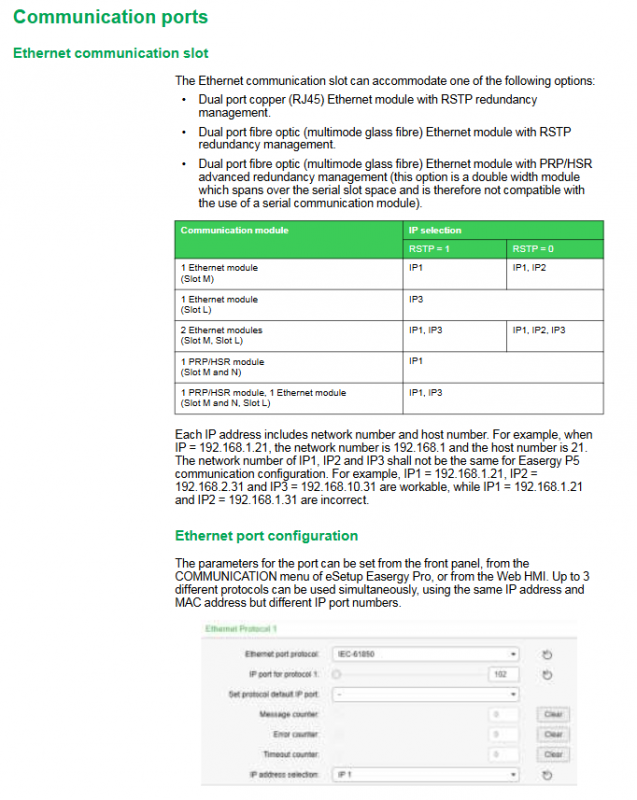
Ethernet network architecture: This is the preferred solution for achieving high-performance, high-density data exchange. Easergy P5 can be directly connected to Ethernet switches and supports running up to three different Ethernet protocols simultaneously on the same physical network and device IP address. This multi protocol parallel capability is highly flexible. For example, IEC 61850 GOOSE can be used simultaneously on the same network to transmit fast tripping signals between relays, and Modbus TCP/IP can be used to communicate with the monitoring system, achieving decoupling of fast control within the protection system and external management data streams.
2、 Comprehensive communication protocol support
Easergy P5 is equipped with mainstream and widely accepted communication protocols in the power industry, ensuring extensive interoperability with SCADA/EMS systems from different manufacturers and automation equipment at different levels.
IEC 61850- Standard for Future Substation Communication: Easergy P5 provides complete support for the IEC 61850 standard (Edition 1&2), including the core client server model and fast and reliable GOOSE communication.
Model and Configuration: The device follows the IEC 61850-6, -7 series standards for modeling and is systematically configured through CID/SCD files. Its logical nodes and datasets can be flexibly configured to meet the information point requirements of different SCADA systems.
GOOSE Communication: This is one of the most revolutionary features of IEC 61850. Easergy P5 can serve as a GOOSE publisher and subscriber, enabling millisecond level peer-to-peer communication between devices. By releasing status information such as trip signals and lockout signals, traditional hard wiring can be replaced, greatly simplifying secondary wiring and improving system reliability. The configuration process can be completed through the professional CET850 configuration tool to ensure the correct mapping and testing of GOOSE messages.
Service capability: Supports up to 8 concurrent client connections, dynamic/static datasets, buffered/non buffered report control blocks, and multiple control modes (direct control, select execute, etc.) to meet the requirements of complex application scenarios.
DNP3- a widely used protocol in North America and globally: The device fully supports the DNP3 protocol (serial port and TCP/IP mode) and has Level 2 compliance. It supports data classification, event triggered reporting (non request response), time synchronization, circuit breaker control, and disturbance record file transmission. Its configuration parameters are rich, and it can finely adjust the link layer confirmation, application layer confirmation, event buffer size, and analog dead zone reporting strategy to adapt to different network bandwidth and reliability requirements.
Modbus – Universal Industrial Protocol: Provides support for Modbus RTU (serial port) and Modbus TCP/IP. As a slave device, it supports function codes 03, 04, 06, 16, etc., allowing the master station to read measurement values, status information, event records, and perform remote control. Specifically, the Modbus interface also supports the transmission of disturbance record (COMTRADE format) files through file reading function (function code 20). For scenarios that require integration with PLC or traditional HMI, Modbus provides a simple and direct solution.
Other important agreements:
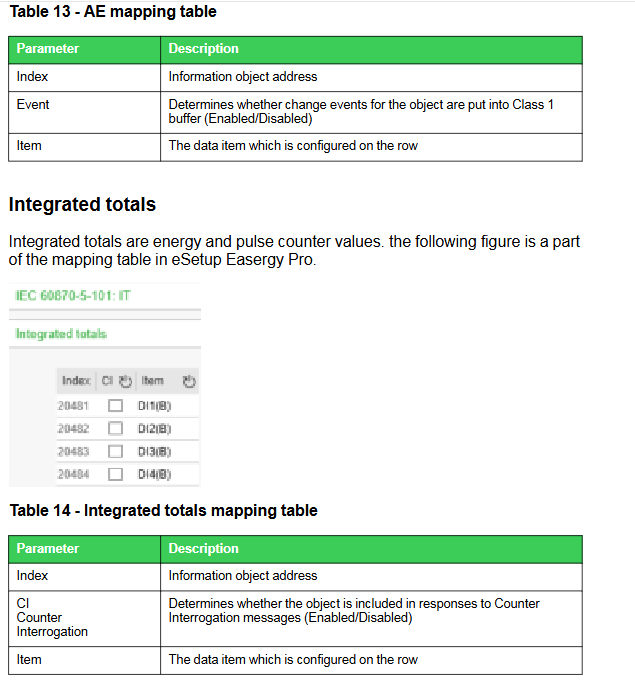
IEC 60870-5-101/103: Supports both remote control protocols applied to substations, especially when integrated with outdated SCADA systems or regional systems following specific industry practices.
EtherNet/IP: Supports this industrial Ethernet protocol, facilitating direct data exchange with industrial controllers and systems using brands such as Allen Bradley.
Auxiliary protocols: Support sFTP for secure file transfer, SNMP for network management, SNTP for network time synchronization, and HTTPS for secure web HMI access.
3、 Industrial grade Ethernet redundancy technology
The requirements for communication reliability in the power system are almost stringent. Easergy P5 supports three mainstream redundancy protocols through optional Ethernet modules, ensuring zero switching or fast recovery of communication in case of network failures.
Parallel Redundancy Protocol: Provides the highest level of redundancy. Data is transmitted in parallel on two completely independent networks (Network A and Network B) simultaneously. The receiving end automatically discards duplicate frames. PRP can achieve a 0 millisecond fault recovery time, but at the cost of building double the network infrastructure. Suitable for critical services that absolutely do not allow communication interruption, such as protection tripping.
High availability seamless redundancy: typically applied to ring topologies. Data frames are transmitted simultaneously in both directions along the ring, and the receiving end processes the frames that arrive first. It also has a 0-millisecond recovery time and saves network equipment costs compared to PRP. The PRP/HSR module of Easergy P5 occupies dual slots and provides dedicated configuration parameters.
Fast spanning tree protocol: a more universal Ethernet redundancy scheme. It prevents loops by blocking redundant links, recalculating and activating backup links in the event of a failure. The advantage of RSTP lies in its good compatibility and suitability for any network topology, but its recovery time (which may range from hundreds of milliseconds to seconds) may not meet the strictest protection level communication requirements.
Users can choose appropriate redundancy solutions based on reliability requirements, cost budget, and existing network architecture.
4、 System Configuration and Security Practice
Configuration toolchain: Easergy P5 achieves a combination of software and hardware configuration. Basic settings can be made through the device front panel and Web HMI. Advanced configurations (such as IEC 61850, GOOSE mapping, DNP3 point table) rely on eSetup Easergy Pro configuration software. For IEC 61850 system engineering, it is recommended to use the independent CET850 tool to edit and verify SCD files, in order to achieve collaborative configuration with the entire substation automation system.
Port hardening and network security: The device provides port hardening functionality, allowing users to disable unused communication ports or protocols at the physical layer, effectively reducing the attack surface. The manual also solemnly points out the importance of industrial network security, emphasizing that most supported traditional protocols (such as IEC 61850, DNP3 Ethernet) do not provide encryption themselves, except for encrypted Get Set/TLS channels. Therefore, it is necessary to strengthen the network by partitioning VLANs, using firewalls, filtering IP addresses, and adopting standard security practices such as VPN/TLS tunneling when connecting externally.