Guide to Deep Application of Inline Series Automation Terminals
The cornerstone of industrial automation systems: In depth analysis and application guide for Inline series modular I/O terminals
In the wave of Industry 4.0 and intelligent manufacturing, flexibility and modularity have become the core demands of automation control systems. As a classic work of Phoenix Contact, the Inline series of automation terminals are widely used in various fields from discrete manufacturing to process control due to their high flexibility, compact structure, and excellent compatibility. This article will combine the core points of the technical manual to deeply analyze the architecture logic, electrical characteristics, installation specifications, and network security defense system of the Inline system, providing engineers with a detailed professional practice reference.
System Architecture: Flexibility Strategy for Modular Design
The Inline series is not simply a hardware stack, but a logically rigorous modular system. The core design concept is “function oriented”, allowing users to assemble optimized control stations on DIN rails like building blocks according to their actual needs.
1.1 Basic Composition of the Site
A typical Inline site typically consists of the following components:
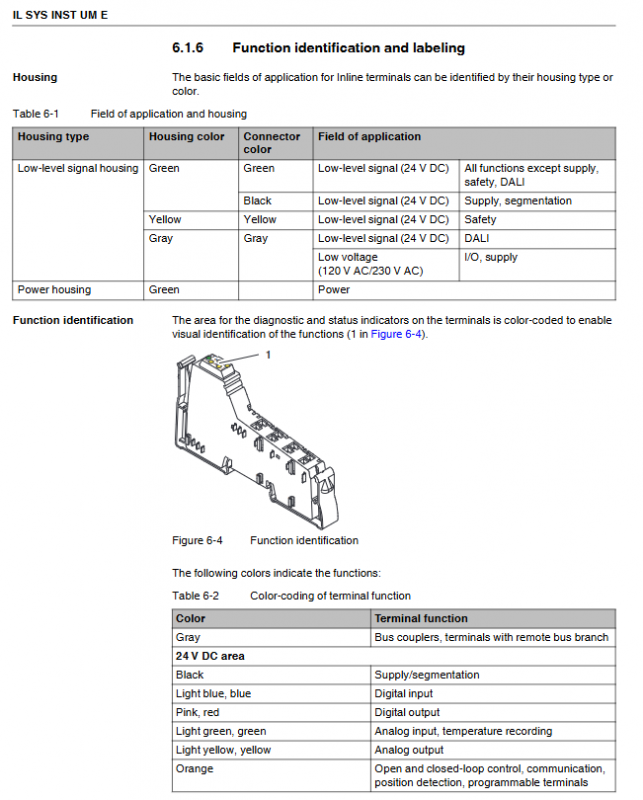
Bus coupler: The brain of the station, responsible for protocol conversion and data exchange between the Inline local bus and the upper industrial network (such as PROFINET, PROFIBUS, Ethernet/IP, etc.).
Power supply and segmented terminals: responsible for introducing, isolating, and protecting logic voltage and I/O voltage.
I/O terminal: includes functional modules such as digital quantity, analog quantity, temperature acquisition, communication, etc., which process low-level signal acquisition and execution.
Power level terminal: used to control high-voltage power equipment such as motors (note: some old models have been discontinued or replaced by new series).
1.2 Flexible slot configuration
Inline provides modules with different widths such as 2 slots and 8 slots. This design can minimize the waste of installation space to the greatest extent possible. The 2-slot module is suitable for refined configuration requirements, while the 8-slot module significantly improves the assembly efficiency of large sites.
Electrical and Voltage Zone Management: The Essence of Safety Isolation
In complex industrial sites, the mixing of different voltage levels is the main source of electrical faults and safety hazards. The Inline system achieves dual protection of physics and logic through strict “voltage zone” division.
2.1 Physical isolation of voltage regions
The system strictly distinguishes between the 24V DC low voltage zone and the 120V AC/230V AC high voltage zone.
24V DC area: mainly used for the transmission of sensor signals (US) and actuator signals (UM), as well as the power supply of system logic voltage (UL).
AC area: used for connecting AC power supply. The system uses a dedicated “AC power terminal” as a dividing line and uses different electronic bases and connectors to prevent errors in the physical structure, effectively preventing the risk of high voltage entering the low voltage area.
2.2 Current distribution and potential jumper
The uniqueness of Inline lies in its automatically created potential circuit. When modules are installed side by side, their internal potential jumpers will automatically connect, and current flows between modules through the bus rail, greatly reducing the need for external parallel wiring.
Installation and wiring: professional standards from specifications to details
Reliable physical installation is a prerequisite for the long-term stable operation of automation systems.
3.1 Anti static and Environmental Adaptability
All Inline devices are enclosed in ESD protective bags. When used in environments with an altitude exceeding 3000 meters, temperature derating must be considered, as the air in high-altitude areas is thin and the heat dissipation efficiency decreases. The maximum allowable ambient temperature of the system will decrease with increasing altitude.
3.2 Wiring Technology and Shielding Strategy
Unshielded wiring: Suitable for standard digital signals, using direct insertion connectors to improve efficiency.
Shielded wiring: For analog and high-speed communication signals, Inline provides specialized shielded connectors. It is recommended to use a large-area shielding grounding method, which establishes a low impedance connection between the FE (functional grounding) spring and the DIN rail to effectively resist electromagnetic interference.
Equipotential balance: In a multi power supply system, the logic power supply and I/O power supply should be powered by independent power modules as much as possible, and the scientific connection of each potential reference point should be ensured.
Network Security: Defense Depth in Industry 4.0 Environment
With the increase of device networking rate, PLC and I/O stations are no longer isolated islands. The Inline manual emphasizes network security measures based on the “defense in depth” strategy.
Access control: It is recommended to only allow authorized personnel to physically access the device and disable all unnecessary communication channels.
Firmware update: Install the latest official firmware in a timely manner to patch known security vulnerabilities.
Supporting protection: In safety critical applications, it is recommended to use mGuard series routers in conjunction. This product provides a secure tunnel for remote maintenance of local networks through hardware firewalls and virtual private network (VPN) technology, effectively resisting external network attacks.
Diagnosis and maintenance: “intuitive” design for quickly locating faults
Shutdown time is the biggest cost for factories. The Inline system has designed an intuitive LED diagnostic matrix:
Bus status light (BUS): A constant green light indicates normal data exchange, while a flashing red light indicates communication interruption or configuration error.
Power status light (PWR): Real time monitoring of logic power supply, analog power supply, and I/O power supply voltage to ensure they are within the allowable tolerance range.
I/O diagnostic light: It directly indicates channel level overload, disconnection, or short circuit faults through different colors and flashing frequencies of the LED.