KONGSBERG High Precision Acoustic Positioning – HiPAP®
Product Overview
HiPAP ® It is the second generation high-precision underwater acoustic positioning system developed by Kongsberg Maritime. It was originally designed for deepwater high-precision seabed survey to avoid complex deployment of LBL. It adopts SSBL (ultra short baseline) core technology and is compatible with LBL (long baseline). It is one of the most widely used underwater positioning solutions in the world.
Positioning principle
SSBL/USBL
Only ship mounted transducers and underwater responders are needed, without the need for seabed array calibration, making installation simple.
Measure azimuth, elevation, and slant range, and calculate the 3D relative position; The accuracy slightly decreases with increasing distance.
LBL
Underwater deployment and calibration of a responder array, with accuracy independent of depth, suitable for long-distance high-precision operations.
HiPAP supports automatic LBL ranging and calibration, and can be used in dual-mode switching.
Core components of the system
Operation Unit (APOS): Windows style human-machine interface, supports multiple operation stations, seamless switching between one primary and multiple backup.
Transceiver: Installed near the hull, fiber optic communication, digital transmission/preamplifier/beamforming.
Transducers: The number of array elements far exceeds that of competitors, with the 501 model containing 241 array elements and a spherical structure covering all directions.
Hull unit: Gate valve installation, can lower the transducer outside the turbulent flow zone of the hull, supporting a speed of 10 knots.
Answerer: Supports traditional FSK and new cNodes ® (Cymbal protocol), with over 100 channels.
External sensors: heading sensor (gyroscope), MRU attitude sensor GNSS, Used for error compensation.
Core technological advantages
Digital beamforming
DSP independently controls each element, measures phase and amplitude, forms narrow directional beams, and suppresses noise and multipath reflections.
Cymbal ® Broadband protocol
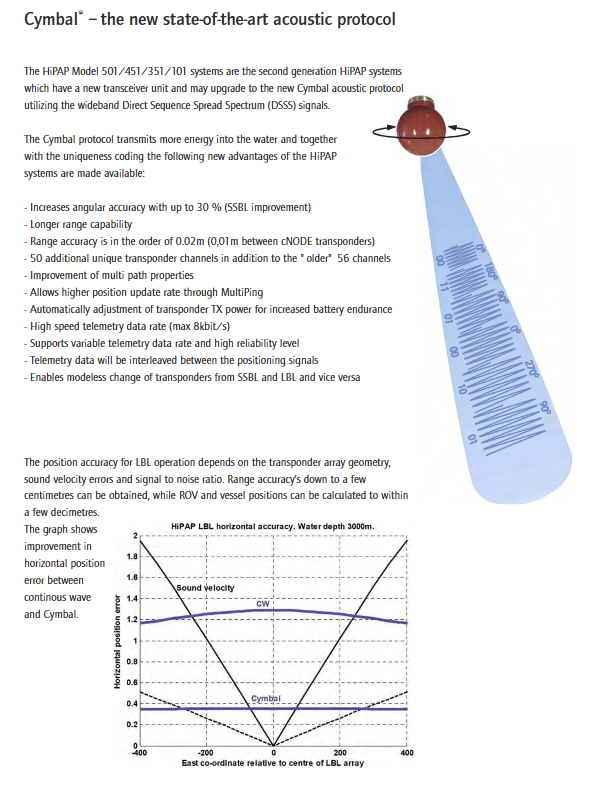
Based on DSSS, the angle accuracy has been improved by 30%, and the distance measurement accuracy is 0.02m.
Add 50 channels, high-speed telemetry at 8kbit/s, adaptive transmission power to extend battery life.
error compensation
Real time correction of ray bending and distance errors in the sound velocity profile.
MRU compensates for ship roll/pitch, and the heading sensor corrects azimuth errors.
HiPAP family model parameters
Model Operation Distance Angle Accuracy (20dB S/N) Number of Array Elements Reception Beam Gate Valve Size Maximum Depth
HiPAP 501 1–4000m 0.12° 241 10° 500mm 4000m
HiPAP 451 1–3000m 0.18° 46 15° 500mm 3000m
HiPAP 351 1–3000m 0.18° 46 15° 350mm 3000m
HiPAP 351P 1-3000m 0.18 ° 46 15 ° 350mm Portable
HiPAP 101 1–10000m 0.14° 31 20° 500mm 6500m
Core functions
Standard functions: automatic calibration, radiation bending compensation, position/angle alarm, DP/survey data output, noise analysis.
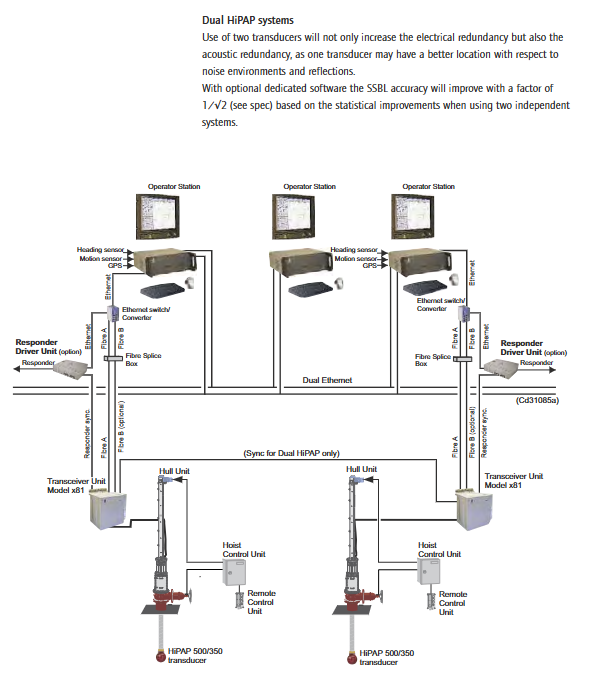
Optional features: LBL, multi-user LBL, dual machine redundancy, riser angle monitoring, BOP acoustic control, ocean current monitoring.
System integration: Supports HAIN acoustic assisted inertial navigation to improve accuracy, update rate, and endurance, and supports continuous positioning during acoustic interruptions.
Typical applications
Deepwater survey, ROV/AUV positioning, dynamic positioning (DP) reference.
Drilling platform: monitoring of riser angle, remote control of BOP, positioning and return of drill bit.
Underwater construction, multi ship collaborative operation, and ocean current measurement.
Service and Training
Global 24-hour technical support, local spare parts and on-site service.
APOS Trainer simulation training software supports operation training, array planning, and interface testing.
Standardized upgrade kit to protect user investment.
Key issue
Question: What core improvements does the Cymbal protocol used in HiPAP system bring?
Answer: Cymbal improves angle accuracy by 30% and ranging accuracy by 0.02m; adds 50 responder channels, supports 8kbit/s high-speed telemetry, adapts power to extend battery life, and optimizes multipath suppression and positioning update rate.
Question: What is the difference in core positioning between HiPAP 501 and HiPAP 101?
Answer: HiPAP 501 is an omnidirectional top configuration type with 241 elements, 10 ° narrow beam, 4000m operating distance, and the highest accuracy; HiPAP 101 is a low-frequency ultra deep water type, with a working depth of up to 6500m and a distance of 10000m, suitable for extremely deep water areas.
Question: How does HiPAP ensure positioning accuracy in deep water and complex environments?
Answer: Using digital beamforming to suppress noise; Compensate for ship motion through MRU and heading sensors; Support real-time correction of sound velocity profile; Paired with Cymbal protocol and dual-mode positioning (SSBL+LBL), it can also integrate HAIN inertial navigation to improve stability and accuracy.