ABB SCC Series Sample Gas Processing System Components
Overall product list
SCC-C: Sample Gas Cooler
SCC-F: Sample Gas Supply Unit
SCC-S: Sample Gas Supply Unit (Economic Type)
Diaphragm pump 4N: Diaphragm pump
SCC-K: Converter (NO ₂ → NO catalytic conversion, high-temperature thermal conversion)
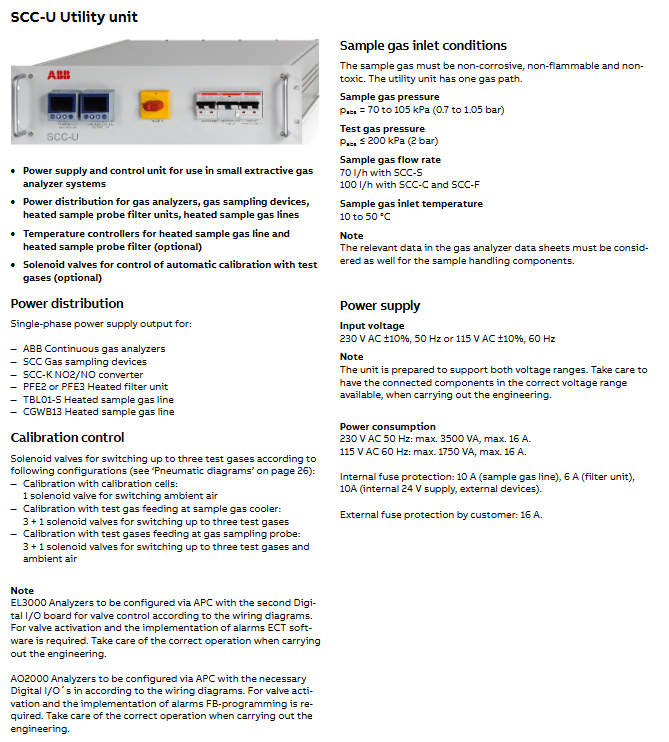
SCC-U: Public Power Control Unit
Membrane filter: Membrane filter
CGKW: Condensation Monitoring Filter
Acid filter: Acid mist filter
Disposable filter: disposable filter
Flow meter/flow monitor
ER-144A/Ex isolation switch unit; KFA isolated switching amplifier
Gas cylinder pressure reducing valve; Multi channel testing cyclone plug valve
Detailed explanation of core modules
1. SCC-C sample gas cooler
Function: Refrigeration and dehydration of the sample gas, reducing the dew point of the sample gas, and separating condensed water; Optional peristaltic pump automatic coagulation and micro dosing unit.
The material of the heat exchange chamber can be selected from glass/PVDF/stainless steel, suitable for corrosive flue gas.
Power supply: 115/230V AC, maximum power consumption 200VA; built-in temperature display and PT100 temperature measurement.
Peristaltic pump option: Drainage flow rate of approximately 300 ml/h; Metering pump 15 ml/h, used for suppressing acid aerosols under low concentration SO ₂ conditions; The lifespan of the hose is about 5 months.
Certification: CB, CSA; ATEX Zone2 explosion-proof version (II 3G Ex eC nC IIC T4 Gc), certified by GOST Eurasian Customs.
Environment: Working+5-45 ℃; Storage -25~+60 ℃; The shell has an IP50 rating.
The ordering code is a combination of multiple fields, which can be selected from: installation form, heat exchanger material, gas path quantity, peristaltic pump configuration, temperature monitoring, voltage, and certification.
Attachment: Time relay, condensation collection bottle, liquid level monitor, condensation trap.
2. SCC-F sample gas supply unit
Function: Matched with SCC-C cooler, diaphragm pump extracts sample gas, rotor flowmeter displays and adjusts flow rate; Dual independent gas path.
Cannot be used in explosive hazardous areas and cannot transport flammable mixtures.
Inlet conditions: absolute pressure of 70-105 kPa, inlet temperature+10-50 ℃; The dew point of the sample gas must be at least 5 ℃ lower than the ambient temperature.
Performance: Maximum 100 l/h per channel, maximum 200 l/h for bypass; The dead volume is about 10 cm ³; Air tightness 5 × 10 ⁻⁶ hPa/s.
All gas paths are metal free (PVDF/PTFE) and corrosion-resistant; 189-19 inch rack/wall mounted, IP20, The maximum weight is 15 kg.
Optional I/O board: communicates with the AO2000 analyzer system bus, reads cooler temperature, condensation/flow alarms, and can drive external solenoid valves.
The status relay outputs condensation and flow alarms; Provide multiple versions of gas circuit schematics; Provide a complete ordering and selection matrix.
3. SCC-S Economic Sample Gas Supply Unit
Targeting EasyLine analyzer, cost optimized, supporting 19 inch 4U rack or wall mounted.
Configuration: Diaphragm pump, membrane filtration, condensation monitoring, rotor flowmeter; Optional integrated Peltier cooler (dew point stability+3 ℃ after cooling) and test gas solenoid valve switching.
Air flow rate: 7-70 l/h for the main road; Bypass 15-150 l/h; Air tightness 5 × 10 ⁻⁶ hPa/s.
Comes with 24 VDC (maximum 30 VA) to drive external solenoid valves; Provide multiple sets of pneumatic schematics and support external coolers.
Working temperature+10-40 ℃; IP20。
Ordering options: installation method, gas path configuration, test gas solenoid valve, built-in Peltier cooler, condenser pump, power supply voltage.
4. Diaphragm pump 4N independent diaphragm pump
Independent suction pump module, used for sample gas extraction.
Flow rate: maximum 250 l/h at normal pressure; Absolute pressure intake is 70-105 kPa.
The protection level can be selected as IP20/IP54; Plastic shell, EPDM, PP, FPM, ETFE resistant to corrosion when in contact with liquid.
Power supply: 115/230V AC; Power consumption is about 50 VA; weight is about 1.8 kg; provide complete order number.
5. SCC-K Converter Unit
Two modes: NO ₂ – NO catalytic converter, quartz tube high-temperature thermal converter, 19 inch 3U rack. 1) NO ₂ → NO catalytic conversion (carbon molybdenum catalyst)
Function: Smoke analysis, reducing nitrogen dioxide to NO for measurement; Catalyst does not require tool replacement.
Maximum flow rate of 150 l/h; Working temperature 320-360 ℃; Conversion efficiency ≥ 95%; Catalyst lifespan>6 months. 2) Quartz glass thermal converter (up to 680 ℃)
No consumables; Conversion efficiency ≥ 99%; Used in papermaking TRS, chlorine chemical industry, PVC chlorinated hydrocarbon and other working conditions to convert sulfur/halogen organic compounds into measurable components.
Passive contact for temperature deviation alarm output; Includes multiple gas path options: standard ball valve, dual solenoid valve bypass, heated sample gas inlet option.
Power supply 120/240V AC, maximum power consumption 575 VA; with CB, CSA, GOST certification.
6. SCC-U Utility Unit
The entire preprocessing system is equipped with a centralized power supply and calibration control unit, a 19 inch 3U rack, IP20。
Function: Allocate power to analyzers, SCC pre-processing, heated sampling probes, and heat tracing pipelines; Two optional temperature controllers can be used to heat the probe and heat tracing pipeline; The built-in solenoid valve enables automatic zero/range testing gas switching calibration.
Power input: 115/230 V AC, maximum 3500 VA; built-in multiple fuse protection.
There are three options for the test gas switching scheme: ① only air zero point; ② At most three road markings can be connected to the cooler end; ③ Three road sign air and zero point air are connected at the sampling probe end.
Interact DI/DO signals with the analyzer (AO2000/EL3000) through 15 pin D-Sub;
Engineering Tip: The SCC-K converter must be installed at the top of the cabinet with reserved heat dissipation space; The installation of the heat tracing pipeline needs to be tilted downwards to avoid liquid accumulation.
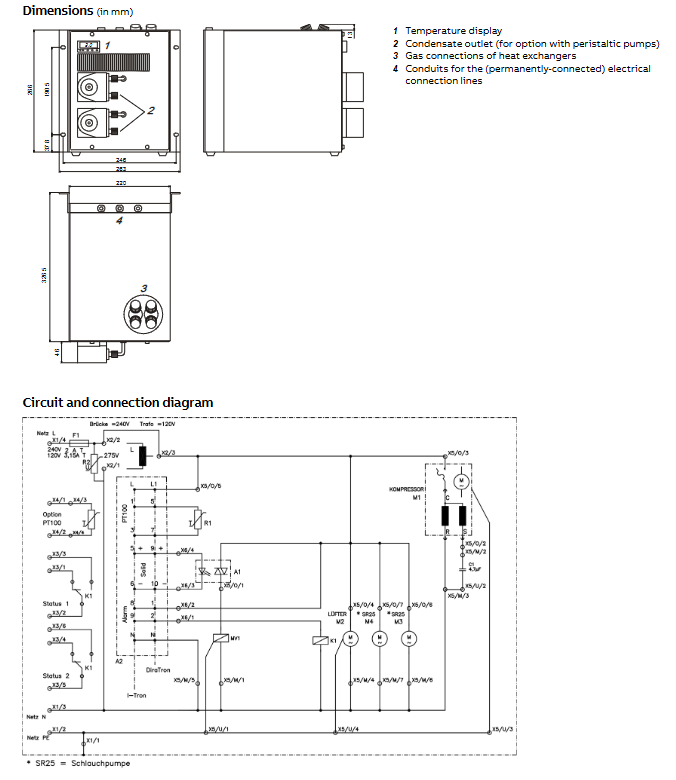
The appendix includes a complete wiring schematic, air circuit diagram, and mechanical dimension drawing.
Auxiliary components
Membrane filter: intercepts particles ≥ 1 μ m; Maximum 300 l/h; Material: PVC/stainless steel.
CGKW condensation monitoring filter: dual function of filtering and conductive condensation alarm; Combined with the ER-144A/Ex intrinsic safety relay, it can be used in Zone 1/2 hazardous areas.
Acid filter: captures sulfuric acid aerosols and high SO ₂ smoke scenes; Borosilicate fiber filter cartridge, resistant to 150 ℃.
Disposable filter: Micro fiberglass filter, small in size, recommended to be replaced every 6 months.
Flow meter and flow monitor: float type, with needle valve adjustment; Some models come with sensing limit contact output alarms; Supports special versions of chlorine gas.
ER-144A/Ex: Intrinsic safety isolation relay for CGKW condensation monitoring, DIN rail installation, used for safe isolation of sensors in hazardous areas.
KFA isolation switch amplifier: flow monitoring probe intrinsically safe isolation, monitoring for wire breakage and short circuit.
Gas cylinder pressure reducing valve: first/two-stage pressure reducing valve, available in stainless steel versions for ordinary nitrogen, non corrosive gases, and strongly corrosive gases; Equipped with low voltage alarm dry contacts.
Multi channel testing cyclone plug valve: manually switch the zero/range sample gas.
General specifications, certifications, and engineering points
Safety standards: all comply with EN 61010-1; EMC Industrial Environment EN 61326-1; The impact vibration meets EN 60068.
Certification types: IECEE-CB, CSA Safety, ATEX Explosion proof, Eurasian Economic Union GOST.
Wetting materials: PVDF, PTFE, FPM, ETFE, quartz glass, 316Ti stainless steel are widely used, suitable for acidic and sulfur-containing flue gas.
Cabinet engineering requirements: Reserve at least 1U of heat dissipation spacing between modules; Top mounted thermal device (SCC-K); Tilt the heat tracing pipeline downwards to prevent condensation and accumulation of liquid; The cabinet must be equipped with fans/air conditioning.
System configuration logic (typical extraction flue gas pretreatment link)
Sampling probe → heat tracing pipeline → SCC-C cooling water removal → SCC-F/SCC-S sample gas supply unit (pump+filtration+flow rate) → optional SCC-K converter → analyzer; SCC-U centralized power supply, connected to standard gas cylinder pressure reducing valve for automatic calibration; CGKW filter monitoring system internal condensation water risk.
If you need, I can create a product category comparison table between this SCC sample gas pretreatment document and the previous NGC8209 chromatography, DCS transmission, ACS800, ASTAT, to distinguish between the two major categories of analytical instruments and electrical transmission.