GE SPEEDTRONIC ™ Mark VI Gas/Steam Turbine Control System
1. Product positioning and core values
SPEEDTRONIC ™ Mark VI is an integrated control, protection, and monitoring system developed by GE for gas and steam turbines, covering both generator and mechanical drive scenarios. It can integrate power island and plant wide auxiliary control and has over 30 years of mature application experience.
2. System architecture
The core is the control module, using 13 slot/21 slot standard VME card cages
The main processor card occupies 2 slots, and the I/O card is equipped with a TMS320C32 DSP, converting data to 32-bit IEEE-854 floating-point numbers
Operating system: QNX, supports multitasking and preemptive scheduling, controls frame rate of 10/20/40ms
Communication bus: IONet (10Base2 Ethernet, ADL protocol) Unit Data Highway(UDH)
Redundant architecture: Supports single and triple module redundancy (TMR), three independent control modules/power supply/IONet, software fault-tolerant (SIFT) voting, and online replacement of faulty modules
3. I/O interface system
(1) Universal I/O
Type represents card specifications
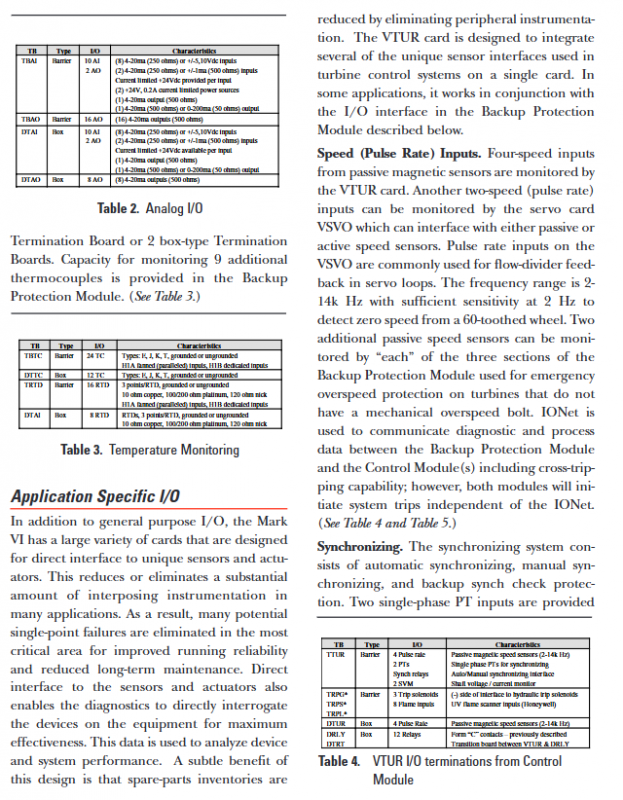
Discrete I/O VCRC 48 in/24 out, SOE 1ms
Analog I/O VAIC/VAOC 20 in/4 out, 16 out, 4-20mA/± 5/10V
Temperature monitoring VTCC/VRTD 24 channel TC, 16 channel RTD
(2) Dedicated I/O
Speed: VTUR/VSVO, supports 2-14kHz magneto electric sensors
Servo: VSVO, 4-channel, compatible with * * ± 10~± 120mA * * servo valve
Vibration: VVIB, 16 way vibration/8 way position/2 way Keyphasor
Synchronous/shaft voltage/flame detection/three-phase PT/CT/pyrometer all have dedicated cards
4. Human Machine Interface (HMI)
Platform: Windows NT+CIMPLICITY Graphics System
Refresh rate: 1 second, SOE event time scale 1ms
Permission: Level 5 user account, supports remote maintenance and engineer station
Feature: HMI failure does not affect control logic, can be restarted/replaced online
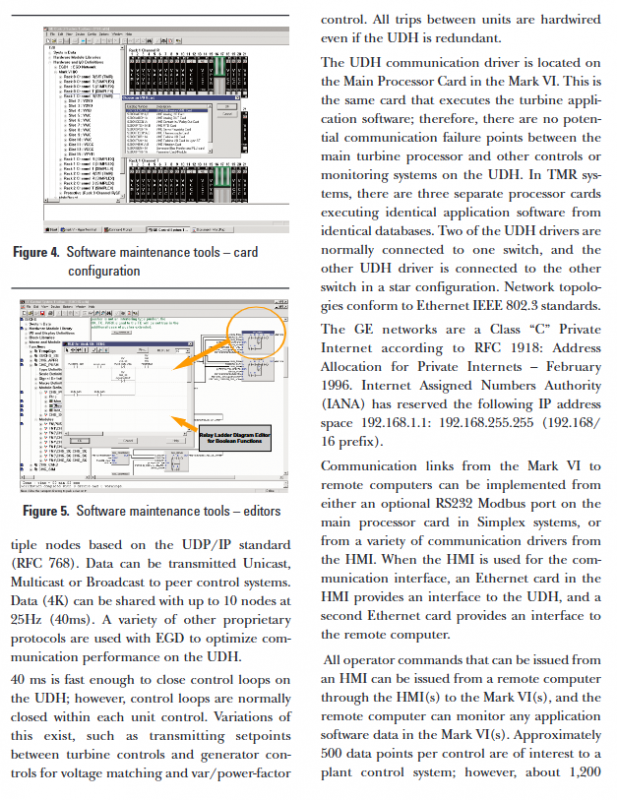
5. Software maintenance tools
Programmable control, built-in GE algorithm library and functional blocks
Support online modification and download, program stored in flash memory
Editor: ladder diagram, logic forcing, trend recording, 5-level password protection
6. Communication system
Internal: IONet, UDH Ethernet (EGD/UDP/IP)
External: RS232 Modbus, Ethernet Modbus TCP/IP, GSM
TMR system: only supports data monitoring, does not support remote control commands
7. Time synchronization
Support GPS/IRIG-B/NASA36 and other time sources
Using NTP, synchronization accuracy * * ± 1ms**
8. Diagnostic function
Each card has dual diagnosis of hardware limit/software limit
Card surface RUN (green)/FAIL (red)/STATUS (yellow) three LED indicators
Fault classification: sensor fault/electronic fault, supporting alarm linkage and SOE recording
9. Power Supply and Environment
(1) Power parameters
Type Voltage Range Load Requirements
125Vdc 100~144Vdc 10.0A Ripple ≤ 10Vp-p
120Vac 108~132Vac 10.0A harmonic<5%, 47~63Hz
240Vac 200~264Vac 5.0A harmonic<5%, 47~63Hz
(2) Environmental requirements
Operating temperature: 0~+45 ℃, storage: -40~+70 ℃
Humidity: 5%~95% without condensation
Altitude and seismic resistance: meet UBC Zone 4, IP20 protection requirements
10. Standards and Certification
Quality: ISO9001
Safety: UL508A, CSA 22.2 No.14
Electromagnetic compatibility: EN50081-2/50082-2, EN55011
Low voltage: EN61010-1, IEC529 (IP20)
11. Supporting documents
System manual GEH-6421, configuration tool manual GEH-6403, I/O list, topology diagram, application program diagram, etc
Key questions and answers
Question 1: What are the core advantages and implementation methods of Mark VI’s Triple Redundancy (TMR)?
Answer: The core advantages are non-stop maintenance for single point faults, online repair, and differentiation of sensor/electronic faults; The implementation method consists of three completely independent control modules, power supply, and IONet network. The input voting is completed using software fault tolerance (SIFT), and the output is voted using three coil servo/three out of two relay. The system can operate with faults and replace faulty components online.
Question 2: What are the two types of I/O systems for Mark VI, and what are the key turbine monitoring and control objects covered by dedicated I/O?
Answer: It is divided into general I/O (discrete, analog, temperature) and dedicated I/O; Specialized I/O covers core objects of the turbine, such as speed, synchronous grid connection, shaft voltage and current, flame detection, hydraulic tripping, servo valves, vibration displacement, three-phase PT/CT, blade pyrometer, etc.
Question 3: How can the real-time performance and reliability of Mark VI be guaranteed through hardware, software, and communication?
Answer: The hardware uses VME+DSP distributed processing, TMR redundancy, and online replaceable; Software using QNX real-time system, 10/20/40ms frame rate, online download; IONet deterministic protocol, UDH high-speed Ethernet, and hard wired interlocking are used for communication, combined with card level diagnostics and 1ms SOE, to ensure real-time control and system reliability.