ABB LS4000 diode laser gas analyzer
Product Overview and Measurement Principles
1. Product Introduction
LS4000 is a cross pipeline in-situ laser analyzer, which consists of three parts: the emitting unit (with laser light source), the receiving unit (photodetector), and the junction box; The transmitter and receiver are installed on both sides of the process pipeline/chimney, and electrical collection is completed through junction boxes.
Core advantages: No need for sampling pipelines, no pre-processing system, direct measurement of internal gas in the process, fast response speed; Anti vibration, compact and lightweight structure, suitable for high temperature, high pressure and harsh flue gas conditions.
2. Measurement principle – TDLAS tunable diode laser absorption spectroscopy
The adjustable laser diode at the emitting end emits laser of a specific wavelength, which passes through the measured process gas;
The target gas will absorb laser of a specific wavelength, causing a decrease in light intensity;
The receiving end photodetector collects transmitted light;
According to the Beer Lambert law, the gas concentration is calculated by processing the light attenuation amount through an algorithm;
Built in dynamic automatic correction algorithm, automatically eliminating measurement interference caused by temperature and pressure changes; If there is a significant change in process temperature and pressure, an external 4-20mA temperature and pressure sensor input is required to participate in compensation.
3. Measurable components and measuring range
Measurement range of the tested gas
NH3 0-10 ppm~0-1000 ppm
H ₂ O water vapor 0-10 vol%~0-50 vol%
Simultaneous measurement of ammonia gas and water vapor using NH ∝+H ₂ O combination
Boundary conditions of working conditions
Absolute pressure: 0.5~1.7 bar
Maximum process temperature: 450 ℃
Optical path length OPL (transmission reception distance): 0.5 ~5 m
Note: Each component only supports one physical measurement range; The sample indicators are based on a 1-meter optical path and nitrogen background gas testing according to IEC 61207-1:2010; The actual detection limit and range are jointly affected by optical path length, temperature, pressure, and gas composition; The upper limit of pressure and temperature is the theoretical limit of spectroscopy, and it may not be possible to achieve them all at the same time. Special working conditions can be customized with ABB.
Key performance indicators (standard operating conditions)
1. Performance of NH3/NH3+H ₂ O
Linear deviation: ≤ 1% FS (range)
Repeatability:<2% of readings
Zero drift: negligible
Output fluctuation (2 σ): ≤ 1% of minimum range
Detection limit (4 σ): ≤ 2% of minimum range
2. Environmental interference impact
Interference source NH ∝/NH ∝+H ₂ O H ₂ O
The impact of process temperature changes is less than 3%, and the measurement reading is less than 3%
Process pressure change<2% reading/every 30 hPa<4.5% reading/every 30 hPa
Dust: Light transmission loss<97%, the instrument can still work normally;
Cross interference: Under normal operating conditions, there is almost no gas cross interference;
Gas flow rate: The flow rate itself does not affect the measurement, only the consumption of gas for blowing;
Environmental temperature: No measurement impact within the allowable range;
Preheating time:<5 minutes; Typical response time: 5 seconds.
3. Calibration and maintenance
Calibration method: single point calibration; An external offline calibration pool and standard testing gas are required for matching;
Verification/calibration cycle: Depending on the working condition dust, typically once a year;
Maintenance interval: depends on the on-site dust load; The casing of the instrument body does not require blowing, while the process side lenses usually require instrument air/nitrogen blowing.
Hardware, casing, flanges, and blowing
Transmitting unit, receiving unit
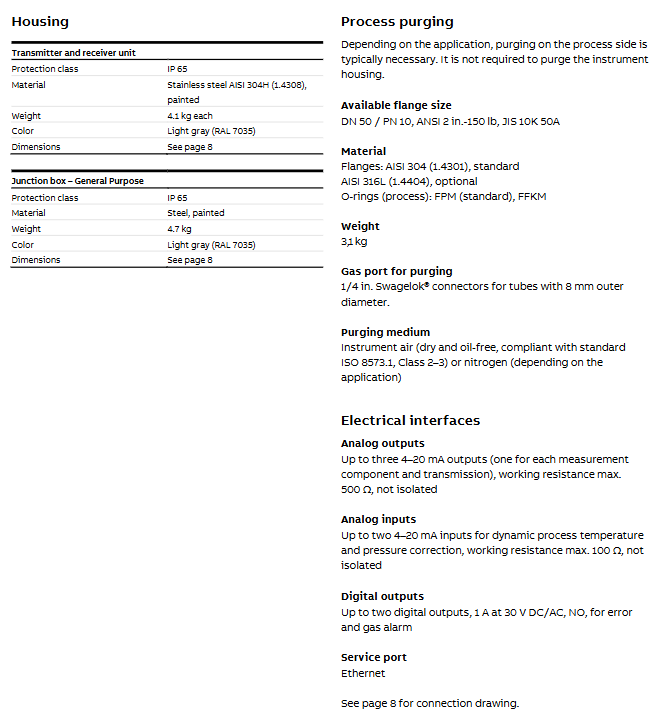
Protection level: IP65; Material: AISI 304H stainless steel spray coating; Single unit weight 4.1 kg; color RAL7035 light gray.
Universal junction box
IP65, Spraying steel; Weight 4.7 kg, RAL7035 light gray.
Process flange standards: DN50-PN10, ANSI 2-150lb, JIS 10K-50A
Standard flange material AISI 304; Optional AISI 316L;
O-ring standard FPM, optional FFKM;
Purging air interface: 1/4 “Swagelok, compatible with pipes with an outer diameter of 8mm;
Blowing medium: dry oil-free instrument air (ISO 8573.1 2-3 levels) or nitrogen.
Installation alignment requirements: The parallelism error of the flanges on both sides should be ≤ 1.5 °; The gas in the measurement area must be thoroughly mixed to avoid measurement errors caused by gas stratification.
Electrical interface and power supply
1. Signal interface
Analog output AO: up to 3 channels of 4-20 mA; corresponding to component 1, component 2, and light transmittance respectively; Maximum load of 500 Ω; Not isolated.
Analog input AI: up to 2 channels of 4-20 mA, connected to external temperature and pressure sensor signals for dynamic temperature and pressure compensation; Maximum load of 100 Ω, non isolated.
Digital output DO: up to 2 relay outputs, 30V AC/DC, 1A, normally open; Used for fault alarm and gas over limit alarm.
Service debugging port: Ethernet.
2. Choose one of the two power supply schemes
Version without built-in power supply: DC 24V power supply, input DC 18-32V; power consumption<10W;
Integrated power version of junction box: AC 100-240V, 50-60Hz; Output internal DC24V; The overall power consumption of the machine is 30 VA.
3. Working environment temperature
Operation: -20~+55 ℃, avoid direct sunlight;
Storage and transportation: -40~+70 ℃.
Optional attachments
Calibration cell: Offline calibration instrument; Material options include 6082-T6 aluminum/AISI 316L stainless steel.
Validation cell: permanently installed between the pipeline and analyzer for online performance validation; Material AISI 316L.
Isolation flanges: used for high-pressure, toxic, and flammable gas conditions, meeting PED 2014/68/EU pressure vessel specifications; Maximum 16 bar absolute pressure and 300 ℃.
Insertion tubes (1 m): In high dust conditions, shorten the effective optical path and reduce dust attenuation; Material AISI 316L.
Certification compliance
CE certification: Low Voltage Directive 2014/35/EU (EN 61010-1); EMC Electromagnetic Compatibility 2014/30/EU (EN 61326-1).
IECEE CB certificate (DE1-52306); UL/CSA safety certification (certificate 70001037), for use in general safety environments.
Applicable Scenarios
LS4000 belongs to the through type in-situ laser analyzer, suitable for high-temperature and dusty process pipelines/chimneys, mainly for measuring ammonia gas (SCR/SNCR denitration ammonia escape) and flue gas water vapor; Compared to extraction based methods, canceling sampling preprocessing results in faster response times; Disadvantages: Measurement is limited by optical path length and dust attenuation; When there is a large fluctuation in temperature and pressure, an external temperature and pressure sensor is required for compensation; Continuous blowing and anti pollution of the process side lenses are required.