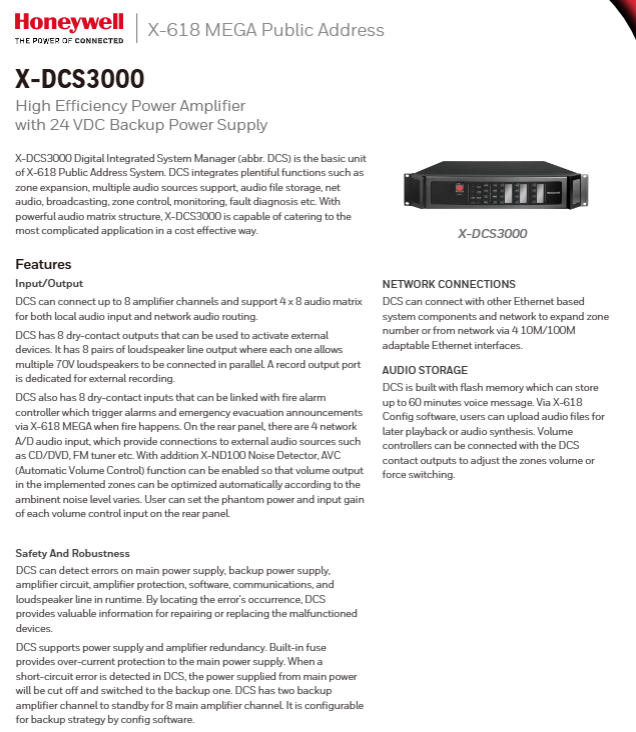
Honeywell X-DCS3000 Digital Integrated System Manager
Product positioning
X-DCS3000 (DCS for short) is the core control unit of X-618 MEGA public broadcasting system, which provides integrated audio management, partition control, fault self checking and redundant backup for complex public broadcasting scenarios.
Core Features and Advantages
Highly integrated audio matrix: 4 × 8 audio matrix, supporting mixed routing of local and network audio sources
High power amplifier output: 8-channel 70V constant voltage speaker output, maximum 250W per channel
Dual redundancy design: 2 backup power amplifiers support 8 main power and heat release backups; AC+24V DC dual power supply fault automatic switching
Intelligent linkage: 8 dry contact inputs are connected to the fire control host, triggering emergency broadcasting; 8-way dry contact output controls external devices
Network expansion: 4-port 10/100M adaptive network port, TCP/IP extended partition
Automatic volume control: paired with X-ND100 noise detector to achieve AVC automatic tuning
Built in storage: Flash stores up to 60 minutes of voice files, supports uploading and playing
High priority broadcasting: supports 255 levels of broadcasting priority, meeting the requirements of fire/emergency/business classification
Comprehensive diagnosis: Real time monitoring of power supply, amplifier, speaker circuit, communication, and software faults
Interface and Resource List
Category Quantity/Specification Description
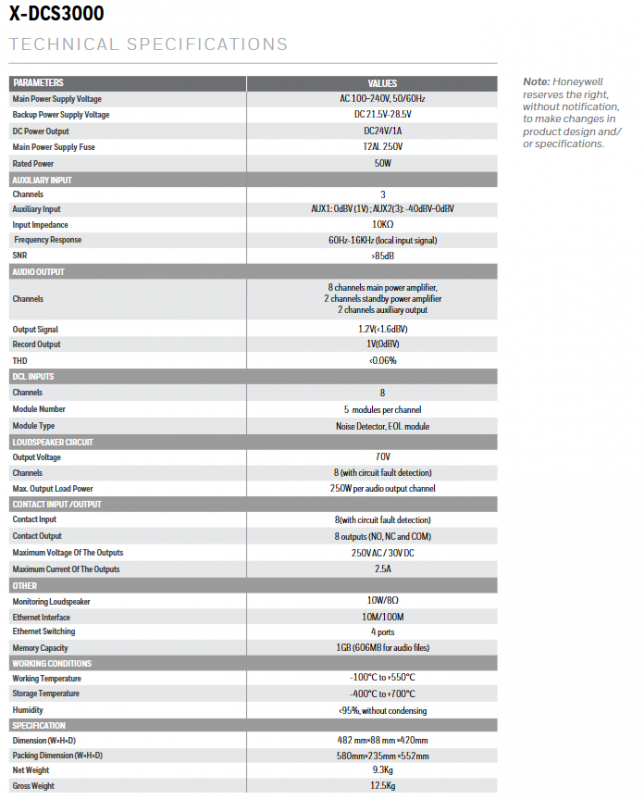
The power amplifier outputs 8 main power amplifiers and 2 backup 70V constant voltage channels, with a maximum output of 250W per channel
Audio matrix 4 inputs x 8 outputs Local+network hybrid routing
Dry contact input with 8 fire alarms/external triggers
Dry contact output with 8 external device controls
AUX input 3 channels AUX 1: 0dBV; AUX2/3:-40~0dBV
Network audio input with 4 remote audio sources
Ethernet port 4-channel 10/100M adaptive
DCL input with 8 channels connected to noise detector/module
1 dedicated external recording interface for recording output
Power supply AC100~240V+DC21.5~28.5V dual power automatic switching
Broadcast function
Multi audio support
Local: CD, DVD, FM tuner
Network: IP network remote paging, network audio
Built in: Store voice messages
Concurrent broadcasting: simultaneously playing 4 audio or network sources
Timed broadcast: Scheduled execution through X-SMART configuration software
Priority management: 255 priority levels, with emergency broadcasting being the highest
Partition control: matrix partitioning, flexible routing
Safety and reliability
Power redundancy: Automatic switching of 24V DC backup power supply in case of main power failure
Amplifier redundancy: Two backup amplifiers can take over the output of any main amplifier
Line monitoring: All 8 speaker lines support fault detection
Self diagnosis: Real time monitoring of power supply, amplifier, software, communication, and circuits
Overcurrent protection: The main power supply has a built-in T2AL 250V fuse
Working environment: -10 ℃~+55 ℃, humidity<95% RH (no condensation)
Physical specifications
Parameter values
Dimensions (W × H × D) 482mm × 88mm × 420mm
Net weight 9.3kg
Gross weight 12.5kg
Rated power 50W
Built in protection, front panel standard rack installation
Certification standards
UL60065, FCC compliant
Key questions and answers
Question 1: What specifically does the dual redundancy design of X-DCS3000 refer to? In what scenarios will they take effect?
Answer: Contains two layers of redundancy:
Power redundancy: After the main AC power is cut off, the 24V DC backup power automatically switches seamlessly to ensure continuous broadcasting.
Amplifier redundancy: Two backup amplifiers can be configured to take over eight main amplifiers. If any one of the main amplifiers fails, it will automatically replace it to prevent partition loss of sound.
Question 2: How does the device achieve fire emergency broadcast linkage? What are the core interfaces and logic?
Answer: Connect to the fire alarm controller through 8 dry contact inputs; When a fire alarm is triggered, the dry contact signal input → DCS automatically switches to the highest priority emergency broadcast → forcibly cuts off normal audio sources → starts evacuation voice → outputs through 8-channel partition amplifiers, and can also be linked to external alarm lights/sirens through dry contact output.
Question 3: How to implement AVC automatic volume control for X-DCS3000? What hardware does it need to be paired with?
Answer: An external X-ND100 noise detector needs to be connected to the DCL input port; The system automatically adjusts the broadcasting volume of the corresponding zone based on the level of environmental noise. If the noise is high, the volume will be automatically increased, and if the noise is low, the volume will be reduced, achieving comfortable broadcasting all day long.