MX321 AVR Automatic Voltage Regulator
Product Overview
MX321 is a three-phase automatic voltage regulator specifically designed for brushless generators and is a core component of the generator excitation system.
Power supply source: Three phase PMG permanent magnet generator, which isolates nonlinear load interference, reduces RF interference, and supports continuous short-circuit current output.
Working principle: Sample the main winding voltage of the generator, adjust the excitation current in a closed-loop manner, maintain stable output voltage, and compensate for fluctuations in load, speed, temperature, and power factor.
Core highlights: Three phase RMS sampling, soft start, low-frequency V/Hz protection, overvoltage/overexcitation dual protection, parallel droop control, remote voltage regulation.
Core technical parameters
Key indicators of parameter categories
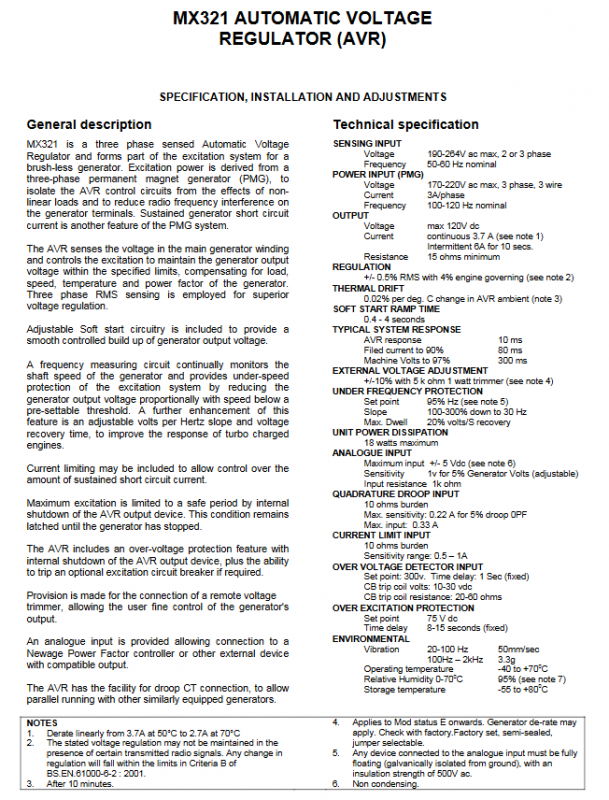
Sampling input 190-264V AC, 2/3 phase; 50/60Hz
PMG power input 170-220V AC, 3-phase 3-wire; 3A/phase; 100~120Hz
The maximum excitation output is 120V DC; Continuous 3.7A; intermittent 6A/10s; Minimum load 15 Ω
Voltage stabilization accuracy ± 0.5% RMS (engine speed regulation 4%)
Soft start time adjustable from 0.4 to 4 seconds
Low frequency protection threshold 95% Hz; slope 100~300%; Maximum drop of 20% V/s
Overvoltage protection 300V, fixed delay of 1 second
Overexcitation protection 75V DC, fixed delay of 8-15 seconds
Environmental temperature working -40~+70 ℃; Storage -55~+80 ℃
Maximum power consumption 18W
Hardware and Control Interface
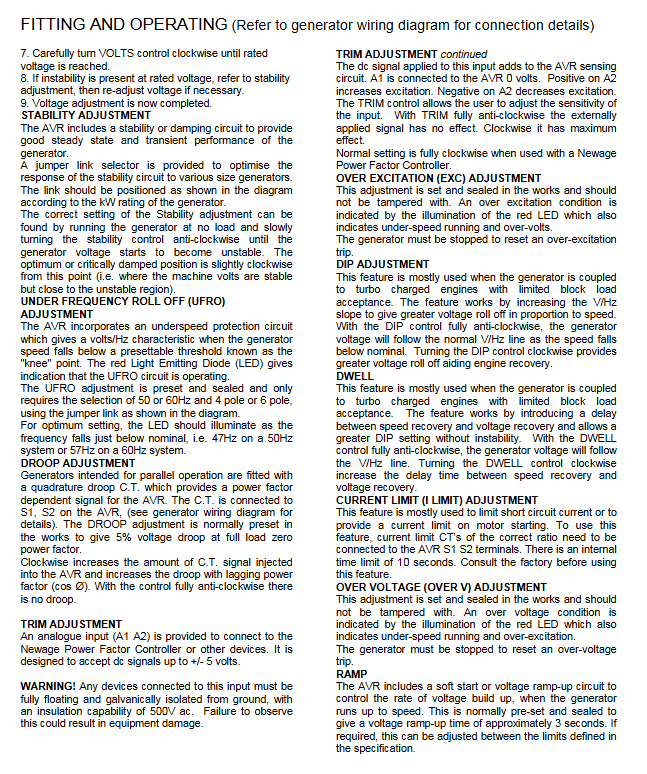
Control knob function
|Knob | Function | Adjust Direction|
|VOLTS | Set generator output voltage | Clockwise → Boost|
|DROOP | Parallel reactive power droop adjustment | Clockwise → droop increase|
|DIP | Low frequency voltage drop slope | Clockwise → Drop deepens|
|DWELL | Voltage Recovery Delay | Clockwise → Delay Extension|
|I Limit | Stator current limit | Clockwise → Increased current limit|
|OVER V | Overvoltage protection threshold | Clockwise → Threshold increase|
|RAMP | Idle Soft Start Time | Clockwise → Time Extension|
Jumper configuration
Frequency selection: 50Hz/60Hz
Pole selection: 4-pole/6-pole
Stability selection: divided into three levels according to power:<90kW, 90~550kW,>550kW
external interface
Remote voltage regulation: 1 and 2 terminals, 5k Ω/1W potentiometer, ± 10% voltage regulation range
Analog input: A1/A2, ± 5V DC, 1V corresponds to 5% voltage variation
Pendant CT: S1/S2, 10 Ω load
Overvoltage trip: external excitation circuit breaker output
Detailed explanation of core functions
The voltage regulation adopts three-phase RMS true RMS sampling, amplifies the error signal after comparing with the reference voltage, controls the excitation power device, and achieves high-precision voltage stabilization of * * ± 0.5% * *.
Soft start (RAMP) is adjustable from 0.4 to 4 seconds, allowing the generator voltage to establish smoothly and avoiding sudden excitation shocks.
When the low frequency protection (UFRO) speed is lower than the set threshold, the voltage linearly decreases with frequency to protect the engine and excitation system;
Slope (DIP): Enhance voltage drop to help boost engine recovery
Recovery Delay (DWELL): Delay boosting after speed recovery to avoid oscillation
LED indicator: Red light on during action
protection function
Overvoltage protection: detects 300V, locks output after 1 second, can drive external tripping
Overexcitation protection: If the excitation exceeds 75V DC, it will be locked for 8-15s and must be stopped and reset
Current limiting protection: limits short-circuit current or starting current, with a maximum action time of 10 seconds
Parallel operation achieves reactive power distribution through droop CT, with 5% voltage droop at 0 power factor full load, supporting multi machine grid connection.
Extended features
Remote voltage adjustment: No need to open the cover on site
Analog input: connected to power factor controller or external control signal
Stability circuit: Negative feedback regulation to ensure steady-state and transient performance
Key points for installation and debugging
Voltage regulation steps
Stop the machine and turn VOLTS counterclockwise to the end, with remote pressure adjustment centered
Run at no-load rated speed and slowly adjust VOLTS clockwise to the rated voltage
Optimize oscillation with stability jumper and knob
Stability settings
Select jumper according to generator power:<90kW/90-550kW/>550kW
Rotate counterclockwise until the voltage becomes unstable, and then slightly adjust clockwise to reach the optimal point
Low frequency protection only requires jumper selection of 50/60Hz, 4/6-pole, factory pre-set threshold
Parallel droop connection droop CT, adjust DROOP to full load 0PF, voltage droop 5%
Key issues
Question 1: What are the core advantages of the PMG power supply method of MX321 compared to traditional AVR?
answer:
Electrical isolation: Isolate the AVR control circuit from the generator main circuit to resist nonlinear load interference and radio frequency interference.
Short circuit capability: Supports continuous short-circuit current output from the generator to meet protection coordination requirements.
Stability: not affected by voltage distortion in the main circuit, higher voltage regulation accuracy and reliability.
Question 2: The low-frequency protection (UFRO) of MX321 includes two adjustment options, DIP and DWELL. What are their respective functions?
answer:
DIP (slope): controls the amplitude of voltage drop with frequency, increasing clockwise can deepen the voltage drop and help the turbocharged engine quickly recover torque.
DWELL (Recovery Delay): Control the delay time for the voltage to rise after the speed is restored. Clockwise adjustment can prevent the voltage from rising too quickly and causing the unit to oscillate.
Question 3: What is the difference between overvoltage and overexcitation protection for MX321? How to reset after triggering?
answer:
Overvoltage protection: Monitor the stator voltage of the generator at 300V, activate with a 1-second delay, lock the AVR output, and drive the external excitation circuit breaker to trip.
Overexcitation protection: Monitor the excitation voltage of 75V DC, delay the action for 8-15s, and lock the excitation output.
Reset method: Both types of protection must be stopped before resetting, and cannot be reset online.