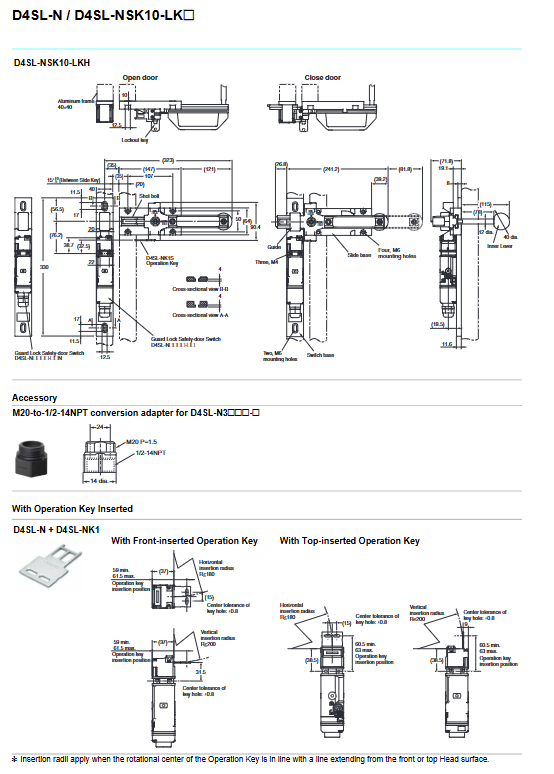
OMRON D4SL-N Safety Door Switch (Including Locking) Specification
Product positioning and scope of application
Main product: D4SL-N safety door locking switch
Accessories: D4SL-NSK10-LK sliding key unit (to prevent personnel from getting trapped)
Purpose: Interlocking of mechanical equipment safety doors, locking of protective doors, and control of access to hazardous areas
Standards: Compliant with Machinery Directive, Low Voltage Directive, EMC Directive
Security certification and level
Certification standards
T Ü V EN 60947-5-1, EN ISO 14119
UL/CSA UL508、CSA C22.2 No.14
CCC GB/T 14048.5
Security level PL e/Category 4 available
Encoding Level Type 2 Low Encoding
Core electrical and mechanical parameters
1. Mechanical properties
Locking retention force: ≥ 1300N
Direct disconnection force: ≥ 60N
Mechanical lifespan: 1000000 cycles
Electrical lifespan: 150000 cycles
Operating speed: 0.05~1m/s
Operating frequency: 4/5 contacts 30 times/minute; 6 contacts 5 times/minute
2. Electrical parameters
Coil voltage: 24VDC (± 10%/-15%)
Power consumption: 6.4W/4.8W upon startup; Maintain 2.6W
Load: AC-15 1.5A/120V; DC‑13 0.22A/125V
Insulation: Ui=150V, impulse withstand voltage 2.5kV
Indicator light: Orange LED 24VDC/10mA
3. Environment and Protection
Protection level: IP67 (UL 4X indoor)
Working temperature: -10~+55 ℃
Humidity: ≤ 95% RH
Pollution level: 3
Model coding rules (core)
Number of contacts: 4/5/6 contacts
Outlet: 2=G1/2, 3=1/2-14NPT, 4=M20
Contact structure: A/B/C/D/S/T/U/V/E/F/G/H/N/P/Q/R
Locking type: A=mechanical lock/electrically unlocked; G=Electromagnetic lock/manual unlock
Indicator light: D=with LED; None=Not included
Unlock key: None=Metal; 4=Resin
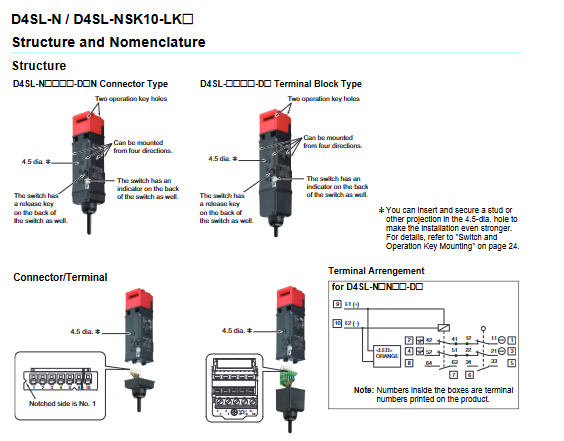
Wiring: Terminal block/connector (N)
Head material: F=resin; D=Metal
Contact configuration (safety core)
Door status detection: using forced direct disconnection of NC contacts to meet safety standards
Lock status detection: monitor whether the lock is truly locked
Common combinations:
1NC/1NO + 1NC/1NO
2NC + 2NC
2NC/1NO + 2NC/1NO
3NC + 3NC
Only the NC channel has mandatory disconnection authentication
Two locking modes of operation
Mechanical lock type (A)
Door closing → Automatic mechanical locking
Unlock: Power on the coil or manually unlock the key
Electromagnetic lock type (G)
Close the door → The coil must be powered on to lock it
Unlock: Power off automatic unlock or manual unlock
Attention: The electromagnetic lock must be closed before being powered on, otherwise the locking tongue cannot be in place
Wiring method
Terminal block type: direct wiring, suitable for on-site wiring
Connector type: quick plug connector, requires additional purchase of cable (D4SL-CN1/3/5/10)
Coil polarity: E1=+, E2=-, cannot be reversed
Accessory system
Operation key D4SL-NK
NK1: Level
NK2: Vertical
NK3: Adjustable Level
NK5: Adjustable horizontally/vertically
Connection line: 1/3/5/10m
Sliding key unit D4SL-NSK10-LK
Lightweight adaptation ≤ 20kg safety door
Built in locking key, the slider cannot move after removal, preventing the door from being trapped when closed
Installation specifications (mandatory requirement)
Screw torque:
Switch installation: 0.75~1.15N · m
Key installation: 2.4~2.8N · m
Cable lock: 1.8~2.2N · m
A stopper must be installed and the switch cannot be used as a limiter
Keyhole center tolerance: ± 0.8mm
Sliding keys are only allowed to be installed horizontally and are prohibited from being installed vertically
Key issues
Question 1: What is the security core of D4SL-N? Why must NC contacts be used for safety circuits?
Answer:
The safety core is to forcibly disconnect the mechanism directly (Positive Opening).
Only NC normally closed contacts have this certification, and even if the contacts are welded, they can be physically forcibly disconnected to ensure the safety circuit is cut off; The NO contact does not have the ability to forcibly disconnect and cannot be used for safe channels.
Question 2: What is the difference in action logic between mechanical lock type (A) and electromagnetic lock type (G)? What scenarios are suitable for each?
Answer:
Mechanical lock (A): Automatic mechanical locking when closing the door, unlocking when powered on; Suitable for devices that must be kept locked during power outages (safety doors, protective barriers).
Electromagnetic lock (G): When closing the door, it is not locked and must be powered on to lock. When powered off, it is unlocked; Suitable for scenarios where power outages require opening the door (emergency evacuation, maintenance access).
Question 3: What is the “anti trap” principle of D4SL-NSK10-LK sliding key? What are the restrictions on use?
Answer:
Principle: After opening the door, remove the locking key, and the slider mechanism will be mechanically locked, making it impossible for others to lock the door from the outside, ensuring the safety of internal personnel.
Limitations:
Only applicable to lightweight doors with a weight of ≤ 20kg
Can only be installed horizontally, not vertically
Special screws must be used to prevent unauthorized disassembly