Softing CAN-AC2-PCI PCI Bus CAN Communication Interface Board
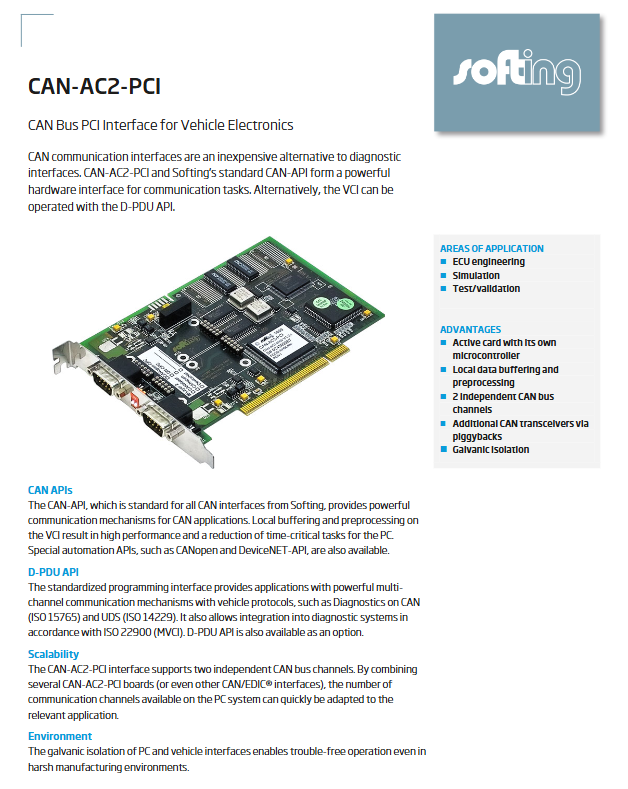
CAN-AC2-PCI is a PCI bus CAN communication interface board developed by Softing for the automotive electronics field. It is used for data exchange between PC and CAN bus, and is compatible with Softing’s standard CAN-API. Alternatively, D-PDU API can be used for ECU engineering development, simulation, testing and verification scenarios.
Main application areas
ECU (Automotive Electronic Control Unit) Engineering Research and Development
CAN bus simulation
Testing and Verification of In Vehicle Electronics
Core advantages
Active board with independent microcontroller: onboard MCU with local data caching and preprocessing capabilities, offloading tasks with high real-time requirements from the PC host and improving overall communication performance.
Two completely independent CAN bus channels; Additional CAN transceivers can be expanded by selecting a piggyback motherboard, and software can be used to switch transceivers.
Electrical isolation: Perform * * galvanic isolation * * between the PC side and the vehicle CAN interface, ensuring stable operation even in harsh factory production environments and avoiding ground loop interference.
Channel Scalability: One PC can insert multiple CAN-AC2-PCI cards and can also be paired with Softing’s other EDIC series CAN interfaces to quickly expand the number of CAN channels.
Two optional upper level software APIs
Softing CAN-API (standard): Softing offers a universal API for all CAN interfaces, providing a complete CAN communication mechanism; It can also support CANopen and DeviceNET dedicated automation APIs.
D-PDU API (optional): Standardized programming interface; Supporting automotive protocols: ISO 15765 (CAN diagnosis), ISO 14229 (UDS unified diagnostic service); Compatible with ISO 22900 (MVCI) diagnostic system integration standard.
Hardware Technical Parameters
Project parameters
Board specification: Short PCI card, size 100 × 160 mm
Power supply is provided by the PC PCI slot at 5V; typical power consumption is 410mA
Onboard MCU Infineon C165 16 bit microcontroller
PC host interface PCI V2.1; 4-KB 16 bit dual port memory DPRAM
Vehicle CAN interface 2-channel D-Sub 9-pin; CAN and PC side electrical isolation; Reserve piggyback motherboard slots for each channel
The CAN protocol follows ISO 11898-2; Supports CAN2.0B, supports 11 bit standard frames and 29 bit extended frame IDs
Working temperature: 0~+55 ℃; Storage temperature -20~+70 ℃
EMC electromagnetic compatibility emission: EN 55022 Class-B; Immunity: EN 61000-6-2 industrial grade; FCC Part15 subpart B Class‑B
Software and System Conditions
Standard software: Softing CAN L2 API; The CD contains CAN-API software and a PDF version of the manual.
System resource requirements: The upper computer requires 4 KB of idle addressing space in the upper memory, occupying 1 available interrupt.
Supported operating systems: Windows 7, Vista, Windows XP.
Supply List
CAN-AC2-PCI PCI-CAN board hardware body
CD: CAN-API software package+PDF manual
Optional/Ordered Products
CAN-AC2-PCI-LS: Low speed CAN piggyback motherboard, equipped with TJA1053 (or compatible) transceiver; Each CAN channel needs to be separately configured with a piggyback motherboard.
PDUAPI-EC: Software upgrade package media that adds D-PDU-API authorization to Softing EDIC/CAN hardware.