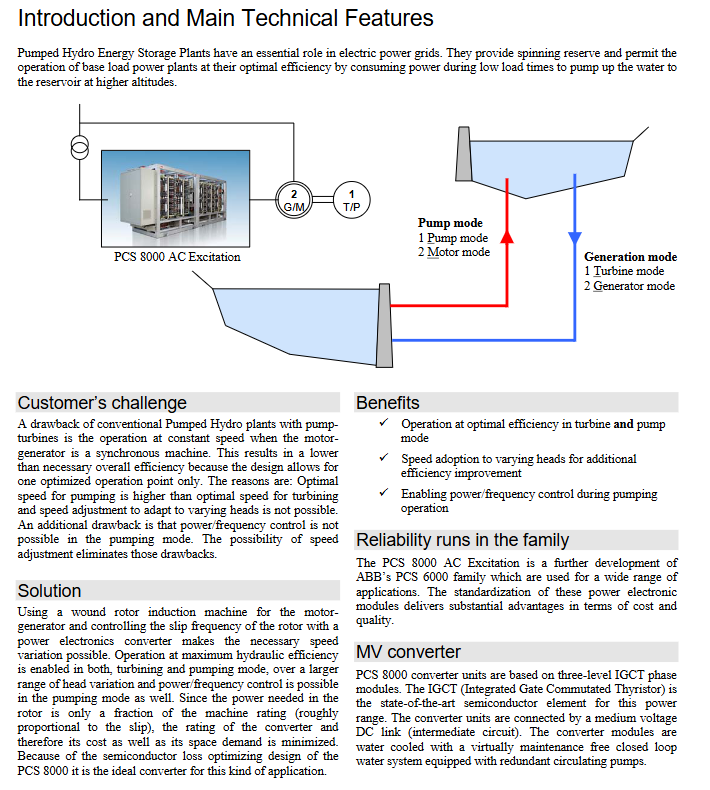
ABB PCS 8000 AC Excitation
Background role of pumped storage power station
Pumped storage power stations play a key supporting role in the power grid:
Provide rotational reserve capacity;
When the electricity consumption is low (load is low), it consumes electricity to pump water to the upper reservoir; During peak electricity consumption, discharge water to generate electricity, ensuring that the base load thermal/nuclear power units operate at their highest efficiency.
The crew has two working modes:
Pump mode/motor operating condition: consumes power and pumps water from the lower reservoir to the upper reservoir;
Generation mode: Drain water and convert it into electrical energy, which is then fed into the power grid.
Existing pain points of traditional synchronous motor pumped storage units
Traditional pumped storage uses synchronous motors as generators – motors that operate at a constant speed and can only be optimized for a single operating point, resulting in significant shortcomings:
The optimal speed of the water pump operating condition is higher than the optimal speed of the water turbine generating condition, and the fixed speed cannot balance the hydraulic efficiency of both, resulting in a lower overall efficiency;
When the water level (head) changes, the rotational speed cannot be adjusted according to the head, and the optimal hydraulic operating point cannot be maintained;
Active power/frequency regulation cannot be achieved in water pump mode.
Technical solution: PCS 8000 AC excitation (doubly fed solution)
Using a wound rotor induction motor (doubly fed motor) as the generator motor, a power electronic converter is used to control the rotor slip frequency, thereby achieving adjustable unit speed.
Both turbine power generation and pump pumping can operate at the optimal hydraulic efficiency point under a wide range of head changes;
The water pump pumping mode also supports active power and grid frequency regulation capabilities;
The rotor side only needs to handle a small portion of the power corresponding to slip, and the rated power, equipment volume, and equipment investment of the inverter can be significantly reduced;
PCS 8000 has been optimized for semiconductor losses and is highly suitable for this type of doubly fed excitation application.
Product technology origin and hardware platform
Technical inheritance: PCS 8000 AC excitation is an upgraded product of PCS 6000 series, which reuses mature power electronic module standardized design and brings cost and quality control advantages.
Power device: Based on three-level IGCT (Integrated Gate commutated Thyristor) power phase module, it belongs to advanced semiconductor devices of this power level.
DC link: using medium voltage DC bus (intermediate circuit).
Cooling method: Water cooling, closed-loop water cooling system; Configure redundant circulation pumps, almost maintenance free.
Key parameters of the product
Project Description
Application scenario: AC excitation (doubly fed excitation) of pumped storage units
Model PCS 8000 AC Excitation
Installation form: Indoor cabinet installation, or containerized complete set
Rated output power customized according to project specifications
Rated frequency 50 Hz/60 Hz
Rated voltage customized according to project specifications
Environmental temperature -25 ℃~+40 ℃
Core benefits of the plan
Both turbine power generation and pump pumping can operate at the optimal hydraulic efficiency, improving the overall energy efficiency of the power station;
The speed can be adaptively adjusted according to the actual water head changes, further improving efficiency;
The pumping condition has the ability to regulate active power/grid frequency, enhancing the flexibility of grid regulation;
Inheriting the mature platform of PCS6000, with high reliability; Standardized power modules are beneficial for cost control and quality assurance.