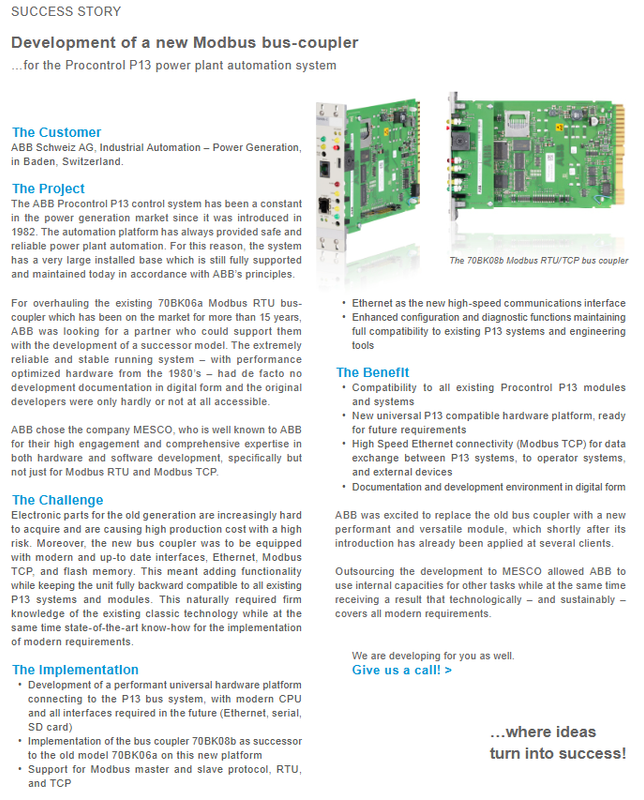
ABB 70BK08b new Modbus bus coupler
When the ‘rock solid’ old system encounters a supply crisis
In the field of industrial automation, what engineers fear the most is not system failure, but the fact that the system is running very well – but the components that produce it have been discontinued.
This type of problem is particularly prominent in distributed control systems (DCS) in the power industry. The lifecycle of a control system can often be as long as 30 years or even longer, while the lifecycle of a single electronic board may only be 10-15 years. When the board is shut down, the original design team is disbanded, and development documents are lost, the control system enters a dangerous state of “prolonging life with disease”: any damage to a board may lead to the risk of irreparable damage to the entire unit.
This article takes the 70BK08b Modbus RTU/TCP bus coupler developed by MESCO Engineering for ABB Schweiz AG (Industrial Automation Power Generation Division) as an example to fully review the entire process of “old platform revival” hardware development. This case has high reference value for power plant owners, system integrators, and automation engineers who are experiencing similar difficulties.
Project background: Procontrol P13 and its “15-year-old veteran”
2.1 Procontrol P13: Evergreen tree for over thirty years
Since its launch in 1982, ABB’s Procontrol P13 control system has been a backbone force in the automation field of the power generation industry. It is known for its safety and reliability, and has accumulated a very large installed base worldwide. According to ABB’s consistent principles, these in-service systems are still fully supported and maintained today – this is also ABB’s commitment as a large automation manufacturer.
However, the longevity of the system also brings a typical “long tail problem”: the early hardware modules designed based on the performance optimization concept of the 1980s are gradually reaching the end of their lifecycle.
2.2 70BK06a: A “living fossil” type bus coupler
70BK06a is a bus coupler responsible for Modbus RTU communication in the Procontrol P13 system, which has been in service in the market for over 15 years. Its problem lies in:
No digital documents: This system is extremely reliable and runs stably for a long time, but in fact, there are no digital development documents retained;
Original developer lost contact: The developers at that time were either retired or difficult to contact, and their core technical knowledge was almost “outdated”;
Component supply interruption: The older generation of electronic components are becoming increasingly difficult to purchase in the market, leading to high production costs and a sharp increase in supply risks;
Technical gap: Old hardware can no longer support the needs of modern communication interfaces and storage media.
For such an irreplaceable and essential board, ABB needs a research and development partner who understands both classic technology and modern design methods.
2.3 Why MESCO?
ABB ultimately chose MESCO Engineering – an engineering company with deep expertise in both hardware and software development, particularly in the implementation of Modbus RTU and Modbus TCP protocols, which is well-known and trusted by ABB.
This choice implies an important lesson: partners who replace discontinued modules must possess both “archaeological capabilities” and “modern design capabilities”. A company that only knows how to make new boards cannot do compatibility, and an old team that only knows how to reverse engineer cannot keep up with modern interface standards.
Technical challenge: walking a tightrope between “backward compatibility” and “forward evolution”
The biggest difficulty of this project is not to make a new board, but to strike a balance between the following interdependent goals:
3.1 Challenge 1: Function addition, compatibility with redline
The new bus coupler must be equipped with modern interfaces – Ethernet, Modbus TCP, Flash Memory – while maintaining 100% backward compatibility with all existing P13 systems and modules.
This means:
The new board must be plugged into any in-service P13 cabinet and must be “plug and play” like the old 70BK06a;
The existing configuration tools and engineering software cannot make any changes to its recognition and configuration;
The bus timing, electrical characteristics, and communication protocol behavior must be aligned with the old product item by item.
3.2 Challenge 2: Rebuilding Knowledge on an Old System Without Documents
As mentioned earlier, there is no digital development document for 70BK06a, which is difficult for the original developers to access. The team must establish a complete understanding of bus interfaces, protocol timing, and boundary conditions through in-depth analysis of existing hardware, and then solidify these “archaeological achievements” into new design specifications.
3.3 Challenge Three: Supply Chain Replacement of Discontinued Components
The shutdown trend of older generation components means that new designs must be built on the basis of using all in production, multi-source supply components, while considering the supply cycle of the next 15-20 years to avoid the dilemma of “just replacing and then shutting down”.
Implementation Plan: Three Step Engineering Path
The implementation plan of MESCO can be summarized into three levels: “platform first, product landing, and comprehensive protocol”:
Step 4.1: Build a high-performance universal hardware platform
The R&D team first created a general-purpose high-performance hardware platform that connects to the P13 bus system, with core features including:
Modern CPU: Performance far exceeds the original platform optimized and designed in the 1980s, reserving sufficient computing power for future functional expansion;
Full interface layout: reserved for all future oriented communication interfaces – Ethernet, serial interface, SD card slot;
Platformization approach: It’s not about simply replicating a board, but rather establishing a carrier that can support multiple generations of products and sustainably evolve.
This decision is highly forward-looking: it makes 70BK08b not just a “replacement” for 70BK06a, but a starting point for the future expansion of the P13 ecosystem.
4.2 Step 2: Implement 70BK08b on the new platform
On the general platform, the team has completed the specific implementation of 70BK08b as the official successor model of 70BK06a. The core upgrades it brings include:
Ethernet as a new high-speed communication interface;
Enhanced configuration and diagnostic capabilities while maintaining full compatibility with existing P13 systems and engineering tools;
By adopting flash storage, we bid farewell to the reliance of old products on volatile/special storage devices.
4.3 Step 3: Full coverage of Modbus protocol stack
In terms of communication capability, 70BK08b supports:
Protocol Role Description
Modbus RTU master/slave maintains compatibility with existing serial link devices and upper level systems
Modbus TCP master/slave achieves high-speed data exchange through Ethernet
This enables it to serve as a data exchange hub between P13 systems, between P13 and operator systems, and between P13 and external third-party devices – a capability that the old 70BK06a was completely unable to achieve.
Compatibility verification: why ‘full compatibility’ is the most difficult and valuable part
In the DCS upgrade and renovation project, behind the word “compatibility” is a complete verification system. According to the common practice of replacing such bus couplers, 70BK08b needs to pass at least the following verifications:
Hardware level compatibility: mechanical dimensions, connector definitions, bus electrical characteristics, power supply requirements are completely consistent with in situ;
Protocol level compatibility: The timing and response behavior of messages on the bus are indistinguishable from old products;
Engineering tool compatibility: Existing P13 configuration and diagnostic tools can configure new modules without upgrading;
Functional level compatibility: All original Modbus RTU function codes, mapping relationships, and diagnostic register behaviors are consistent;
Long term operation verification: Conduct stability assessment under various in-service site conditions.
Because of these studies, 70BK08b has been practically applied by multiple customers shortly after its launch – which is the most convincing market feedback for the reliability oriented power industry.
Inspiration for Engineers: A General Methodology for Replacing Discontinued Modules
From the case of 70BK06a → 70BK08b, a universal method for replacing various discontinued controllers such as Woodward modules and Honeywell system boards can be extracted:
Take early action: Do not wait until the last spare part is used up to initiate a replacement project; The announcement of component shutdown is the start signal.
Platformization rather than individualization: New designs should build an evolving universal platform that benefits multiple generations with a single investment.
Compatibility is product strength: In the context of a large existing system, the value of backward compatibility is higher than any new feature.
Digitalization of documents is a hard work: development documents and engineering environments must be archived in digital form to prevent the next generation of “knowledge obsolescence”.
Full protocol coverage: Dual stack support for both old and new protocols (RTU and TCP) is a key design that connects existing and incremental protocols.