Phoenix Contact Inline I/O System Products
System Overview (Inline Functions)
Inline is a flexible modular I/O system inside the control cabinet:
Modular architecture: composed of bus couplers (gateways) and various I/O functional terminal modules, with a typical module width of 12.5mm, saving control cabinet space; When the module is plugged in, the local bus and power supply are automatically interconnected without the need for additional wiring.
Signal type coverage: digital input/output, analog input/output, temperature acquisition (RTD, thermocouple), counter, encoder position acquisition, energy measurement, multiple communication interfaces.
Special function integration: Supports SafetyBridge safety I/O, Ex-i local security explosion I/O; Can be paired with Inline series PLC controllers to achieve centralized/distributed automation.
Two hardware forms
Standard Inline: Distributed modularization, flexible combination;
Inline Block IO: Integrating couplers with I/O, reducing costs in scenarios with fewer I/O points.
Core hardware features of the product (Inline features)
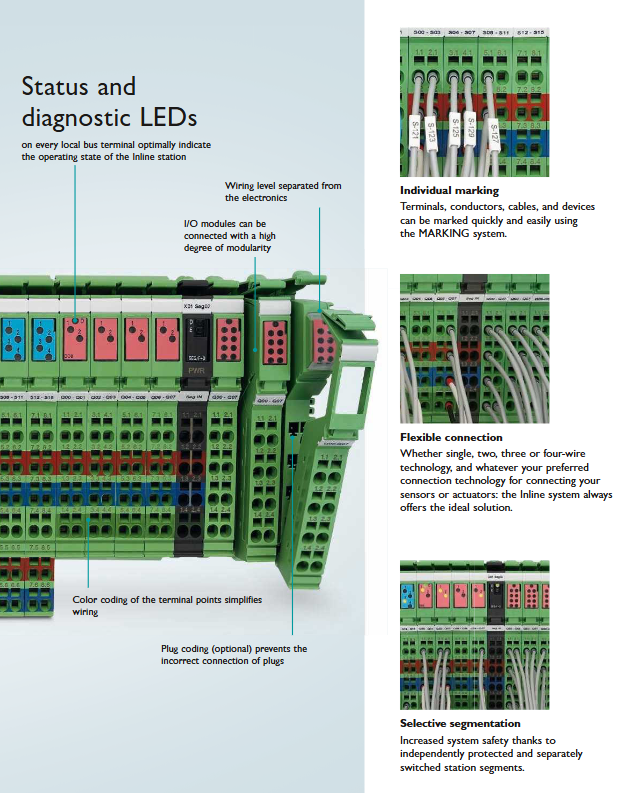
COMBICON cage spring wiring technology, with layered wiring terminals and electronic circuits; Replacing the module does not require changing the external wiring, and maintenance is fast.
Color coded terminals: Different colors are used for different signal types, making wiring identification simple; The terminal numbers are clear.
Each module comes with a status diagnostic LED, which facilitates troubleshooting of network, local bus, and channel faults.
Integrated shielding grounding structure, directly implementing shielding connection at the terminals to reduce wiring inside the cabinet.
Optional plug-in code to prevent module misconnection; Support the complete MARKING identification system, allowing for quick marking of terminals, cables, and equipment.
Segmented power supply function: The station can be isolated and protected in sections, and local faults do not affect the entire I/O station, improving system reliability.
Inline bus openness
Inline relies on different bus couplers to adapt to mainstream industrial networks, and the same I/O module hardware can switch buses by replacing couplers.
Ethernet bus: PROFINET, EtherNet/IP, Modbus TCP, Sercos.
Traditional fieldbus: PROFIBUS-DP, DeviceNet, INTERBUS, CANopen, Modbus RTU.
Controller selection
Class100 compact controller: suitable for simple distributed tasks, expandable for all Inline I/O; Programming software: PC WORX EXPRESS (free).
Class300 high-performance controller: designed for complex automation, with PROFINET interface and dual Ethernet switch ports.
Software development platform: PC WORX, compliant with IEC61131 standard; The communication master station terminal can directly integrate subsystems within the I/O station without the need for additional bus couplers.
Local bus field extensions
The Inline local bus is not limited to the interior of the control cabinet and supports multiple remote expansion solutions:
Fieldline Modular: Connect IP65/IP67 protection level field modules through branch terminals; The maximum length of a single branch is 40 meters, with a maximum of 16 on-site devices, and no additional gateway is required.
Inline on-site multiplexer MUX: 2-core copper wire can transmit up to 12 km; fiber optic can transmit up to 45 km; supports mixed transmission of analog and digital signals without software configuration, point-to-point transparent transmission.
Bluetooth wireless IO: Industrial Bluetooth enables I/O wireless point-to-point communication, suitable for mobile devices.
Multiple row expansion inside the cabinet: Local bus expansion terminals, with a maximum cross row length of 20 meters within the same I/O station cabinet.
SafetyBridge Function Safety I/O (Inline Safety)
Core features: The safety logic runs inside the I/O module, does not require an independent safety PLC, does not rely on the upper layer bus, and can be used with any bus coupler.
Safety performance level: meets PL e (EN ISO13849-1) and SIL3 (IEC61508/EN62061).
Hardware composition
LPSDO security logic main module: handles all security logic and can connect up to 16 external security I/O slave modules;
PSDI security input module: secure dual channel input;
PSDO safety output module: safety dual channel output, safety relay output module;
Configure software SAFECONF: Complete the security logic configuration on the PC and download the configuration to the security logic module; Ordinary standard PLC is only responsible for ordinary data exchange, and safety logic is completely executed on the I/O side.
Adapt to all mainstream Ethernet/fieldbus without the need to build an independent secure bus, reducing project costs.
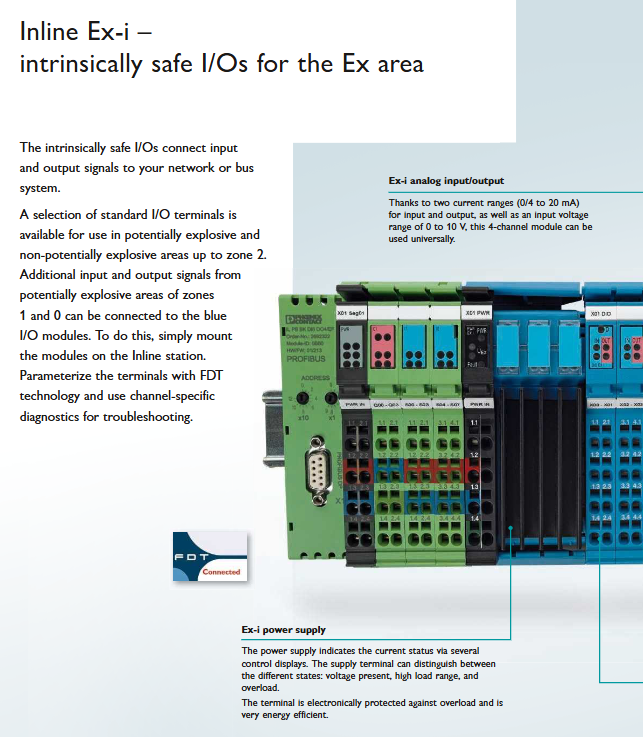
Ex – i local security explosion I/O (Inline Ex – i)
Used for signal acquisition in explosive hazardous areas of 0/1/2 zones:
Blue intrinsic safety series module, supporting NAMUR sensors and intrinsic safety solenoid valves; Supports 4-20 mA, 0-10V analog signals; Thermal resistance and thermocouple temperature signals.
The Ex-i power supply terminal is equipped with overload electronic protection, and the status LED indicates voltage, load, and overload.
Support FDT/DTM technology for parameter configuration and single channel fault diagnosis.
Install intrinsic safety I/O inside the control cabinet and directly connect it to the on-site sensor actuator in the explosion-proof area.
Engineering Planning and Configuration Software (Inline Configuration)
Project+: Free I/O station planning software that automatically verifies module compatibility to avoid selection errors; Generate device description files and interface with mainstream PLCs.
CLIP PROJECT: Cabinet planning and terminal identification printing software; You can import Project+projects to complete DIN rail layout and cable identification.
Support integration with third-party CAE automation tools such as Siemens TIA Portal (STEP7); FDT/DTM implements module parameter configuration without binding controller brand.
Application Cases and Certification (Inline examples of use)
Typical industries: automobile manufacturing, machine tools, packaging, logistics and transportation, water treatment.
The automotive industry extensively uses SafetyBridge safety I/O to meet device safety requirements;
ME (Machine Edition) version: aimed at batch machine devices, high cost-effectiveness;
XC (Extreme Conditions) wide temperature version: used in extreme temperature environments ranging from -40 ℃ to+60 ℃. The product has multiple industry certifications such as T Ü V, PTB, DNV classification.