Bosch Rexroth CD/CG/CS Metallurgical/Pull Rod Hydraulic Cylinder Operating Instructions
Core points of the safety chapter
1) Compliance/Prohibited Use
Allow: Integration into machine equipment within the specified pressure, medium, and environmental conditions of the sample.
Prohibition: Overpressure operation, use of hydraulic oil outside specifications; Hydraulic cylinders cannot serve as guiding components for machines.
2) Key security risks
Danger of hydraulic oil under pressure: The pressure must be completely relieved before maintenance; Do not use a cloth to block high-pressure leaks and fuel injection; Leakage of oil poses a risk of fire and spray injury; The ground wire is strictly prohibited from passing through the cylinder block during welding.
High temperature surface: The working shell can exceed 60 ℃ and must be cooled before touching; Post high temperature warning signs on the equipment side.
Risk of falling during lifting: It is strictly prohibited to stand under the lifted object; There is a risk of accidental piston rod extension during cylinder lifting.
Personnel protection: Wear protective gloves, goggles, safety shoes, helmets, and earmuffs during work.
Responsibility for overall risk: The hydraulic cylinder is only a component, and the overall risk assessment is the responsibility of the machine equipment manufacturer.
IT Security: The product is designed to physically isolate local industrial networks and does not meet the IEC62443-4-2 network security standard.
3) Property protection precautions
The surface of the piston rod, installation surface, and measuring components must not be struck or impacted; Do not use oil cylinders as pedals or handles.
The entire assembly process is strictly cleaned, and the entry of welding slag and metal debris can cause rapid wear of seals and components.
Prohibit mixing different models/brands of hydraulic oil; Cleaning cannot use high-pressure water guns or compressed air to blow the sealing surface or spherical bearings.
Leakage of hydraulic oil must be collected to avoid soil and groundwater pollution.
Scope of Supply and Product Identification
Supply content: Hydraulic cylinder body+ordered accessories; The oil outlet is equipped with a plastic plug/flange protective cover at the factory, which is only used for dust prevention during transportation and is not a working seal; Attached delivery note, special orders come with supporting technical documents.
Structural differentiation
Metallurgical cylinder Mill type: CDH/CGH/CSH series, cylinder head and cylinder bottom flange bolt fastening, without tie rod; Can integrate an external position measurement system.
Tie rod cylinder: CDT/CGT/CST series, with four long tie rods to tighten the end caps of the cylinder barrel at both ends.
Nameplate recognition: The nameplate includes the manufacturer’s material number, serial number, model, maximum pressure, weight, CE/UKCA identification, QR code; there are multiple nameplate size specifications.
Factory condition: Only test oil film remains in the cylinder, standard factory does not fill with oil.
Transportation and Storage
1) Transportation requirements
Prioritize horizontal placement for transportation, use wooden blocks to support the cylinder, and do not support accessories (probes, joints).
Lifting methods: forklift, eyebolt, lifting sling; Lift at least two points; Straps are prohibited from being pressed onto pipelines or sensor attachments.
Weight estimation: The actual weight may be 10% higher than the nameplate, so extra allowance should be left when selecting lifting equipment.
The oil outlet protection plug must be retained during transportation.
2) Storage conditions
Project parameters
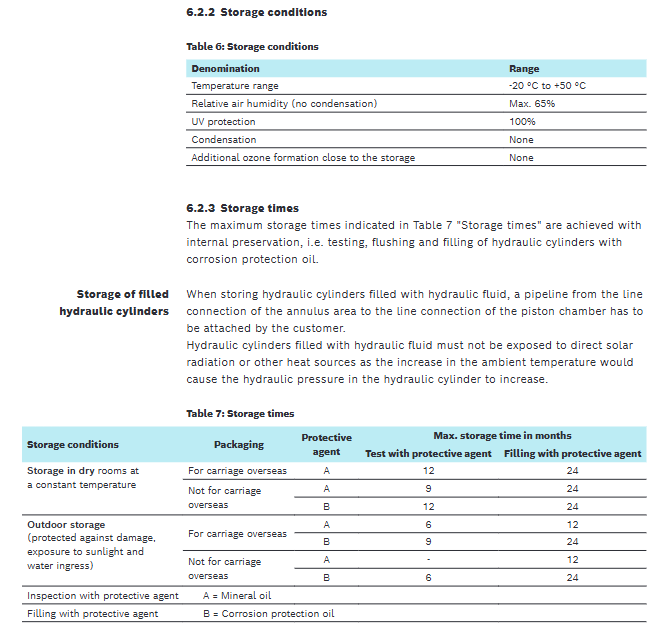
Temperature -20 ℃~+50 ℃
Humidity ≤ 65% RH, condensation is strictly prohibited
Avoid light and ozone in the environment
Internal protection: testing for residual mineral oil (Class A); Fill with rust proof protective oil (Class B).
Storage duration: Indoor dry environment, mineral oil protection for up to 9-12 months; Rust proof protective oil for up to 24 months; Outdoor protected storage is halved.
Storage>6 months Precautions:
Visually inspect rust and oil degradation annually;
Extend and retract the piston rod by a few centimeters each year to prevent seal adhesion;
Suggest rotating the cylinder body 90 ° around the axis every 6 weeks (excluding vertical storage);
Long term storage and sealing may cause deformation. It is recommended to replace the sealing kit directly if stored beyond the expiration date;
Overseas shipping packaging must include desiccants.
Mechanical assembly and installation
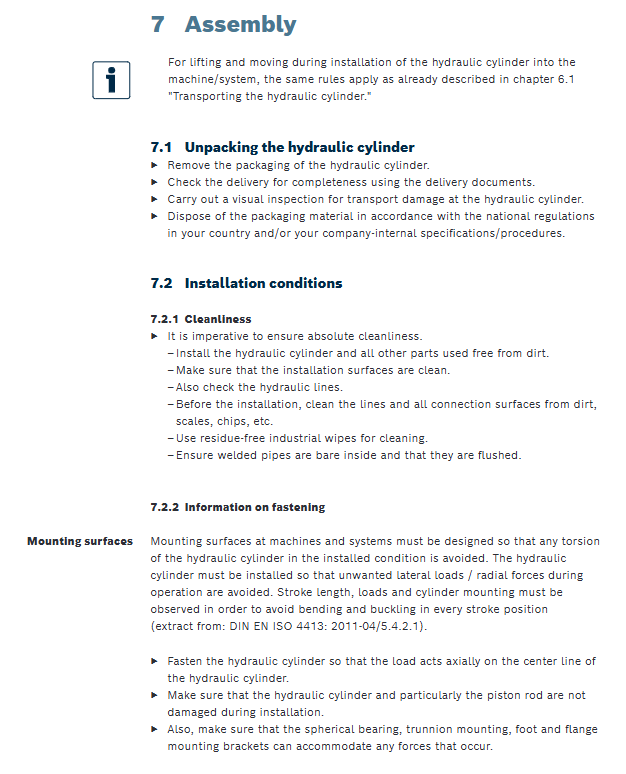
Unboxing: Check the checklist and visually inspect for any damages caused by transportation bumps; Properly dispose of packaging waste.
Installation core principle: Only axial force is allowed, and lateral and bending radial loads are strictly prohibited; The installation base should have sufficient rigidity to avoid twisting of the cylinder block.
Installation of footrest (MS2): It is necessary to add stop bars to reduce screw shear force; The installation of the pull rod cylinder foot seat can be done by removing the buffer throttle valve in advance, resetting it after installation, and strictly following the tightening torque.
Spherical bearings: Control the swing and tilt angle to avoid generating additional lateral forces.
Pipeline joint: It is recommended to use a soft sealed threaded joint; Prohibit the use of hemp thread and raw material tape, as debris can contaminate the system; Distinguish between chamber A (piston chamber) and chamber B (annular chamber).
Electrical accessories: Connect proximity switches and displacement sensors according to the electrical drawings.
Torque example: The throttle valve and measuring coupling joint strictly follow the manual torque (piston diameter 25-63mm/80-200mm divided into two levels).
First debugging and operation
System flushing: During the flushing phase of the entire machine pipeline, it is necessary to disconnect and isolate the hydraulic cylinder, as dirty particles can permanently damage the cylinder.
Pre commissioning inspection: All joints are securely fastened and there is no mechanical interference.
Oil cleanliness: must meet ISO4406-C 20/18/15.
Oil filled exhaust
The oil cylinder horizontally retracts to its initial state; Pressure control ≤ 5 bar, reciprocating exhaust under low pressure;
There are four types of exhaust structures: safety relief plug, internal hexagonal exhaust screw, one-way valve exhaust, and measurement coupling joint exhaust;
Exhaust is considered complete only when the oil flows out completely without any bubbles; Collect the discharged hydraulic oil.
End buffer adjustment
The factory buffer throttle bolt is fully screwed in (with the strongest buffer); Do not completely unscrew the throttle bolt from the valve body;
Unscrew the bolt → Weaken the buffer and increase the impact velocity at the end; After adjustment, tighten the anti loosening nut.
Proximity switch: withstand voltage of 500bar, non-contact induction type, factory adjusted, no on-site adjustment allowed, adjustment will result in loss of warranty.
Restart after long-term shutdown: Repeat the initial commissioning process completely.
Maintenance and Repair
70% of hydraulic system failures are caused by hydraulic oil contamination, and maintenance focuses on the condition of the oil.
Daily inspection items
Are there any external leaks at the joints, cylinder heads, and cylinder bottoms;
Whether there are scratches or indentations on the surface of the piston rod;
Coating damage; Abnormal working temperature.
Piston rod maintenance
Stop the machine and try to retract the piston rod into the cylinder as much as possible;
Regularly apply protective oil film on the piston rod under high humidity/outdoor working conditions;
Chemicals splashing onto the piston rod must be cleaned and maintained immediately; Do not use high-pressure water guns or steam to clean the piston rod.
Spherical bearings: Add corrosion-resistant and pressure resistant lubricating grease periodically.
Vulnerable parts: seals, guide belts, not covered by warranty; Leakage is a signal that seals need to be replaced.
Important warning: Disassembling the hydraulic cylinder barrel by oneself will directly lose the original factory warranty; The sealing kit is ordered from the Rexroth store according to the material number; Prioritize contacting Rexroth service for repairs.
Spare parts ordering: Provide nameplate material number and serial number.
Discontinue, dismantle, and scrap
Stop the pressure relief process: completely release the pressure, release the accumulator pressure, and unload the external load; Cut off power, lock to prevent accidental start; Prepare an oil collection container to collect all the oil.
After removing the oil cylinder, immediately reinstall the oil port protection plug to prevent impurities from entering; If you need to store again, follow the previous storage protection process.
Scrap disposal: Hydraulic oil is treated as hazardous waste; Electronic components such as displacement sensors comply with local electronic waste regulations.
Unauthorized modification of the oil cylinder is prohibited, as any modification will void all promises made by the original factory.
Troubleshooting Summary Table
Possible causes and solutions for fault phenomena
Residual air in crawling/sticking cylinder; Sealing wear; Re exhaust with radial lateral force; Replace the seal; Correct installation to eliminate lateral loads
The leakage seal outside the piston rod is worn; Replace the seal if the radial force exceeds the standard; Improve installation and eliminate lateral loads
Leakage of pipe joints and insufficient torque of joints; Tighten the seal according to the specified torque if it is damaged; Replace the seal
End buffering/impact hard stop buffering throttle valve setting error, readjust end buffering throttle
Disassembling the oil cylinder will result in loss of warranty; After repairing the fault, it is necessary to simultaneously investigate and eliminate the root cause of the fault (such as flushing the system and changing the oil due to oil contamination).