Fireye InSight ® II Marine Flame Scanner
Product basic information
Product model: InSight ® II Marine Flame Scanner (95DSS3-1CEXSS)
Document Number: MF-00-2-6000-0-023-B (2024/08)
Product type: Integrated UV+IR dual probe flame detector
Applicable scenarios: ship power/boilers, extreme industrial environments
Core advantages: Integrated detection, amplification, safety judgment, flame switch, no need for external amplifier
Mechanical and environmental parameters
Specific indicators for parameter categories
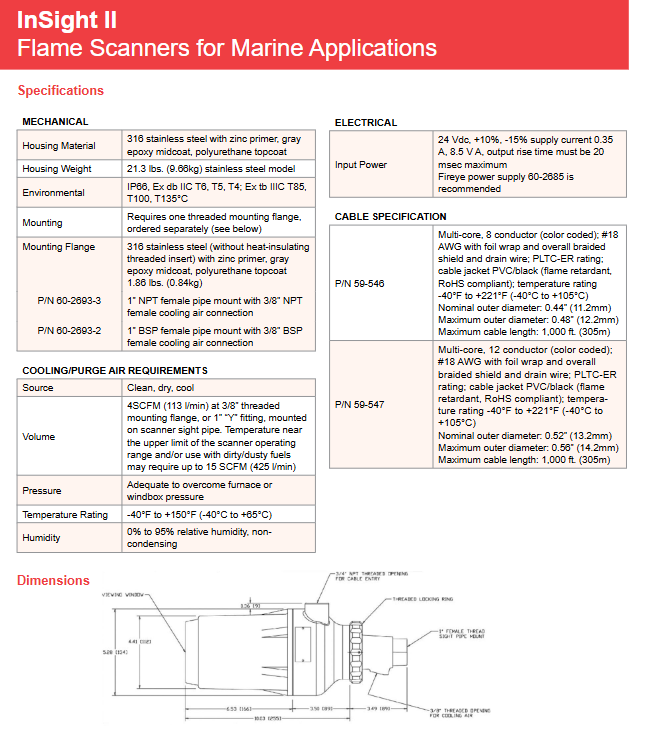
Shell material 316 stainless steel (zinc primer+epoxy intermediate coating+polyurethane topcoat)
Equipment weight 21.3 lbs (9.66kg)
Protection level IP66
Explosion proof certification Ex d IIC T6/T5/T4; Ex tb IIIC T85/T100/T135℃
Working temperature -40 ° F~+150 ° F (-40 ° C~+65 ° C)
Humidity 0~95% RH (non condensing)
Installation method: Threaded installation flange (ordered separately)
Flange material 316 stainless steel, weight 1.86 lbs (0.84kg)
Cooling/blowing air requirements
Air source: clean, dry, cold air
Standard air volume: 4 SCFM (113 l/min)
High load/dust conditions: maximum 15 SCFM (425 l/min)
Pressure: Overcome the furnace/bellows pressure
Electrical parameters
Project specifications
Supply voltage 24 Vdc (+10%/-15%)
Working current 0.35 A
Recommended power supply Fireye 60-2685
Output rise time ≤ 20 milliseconds
Standard functions and interfaces
Dual sensor detection
**UV+IR * * dual probes, strong anti-interference
relay output
2-channel independent adjustable flame relay (optional UV/IR/dual trigger)
1-channel fault relay
Analog output
2-channel 4-20mA (corresponding to FR1/FR2 flame intensity respectively)
Regulation and Storage
Sensor gain adjustable
Adjustable relay action threshold
21 modulation frequencies to choose from
4 sets of programmable configuration files (adapted to different fuels/loads)
Operation and Communication
Standard alphanumeric VFD display screen+keyboard
Support Auto config automatic configuration (can be manually forced)
Optional Fireye Explorer software for remote communication on PC
Cable specifications
Model, specification, length
59-546 8-core, 18AWG, dual shielded, PLTC-ER maximum 1000ft (305m)
59-547 12 core, 18AWG, dual shielded, PLTC-ER maximum 1000ft (305m)
Install accessories
Installation flange: 60-2693 series (1 “NPT or 1” BSP, with cooling air interface)
All flanges and shells are made of 316 stainless steel, meeting the anti-corrosion requirements for marine use
Key questions and answers
Question: What are the core advantages of InSight II marine flame scanner compared to ordinary single probe detectors?
Answer: Adopting UV+IR dual sensors for detection, flame recognition is more accurate and anti-interference is stronger; Integrated design without the need for external amplifiers; 316 stainless steel+IP66+Ex d IIC T6 meets the requirements of ship explosion-proof and anti-corrosion extreme environments; Standard configuration includes dual 4-20mA+dual relays+4 sets, suitable for complex working conditions with multiple fuels.
Question: What are the requirements for the cooling air system of this device, and why is the air volume divided into two levels?
Answer: Clean and dry cold air must be used, with a standard air volume of 4 SCFM. For high temperature/dust fuel conditions, it needs to be increased to 15 SCFM; The air volume classification is designed to effectively cool the probe in harsh environments, prevent dust adhesion, and ensure detection accuracy and equipment lifespan.
Question: What is the practical value of the four sets of programmable configuration files and automatic configuration functions of the device in marine applications?
Answer: Four sets of configuration files can quickly switch and adapt to different fuels, loads, and working conditions without the need for repeated debugging; Auto config automatic configuration can quickly power on and match on-site working conditions, reducing debugging time; When abnormalities occur, manual forced coverage can be used to ensure the continuous and stable operation of the ship’s combustion system.