PEPPERL+FUCHS SLVA-4Kplus Safety Light Curtain Controller
Product positioning and safety level
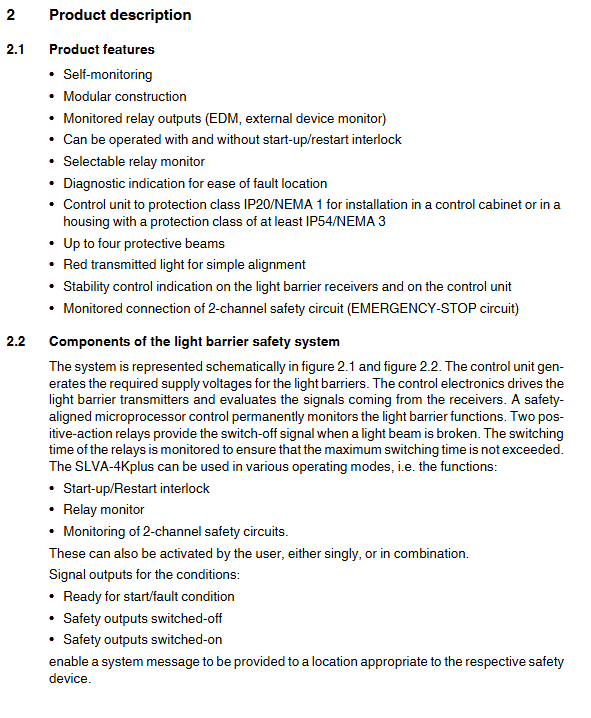
Product: Beijiafu SLVA-4Kplus Safety Light Curtain Controller
Purpose: Drive 1-4 SLA safety light curtains/SLP safety gratings to achieve hazardous area protection
Security certification:
Type 4(EN 61496-1)
Cat.4 / PL e(ISO 13849-1)
SIL 3(IEC 61508)
Protection: Controller IP20, cabinet installation requires ≥ IP54 shell
Core specification parameters
Project parameters
Number of channels: 4 light curtains/gratings
Response time 40ms
Power supply 24V DC/115V AC/230V AC
Safe output OSSD 19-22, 2A, relay passive
Relay monitoring 24V DC, 10mA, 200ms response
Emergency stop type static/pulse (dual channel)
Light curtain cable with a maximum length of 50m
Working temperature 0-50 ℃
Weight 900g
Terminal Definition (Core)
Terminal function
1-2 testing/fault reset (normally closed)
3-4 Start/Restart Enable
5-6 OSSD status indicator light
7-14 Light Curtain Receiver Signal
15-16 Start ready indicator light
17-18 power input
19-22 OSSD safety relay output
23-24 External Relay Monitoring (EDM)
25-32 light curtain transmitter power supply
Working mode (DIP switch configuration)
Set functions through 4 sets of DIP switches:
Switch 1: ON=Enable start/restart interlock
Switch 2: ON=Enable Relay Monitoring (EDM)
Switch 3: ON=Channel 3/4 for emergency stop
Switch 4: ON=pulse emergency stop; OFF=Static Emergency Stop
Key functions
Start/restart interlock (AWS)
Restoration after shading, manual reset is required to restart
Reset signal valid: 0.05-1s
Relay Monitoring (RM/EDM)
Monitor the normally closed point of the external contactor
If there is no feedback within 200ms, fault F will be reported
Dual channel emergency stop
Static: 24V DC, requires independent cable
Pulse: Internal self check, no need for protective wiring
Test function
Trigger TEST to perform a full system self-test and force the safety output to disconnect
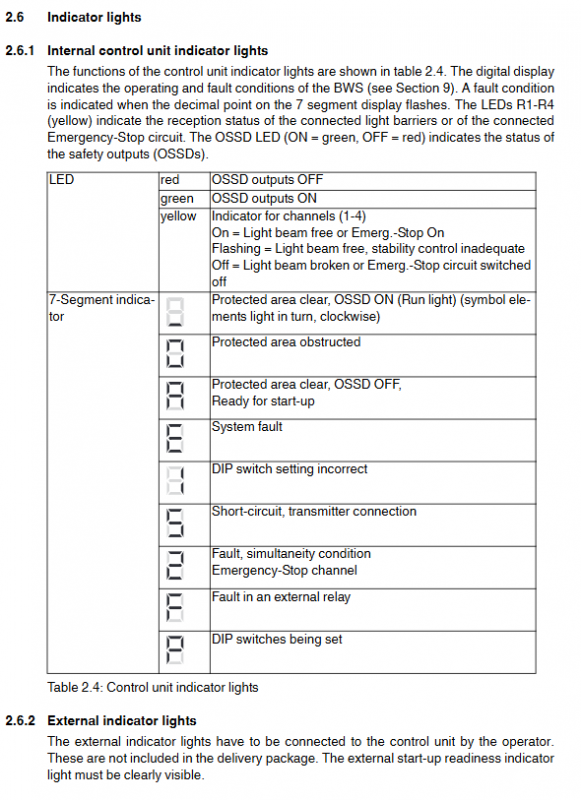
status indicator
7-segment digital display: running/fault codes
LED: Channel Status, OSSD Status
Installation and wiring
Installation: DIN rail 35mm installation
Light curtain wiring:
Transmitter: 25-32 corresponds to channels 1-4
Receiver: 7-14 corresponds to channels 1-4
Idle channels need to be bridged
Safe distance: calculated according to ISO 13855: S=K × T+C
Beam height: 2 beams → 400/900mm; 3 beams → 300/700/1100mm; 4 beams → 300/600/900/1200mm
Debugging and verification
Optical path calibration: Align the red light and keep the indicator light on at the receiving end
Functional check:
Light blocking → OSSD disconnection
Restart interlock → reset takes effect
Emergency stop → immediately disconnect
Relay monitoring → wire breakage fault report
Regular inspection: Daily shading test, regular inspection of emergency stop and interlock
Fault handling
No display: Check power supply
Fault F: Abnormal relay monitoring
Fault 0: Optical path obstruction
Fault E: Short circuit/interference of transmitter
Solution: TEST reset or power off restart, still abnormal and needs to be repaired
Key issues
Question 1: What is the OSSD output of SLVA-4Kplus? What is its function?
Answer: OSSD (Output Signal Switching Device) is a dual channel safety relay output with 19-22 terminals of the controller. It is a passive normally open contact rated at 2A. Its function is to immediately disconnect and cut off the power circuit of the equipment when the light curtain is blocked, emergency stop is pressed, or there is a fault, achieving the highest level of safety shutdown.
Question 2: How does the Relay Monitoring (EDM) function work? What will happen if I make a mistake?
Answer: The relay monitoring monitors the normally closed contacts of the external contactor through terminals 23-24. If the controller does not detect any changes in the contact status within 200ms after switching to OSSD, the fault is determined and the machine is locked. Incorrect connection, disconnection, or contact adhesion can trigger fault F, causing the safety output to remain disconnected and the device to fail to start.
Question 3: What is the difference between static and pulse modes for dual channel emergency stop? How to choose?
answer:
Static emergency stop: Input 24V DC, no cross check, cables must be separated or mechanically protected.
Pulse emergency stop: Internal pulse self check, no need for cable protection, suitable for long-distance wiring.
Selection: Pulse mode for normal environment (DIP4=ON); When there is high interference, long-distance, and no protective casing, static mode must be used and wired separately.