Allen Bradley GuardPLC 1200/1600/1800/2000 Series Controller Systems
The official user manual for Rockwell Automation Allen Bradley Guard PLC (1200/1600/1800/2000 series) safety controller focuses on SIL 3 and PLe/Cat. 4 safety levels, systematically explaining the product’s hardware architecture, installation and wiring, communication configuration, pulse testing, high-speed counting, controller mode, diagnostic monitoring, P2P safety communication, EtherNet/IP networking full process operation, clarifying core requirements such as safety time, watchdog time, wiring specifications, and communication parameters, covering a complete implementation guide from hardware deployment to software programming and network debugging.
Product core positioning and safety standards
product scope
Covering GuardPLC 1200/1600/1800/2000 controllers and 1753/1755 series distributed I/O modules.
Safety Certification
Compliant with IEC 61508 SIL 3, ISO 13849-1 PLe/Category 4, designed for fault safety, and capable of detecting single faults within 24 hours.
Fault response
Permanent fault: Set single point I/O fault to 0, module fault will power off
Instantaneous fault: self-test, permanent fault exceeding the limit
Controller malfunction: Enter FAILURE-STOP, output all set to 0
Hardware installation and environmental requirements
Key project requirements
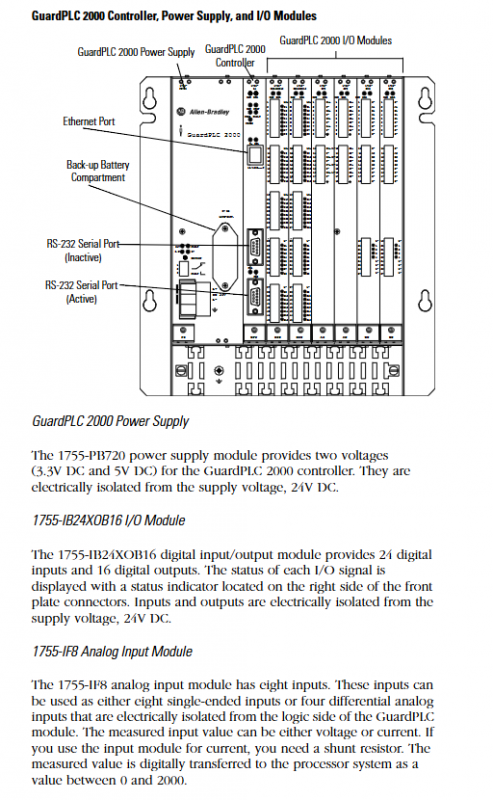
Installation method 1200: DIN/panel; 1600/1800/I/O: DIN only; 2000: Backboard installation
The distance between heat dissipation is ≥ 100mm, and the horizontal distance is ≥ 20mm**
Grounding galvanized yellow chromate DIN rail, ground wire * * ≥ 2.5mm ²**
Power supply 24V DC, range 20.4~28.8V, requires SELV/PELV isolated power supply
Detailed specification for system wiring
Digital quantity wiring
Following the closed-loop principle, input is set to 0 and output is powered off in the event of a fault
Input is powered by LS+, and output is grouped and connected to the corresponding L-
Recommended external 1N4004 freewheeling diode for inductive loads
Analog wiring
Range: 0~10V (10k Ω shunt), 0~20mA (500 Ω shunt)
Cable: shielded twisted pair, length * * ≤ 300m * *, shielded single ended grounded
Idle channel: short circuited to ground
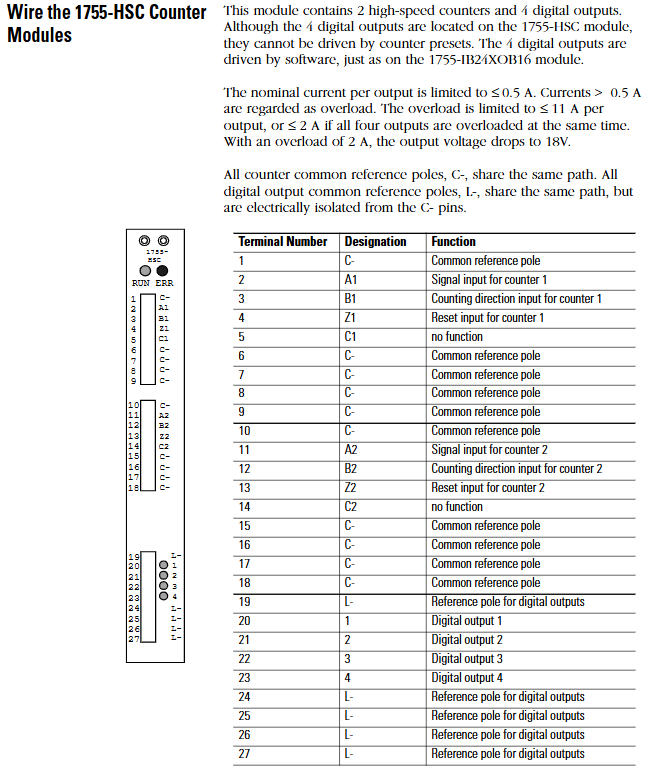
High-speed counter
Frequency: 1200/1800100kHz, 20001MHz
Mode: Counting/Direction/Reset, Gray Code Decoding
Cable: shielded twisted pair, length * * ≤ 500m * *, both ends grounded
Relay output (1753-OW8)
8-way forced guidance relay, all disconnected in case of malfunction
Communication requires double-layer insulated cables, DC with external fuses
Core functional configuration
Pulse testing function
Applicable: 1600/2000, 1200/1800 not supported
Method: OS configuration/authentication function block, pulse width 5-2000 μ s
Detection: wire breakage, short circuit, wiring error, fault set to 0
Controller operation mode
Initiat: Power on self-test
STOP: Safe state, program not executing
RUN: Normal operation, periodic processing
FAILURE-STOP: Shutdown due to malfunction, software reset required
Safety critical parameters
Safe time: 20-50000ms, fault response time limit
Watch dog time: ≥ 10ms, ≤ safety time x 0.5
Communication time slice: minimum n × 1ms+4ms (n ≤ 13)
Communication system configuration
P2P secure communication
Based on HH/UDP/IP, supporting star/chain topology
A single controller can have up to 64 connections, with 900 bytes per connection
Configuration files: 6 types including Fast/Medium, suitable for network environments
Key parameters: ResponseTime, ReceptTMO ≥ 2 × ResponseTime
EtherNet/IP communication
Role: Adapter (Slave)/Scanner (Master)
Connection: Class 1 (real-time), Class 3 (explicit)
Data limit: 16284 bytes per controller, assembly instances 120-183
Other communications
Serial: Modbus RTU, Profibus DP, ASCII
Ethernet: Supports OPC (non secure) and PanelView Plus direct connection
Diagnosis and Status Monitoring
Indicator light status
RUN: Always on, flashing STOP, turning off the fault
ERROR: Always on hardware/system failure, flashing OS damage
Fault: Program/configuration error, I/O failure
COMM: Ethernet/serial communication activation
diagnostic data
Short term: CPU 300, COM 700
Long term: CPU 1000, COM 200, retained for ≥ 7 days
Control Panel
Real time monitoring of resource status, security parameters, cycle time, P2P status, I/O status, supporting online modification and restart.
Key questions and answers
Question 1: What constraint relationship must be met between the safety time and watchdog time of GuardPLC controller? What are the consequences of setting errors?
Answer: Constraint relationship: watchdog time ≥ 10ms, and watchdog time ≤ safe time × 0.5 (ensuring at least 2 cycles are completed within the safe time). Consequences of setting errors: If the watchdog timeout occurs, the controller immediately enters the FAILURE-STOP safe state, and all outputs are powered off. RSLogix Guard PLUS must be used! The software needs to be manually reset to resume operation.
Question 2: What is the core difference between GuardPLC’s P2P secure communication and regular EtherNet/IP communication? What are the hard limitations of networking?
Answer: Core difference: P2P is based on HH security protocol, meets SIL3/PLE security level, with data verification, timeout monitoring, and fault safety value; Ordinary EtherNet/IP is non secure communication and is only used for state interaction. Networking restrictions: A single controller can have up to 64 P2P connections; Distributed I/O only supports one connection; The network prohibits loops and only transmits through a single path; Cross token group communication can have up to 8 links.
Question 3: What mandatory specifications must GuardPLC analog input wiring comply with? What problems will violating lead to?
Answer: Mandatory regulation:
Range: 0~10V voltage (10k Ω shunt), 0~20mA current (500 Ω shunt);
Cable: shielded twisted pair, length * * ≤ 300m * *, single ended grounding of shielding layer;
Idle channel: must be short circuited to ground to avoid interference.
Consequences of violation: Signal drift, measurement error exceeding the standard, electromagnetic interference causing safety misoperation, unable to meet SIL3 safety requirements.