Keyence CV-3502P/CV-3000 series visual system
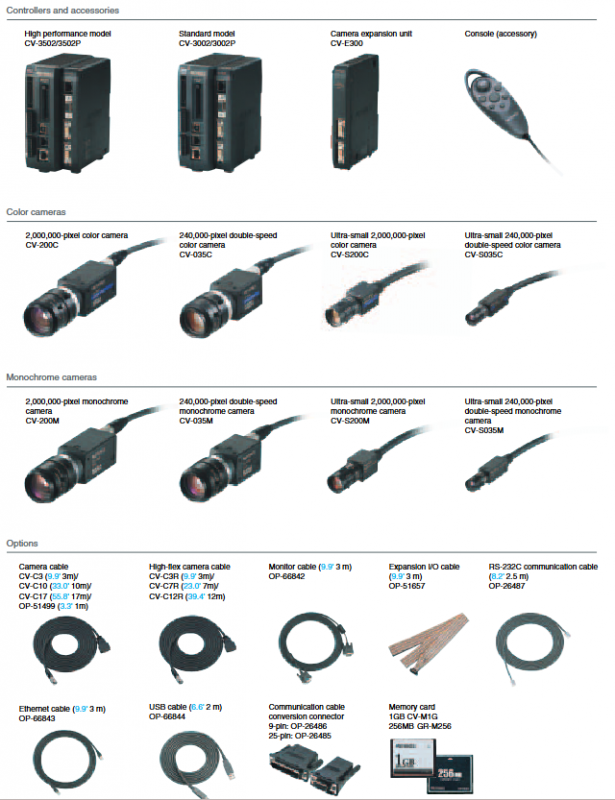
The product manual for the Keyence CV-3000 series multi camera universal machine vision system (including the CV-3502P high-performance controller) is equipped with a three core processor (RISC CPU+dual DSP), supporting up to 4 cameras to be connected simultaneously. It provides 8 black and white/color cameras (2 million pixels/high speed/ultra small) with a processing speed of 20000 pieces/minute. It is equipped with 16 detection tools and ACE color processing engine, and has features such as digital image transmission, dual buffering, local reading, and million times bending resistant cable. It supports SVGA output USB 2.0、 Ethernet and RS-232C communication are widely used for appearance inspection, size measurement, positioning, counting, and defect determination in the electronics, automotive, food, and pharmaceutical industries.
Product positioning and core configuration
The CV-3000 series is a next-generation multi camera universal digital vision system from Keyence, featuring high-speed, high-precision, and multi camera hybrid access.
Controller models: CV-3502P (high-performance), CV-3002P (standard)
Camera access:
Standard: 2 cameras
After expanding CV-E300: up to 4 units, capable of black and white/color mixing
Processor: RISC CPU+dual DSP (three core parallel)
Camera product line (8 models in total)
Type Pixel Speed Size Model
Million pixel color 2 million standard CV-200C
Million pixel black and white 2 million standard CV-200M
High speed color 320000 double speed standard CV-035C
High speed black and white 320000 double speed standard CV-035M
Ultra small million color 2 million standard with a diameter of 17mm CV-S200C
Ultra small million black and white 2 million standard with a diameter of 17mm CV-S200M
Ultra small high-speed color 320000 double speed with a diameter of 12mm CV-S035C
Ultra small high-speed black and white 320000 double speed with a diameter of 12mm CV-S035M
Core performance indicators
processing speed
Up to 20000 pieces per minute
Single tool processing: 0.5~0.83ms
Image transmission: high-speed camera 16ms, local reading 3ms
Image technology
Digital transmission: no attenuation, higher accuracy
Double buffering: capable of receiving the next frame trigger during processing
Sensitivity adjustable at 81 levels, no need for high-frequency flashlights
RGB independent adjustment enhances low contrast imaging
Color Processing (ACE Engine)
HSB color extraction, close to human eye recognition
Stable extraction of dark and low brightness colors
Point selection+numerical fine-tuning, high repeatability
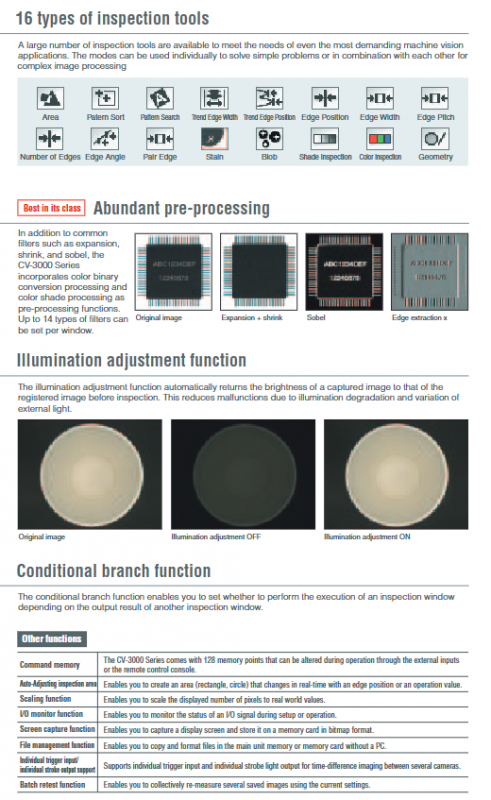
Testing tools (16 types)
Basic testing
Area, edge position/width/spacing/angle, paired edges
Featured Tools
Stain detection: contrast difference judgment, defect distribution color display
Pattern Sort: 256 types of patterns can be registered
Trend edge: Multi point measurement of diameter and spacing, output maximum/minimum/average
Differential detection: extracting differences from the comparison of good product images
Color detection: HSB numerical judgment, lighting changes remain stable
Advanced features
Continuous capture: up to 32 consecutive shots triggered at once, taking the average to eliminate errors
Conditional branch: Determine whether to execute based on the results of the previous window
Batch movement: Batch offset of windows to simplify changeover
Operation and Display
Operational ease of use
Visual process menu: step-by-step setting from top to bottom
Custom menu: only display commonly used items to prevent accidental operation
Administrator/User Mode: Password Permission Management
display system
SVGA output: 800 × 600, 24 bit color
9 layouts: 1-5 split screens
Zoom: 0.06~16x real-time zoom
Custom display: Free combination of text, numerical values, and graphics
Data and Interface
storage capacity
Internal storage: 1000 sets of programs, 511 images (black and white)
Memory card: Supports 256MB/1GB, storing programs, images, and data
Statistical Function
Store 20000 measurement data
Maximum value, minimum value, average value, 3 σ, yield, NG count
Histogram, trend chart, can be associated to view images
communication interface
Ethernet: 100BASE-TX, high-speed PLC LINK
USB 2.0: High speed transfer of images and parameters
RS-232C: Communication with PLC/PC
I/O: Input 2 points, output 27 points (including flash synchronization)
Machinery and Environment
Power supply: DC24V ± 10%
Power consumption: 1.8A (2 cameras), 2.8A (4 cameras)
Working temperature: 0~50 ℃ (million pixel camera 0~40 ℃)
Bending resistant cable: 1 million bending cycles (R30mm)
Typical applications
Electronics: Pin defects, connector flatness, soldering, printing
Automobiles: crankshaft air holes, tire identification, cylinder body defects, oil seal shortage
Food/Medicine: Capsule differentiation, packaging foreign matter, liquid level, dirt and stains
General: Dimensional measurement, positioning, counting, appearance defects
Key issues
Question 1: How many cameras does CV-3502P support at most? Why emphasize ‘digital transmission’?
Answer: CV-3502P with CV-E300 expansion unit can support up to 4 cameras synchronized access. Compared with traditional analog transmission, digital transmission has no signal attenuation, stronger anti-interference ability, and higher image fidelity, which can significantly improve the stability of measurement and detection, especially in long-distance and high noise factory environments.
Question 2: How to achieve the “high speed” of the system? What are the core technologies?
Answer: High speed comes from three core technologies:
Three core processor (RISC CPU+dual DSP) parallel processing
Double buffer memory: capable of receiving the next trigger during processing
Partial image reading: only necessary areas are transmitted, with transmission time reduced to 3ms
The combination of the three achieves a detection capability of 20000 pieces per minute.
Question 3: What scenarios do Pattern Sort and Stain Detection solve respectively?
answer:
Pattern Sort: In response to scenarios where the shape and size of the workpiece fluctuate, 256 templates can be pre registered and automatically matched for classification, solving the problem of unstable traditional template matching.
Stain detection: Targeting surface dirt, scars, color differences, and foreign objects, it determines the distribution of defects through contrast differences and displays them in color, visually presenting small flaws.