Copes Vulcan turbine bypass system (CV-1163)
System positioning and core values
The Copes Vulcan bypass system is a critical protection and regulation equipment for power plants, used for steam control between boilers and turbines.
Service history: supplied since the 1950s, adapted to dry state superheater and reheater cooling in the 1960s
Modern demand:
Shorten boiler/turbine commissioning time and enable independent testing
Steam/metal temperature matching during hot and cold start-up
Suppress boiler pressure fluctuations during turbine trip
Prevent the high-pressure safety valve from tripping, reduce maintenance and condensate loss
Ensure cooling of reheater tube wall during start-up/tripping
Protect the condenser from overheating and overpressure
Industry status: With over 90 years of experience in power generation equipment, we are a global agency and service center with over 50+agents
Core valve type and parameters
The document focuses on introducing 5 types of bypass valves, with the following key parameters:
Core characteristics of pressure rating for valve type structure
DSCV forged valve body, customized top mounted internal parts Class 600~4500, noise reduction, online maintenance
TE-PRDS top mounted temperature and pressure reduction class 150-2500 quick change internal parts, online maintenance
PRDS Classic Temperature and Pressure Reduction Class 600~2500, Reliable Application for 40 Years
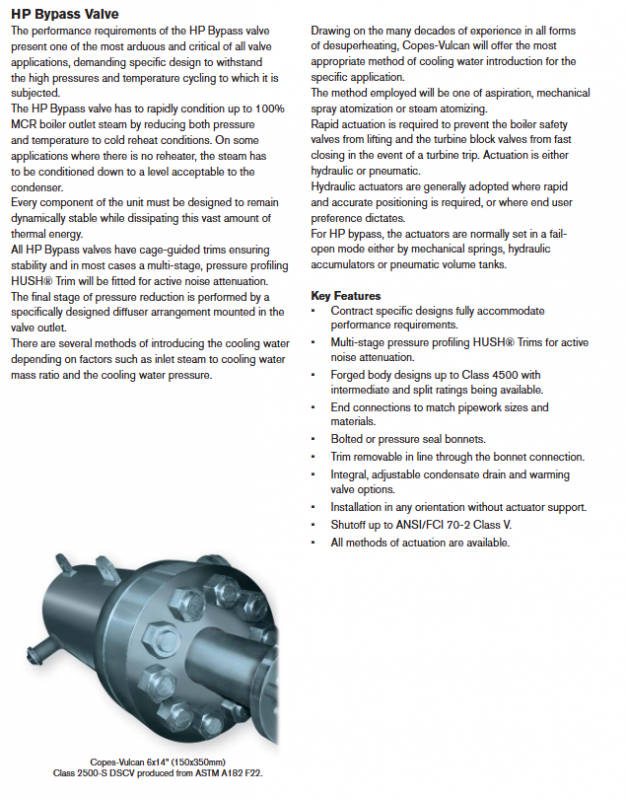
HP bypass valve cage guide+HUSH ® Maximum 220bar quick open, fail open upon power failure
LP bypass valve with large diameter, equipped with diffusion pipe Class 150-900 to protect the condenser, fail close when power is lost
Size range: 1 × 2 “~8 × 16” (25 × 50mm~200 × 400mm)
Closing level: Maximum ANSI/FCI 70-2 Class V
Temperature upper limit: 590 ℃ (1100 ° F)
Pressure upper limit: 220bar (3200pig)
Key technologies and internal components
HUSH ® Multi stage pressure reducing internal components
Function: graded pressure reduction, active noise reduction, anti cavitation
Configuration: HP/LP bypass valve standard, ensuring dynamic stability
Cooling method
Suction type, mechanical atomization, steam atomization
Select based on steam/water flow ratio and water pressure
actuator
Hydraulic: fast and precise, used for HP bypass, equipped with HPU hydraulic station
Pneumatic: piston/diaphragm type, equipped with a speed reducer and quick release valve
Redundancy: Dual pumps, accumulator, power-off action guarantee
Algorithmic Temperature Control (ATC)
Principle: Based on the thermal equilibrium formula Qw=Q ₁× (h ₁− h ₂)/(h ₂− hw)
Input: inlet/outlet pressure, inlet steam temperature, flow rate
Advantage: Solve the problem of inaccurate temperature measurement within 5 ℃ in the saturation temperature zone
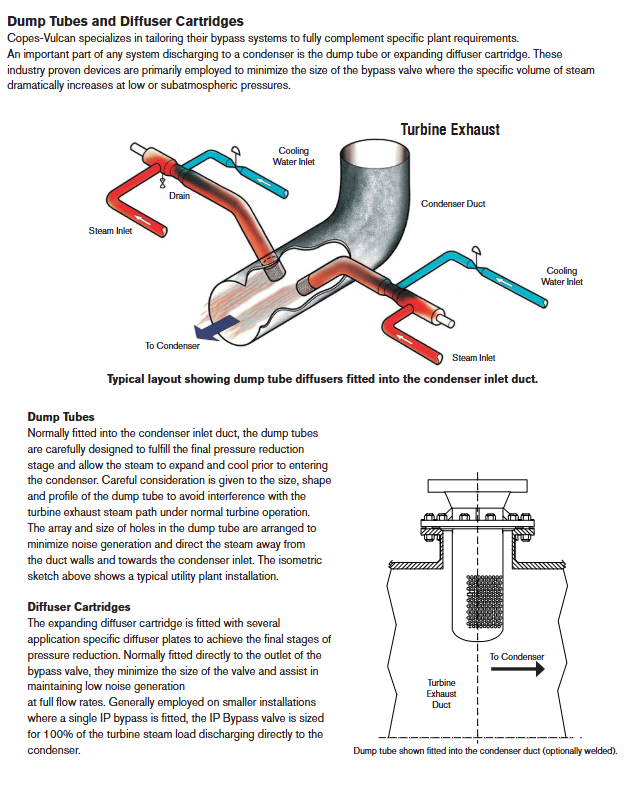
Diffusion tube&discharge pipe
Function: Final pressure reduction, steam diffusion, noise reduction
Installation: LP bypass direct insertion condenser, small hole silencing technology
Differences in HP/LP bypass design
High pressure (HP) bypass
Task: Quickly adjust the main steam of the boiler to the cold and reheat parameters
Action: In case of power failure, quickly open to prevent the safety valve from tripping
Execution: Priority hydraulic, extremely fast response speed
Low pressure (LP) bypass
Task: Adjust the reheated steam to the acceptable parameters of the condenser
Features: Large caliber, significant increase in steam specific volume
Action: Fault power loss shutdown, protect the condenser
Configuration: Must be equipped with discharge pipe/diffusion tube
Control and Safety Logic
Quick action
Steam turbine trip: valve opens quickly throughout the full stroke to prevent overpressure
Start control
Smooth heating, warming up, and boosting, matched with metal temperature
Special for back pressure unit
Trip to achieve undisturbed switching, downstream pressure fluctuation * *<1bar**
PLC pre calculates valve position, with a 2-second backtracking hold
Combined Heat and Power (CHP)
Provide a complete set of bypass, temperature and pressure reduction, water replenishment, and cooling water valve solutions
Single source supply reduces integration risks
Typical application cases
Synthesis gas/CO ₂ compressor drives turbine bypass
Valve type: 6 × 12 “Class 2500 DSCV
Control: Hydraulic station+PLC
Effect: Downstream pressure fluctuation * *<1bar during tripping**
Paper mill CHP power station
Complete set of bypass, temperature reduction, water replenishment, and drainage valve groups
Multi pressure level steam distribution control
Key issues
Question 1: What are the five core functions of the turbine bypass system?
answer:
Realize independent debugging of boilers and turbines to shorten start-up time
Match steam and metal temperature during startup to protect equipment
Quickly release pressure when the steam turbine trips to prevent the safety valve from tripping
Maintain the cooling of the reheater to prevent burning of the tube bundle
Protect the condenser from overheating and overpressure
Question 2: What are the key differences between HP bypass and LP bypass in terms of actuator, fault action, and core protection object?
answer:
HP bypass: commonly used hydraulic execution; Fault power loss quick opening; Protect the boiler, reheater, and main steam safety valve
LP bypass: commonly used hydraulic/pneumatic; Fault power failure shutdown; Protect the condenser from entering high-temperature and high-pressure steam
Question 3: What industry pain points does algorithmic temperature control (ATC) solve? What is its computational logic?
answer:
Pain point: Conventional temperature measurement results in distorted readings and uncontrolled temperature control due to water droplet adhesion within the saturation temperature range of 5 ℃
Logic: Real time calculation of required cooling water volume based on thermal balance formula
Qw=steam flow rate x (inlet enthalpy outlet enthalpy)/(outlet enthalpy water enthalpy)
Advantages: Extremely fast and precise, especially suitable for bypass scenarios of short tubes and direct discharge condensers