Rockwell AutoMax Distributed Power Drive System Manual
Overall system architecture
AutoMax DPS adopts a distributed control architecture that separates advanced logic from power drive:
AutoMax Processor: Advanced Control, Multi Driver Coordination
UDC Universal Driver Controller: Outer loop control, single module can control up to 2 drivers
Fiber optic link: connects UDC and PMI, 10Mbps, EMI resistant, up to 750m away
PMI power module interface: real-time inner loop adjustment, driving power devices
Power module: performs electrical energy conversion and drives AC/DC motors
Core universal hardware
1. UDC module
Architecture: RISC processor, flash storage system
Interface: 2-channel fiber optic, 4-channel D/A output, status LED
Capacity: Up to 10 UDCs per rack, controlling 20 drivers
Function: Store OS, configuration, tasks, and share dual port memory with AutoMax processors
2. Fiber optic communication
Protocol: Manchester encoding, 10Mbps
Advantages: Anti electromagnetic interference, no grounding loop
Usage: UDC ↔ PMI transmission instructions, feedback, diagnosis
3. PMI rack
Type: 4 slots (small and medium power), 8 slots (high power/high voltage)
Standard modules: power supply, PMI processor, Parser/driver I/O
Expansion: Power process module, parallel interface, gate drive interface
Driver series coverage
Series type power/current structure characteristics
SD3000/SF3000 DC drive 1~5000HP 4-channel PMI, SCR rectifier
SA500 AC drive 14~48A integrated PMI, DC bus power supply
SA3000 medium power AC drive 70~240A 4-channel PMI, IGBT, PWM
SA3000 high-power AC drive 534~1457A 8-slot PMI, parallel power unit
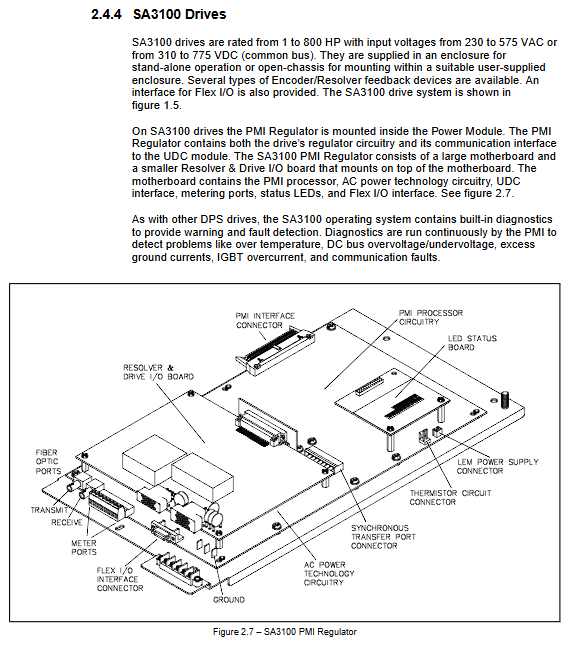
SA3100 AC driver 1~800HP with built-in PMI and Flex I/O
1567 PowerMax medium voltage AC up to 5500HP water-cooled, three-level inverter
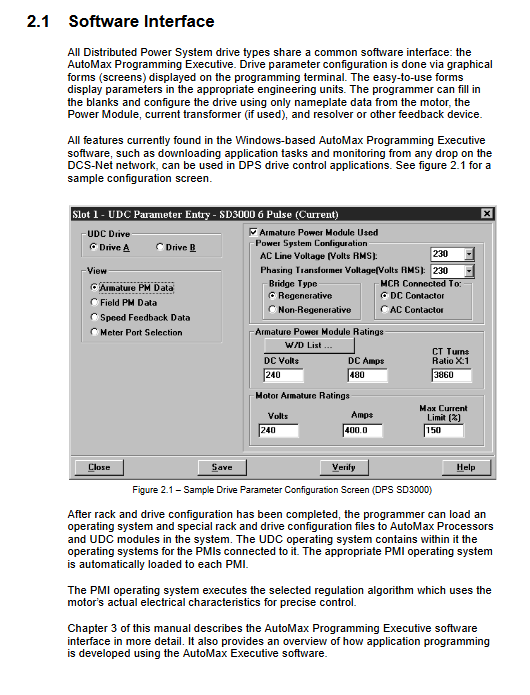
Software System AutoMax Programming Executive
1. Four major configuration tools
System Configurator: Create a system/section/rack
Rack Configurator: Rack and Driver Parameter Configuration
Variable Configurator: Variable Mapping and I/O Binding
Task Manager: Task development, compilation, and loading
2. Support programming languages
BASIC: Advanced logic running on the AutoMax processor
Control Block: Control algorithm, UDC only supports language
Ladder ladder diagram: logic control, running on the AutoMax processor
3. Programming process
Create system/section/rack
Configure the rack UDC、PMI、 drive parameters
Define variable and I/O mapping
Develop tasks and compile them
Download OS and programs
Online monitoring, debugging, and fault diagnosis
UDC/PMI communication mechanism
After power on, PMI requests the operating system from UDC
UDC issues OS, configuration, and instructions to PMI
PMI feedback, status, diagnosis
Synchronization cycle: Completed within the UDC task scanning cycle
Document Structure and Supporting Manual
S-3005: DPS Overview (this document)
S-3007: UDC Module Manual
S-3009: Fiber Optic Cabling Manual
Each series of drivers: configuration, power module, diagnosis, startup guide
Key issues
Question 1: What are the core advantages of the AutoMax DPS distributed architecture? What roles do UDC and PMI play respectively?
Answer: Advantages: Control and power separation, modular expansion, anti-interference fiber optic communication, unified software platform, high-speed RISC computing, long-distance deployment. UDC: External loop control, task execution, and communication with the upper computer, with a maximum of 2 drivers controlled by a single module. PMI: Real time inner loop regulation, triggering power devices, collecting feedback, fault protection.
Question 2: What types of drivers does DPS support? How to achieve high current output with high-power AC drive?
Answer: Supports DC drive, low-voltage AC drive, medium voltage and high-voltage AC drive, covering 1HP~5500HP. The high-power SA3000 adopts multi power unit parallel connection, which is synchronously controlled by 8-slot PMI, parallel interface module, and gate drive module, achieving 534~1457A output.
Question 3: What tools must be used for DPS programming? What language can only be used for UDC tasks? Why?
Answer: AutoMax Programming Executive must be used, which includes four major tools: system/rack/variable/task. UDC tasks only support Control Blocks because UDC focuses on real-time motion control algorithms and requires a fixed control block library to ensure stability and response speed.