Basler A400 series area array industrial camera
Product Overview
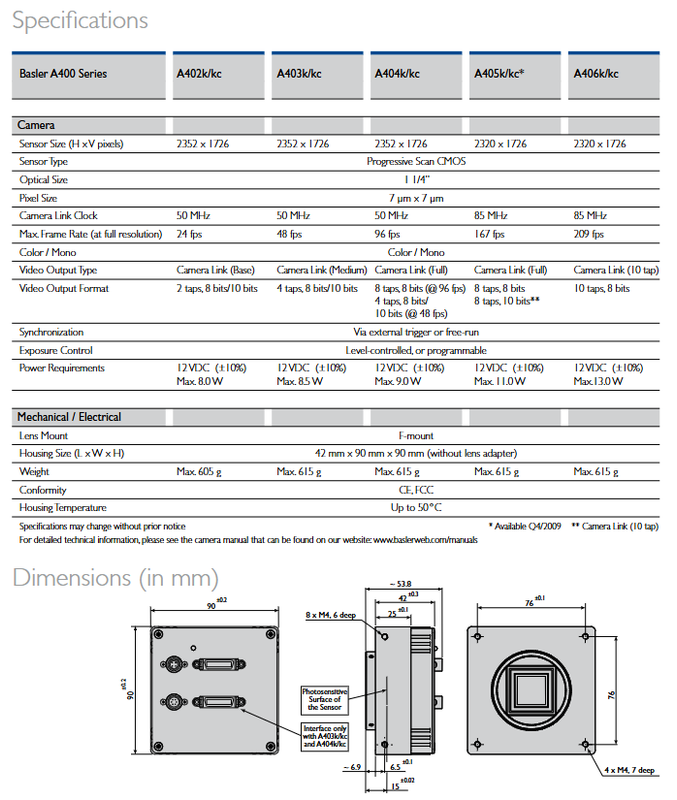
The A400 series uses a 4MP Progressive Scan CMOS image sensor with an effective pixel array of 2352 × 1726 (A405k/kc and A406k/kc are slightly cropped to 2320 × 1726), a pixel size of 7 µ m × 7 µ m, and an optical format of 1-1/4 “. Compared with traditional CCD cameras, it has the following advantages:
Higher full resolution frame rate; No Blooming or Smear defects;
Built in FPGA, supports internal image preprocessing of the camera, and can implement customized algorithms for customers;
Built in 3 image correction functions to eliminate various fixed pattern noise:
Column shading correction
DSNU dark signal non-uniformity correction
PRNU light response non-uniformity correction
The entire machine undergoes 100% quality inspection and factory calibration to ensure consistency.
Overview of frame rates and interfaces for various models
Model Full Frame Resolution Maximum Frame Rate Camera Link Mode Tap Count/Data Format Clock Frequency Power Consumption
A402k/kc 2352×1726 24 fps Base 2‑tap,8/10bit 50 MHz ≤8.0 W
A403k/kc 2352×1726 48 fps Medium/Full 4‑tap,8/10bit 50 MHz ≤8.5 W
A404k/kc 2352×1726 96 fps Full 8‑tap,8bit 50 MHz ≤9.0 W
A405k/kc 2320×1726 167 fps Full 8‑tap,10bit 85 MHz ≤11.0 W
A406k/kc 2320×1726 209 fps 10‑tap 10‑tap,8bit 85 MHz ≤13.0 W
The suffix k represents Mono and kc represents Color; Supports 8-bit/10 bit pixel output.
Core Feature Function: AOI Area of Interest
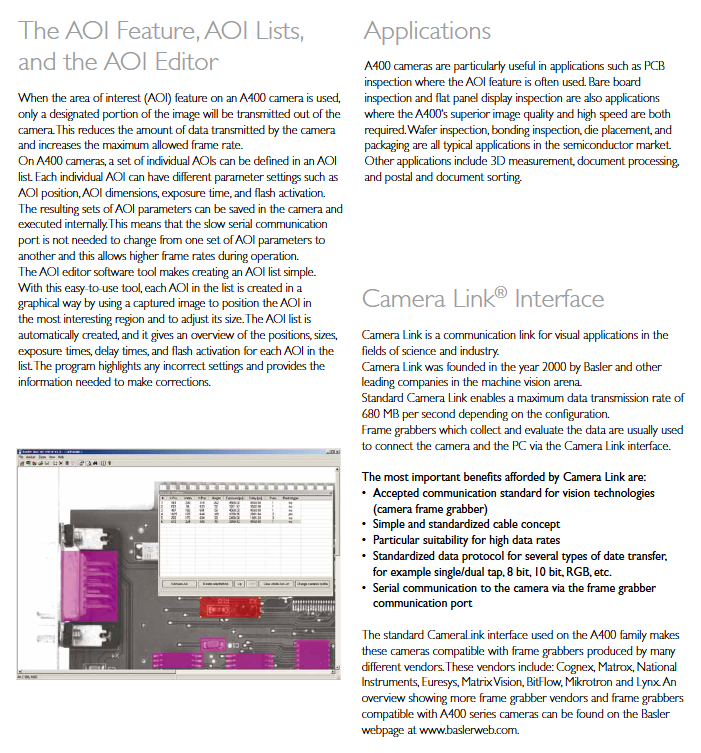
AOI (Area of Interest): Only transmits selected local areas of the image, reducing the amount of transmitted data and effectively improving frame rate.
AOI list function: The camera can store multiple sets of AOI parameter sets internally; Each group can independently set: area position, size, exposure time, flash trigger signal.
The parameter set is saved within the camera hardware; Switching between different AOI configurations does not require slow serial communication, and can be executed directly within the hardware to achieve high-speed multi area acquisition.
Supporting PC AOI Editor graphic editing software: Load the captured image, select the area of interest with the mouse box, and the software automatically generates an AOI parameter list. At the same time, verify the validity of the parameters and prompt errors.
Typical application scenarios: PCB circuit board inspection, bare board inspection, flat panel display panel inspection; Semiconductor wafer inspection, bonding inspection, chip mounting, packaging inspection; 3D measurement, document processing, email sorting.
Camera Link interface
Camera Link is the standard parallel image interface in the machine vision industry, and Basler is also one of the initiators of this standard.
The maximum standard bandwidth can reach 680 MB/s, and it needs to be connected to a PC with an image capture card (Frame Grabber).
Advantages: Standardized cables; Adapt to high-speed big data; Supports multiple data formats such as single/dual/multi Tap, 8-10 bit, RGB, etc; The camera can be configured with registers through the serial port channel of the acquisition card.
Compatible with numerous manufacturers’ collection cards: Cognex, Matrox, NI, Euresys, Matrix Vision, BitFlow, Mikrotron, Lynx, etc.
Electrical and mechanical specifications
Synchronization mode: Free running mode/External trigger mode.
Exposure control: Level control, programmable exposure time.
Power supply: 12 VDC ± 10%, power consumption of different models is 8.0~13 W.
Lens interface: F-mount.
Dimensions: Excluding lens adapter: 42 mm (L) × 90 mm (W) × 90 mm (H).
Weight: Maximum 605-615g.
Shell operating temperature: maximum 50 ° C.
Compliance certification: CE, FCC.
Factory quality assurance system
Each A400 camera undergoes complete factory calibration, with the following key points:
Accurately measure and adjust the focal length BFL to ensure the distance between the lens flange and the sensor meets optical standards;
Using self-developed CTT+(Camera Test Tool+) fully automatic camera testing system: integrating optical hardware and software, automatically testing all key image indicators of the camera, completing calibration, comparing and determining whether they meet specification standards, and achieving automated quality inspection of the entire production line.