Emerson Ovation OCR1100 Controller
Product Overview
OCR1100 is an Ovation DCS series hardware controller that performs continuous control (PID), logic, sequence control, and data acquisition; Maximum support for 32000 process points; Support local/remote I/O, as well as virtual I/O docking with third-party OEM devices, fanless low-power design, used for production control of critical tasks. Typical applications: Process factories that require high reliability and network security, such as thermal power generation, water and sewage treatment, etc.
Main functional capabilities
PID continuous adjustment control
Boolean logic, advanced algorithms, special logic, and temporal functions
Process data collection, cold end compensation
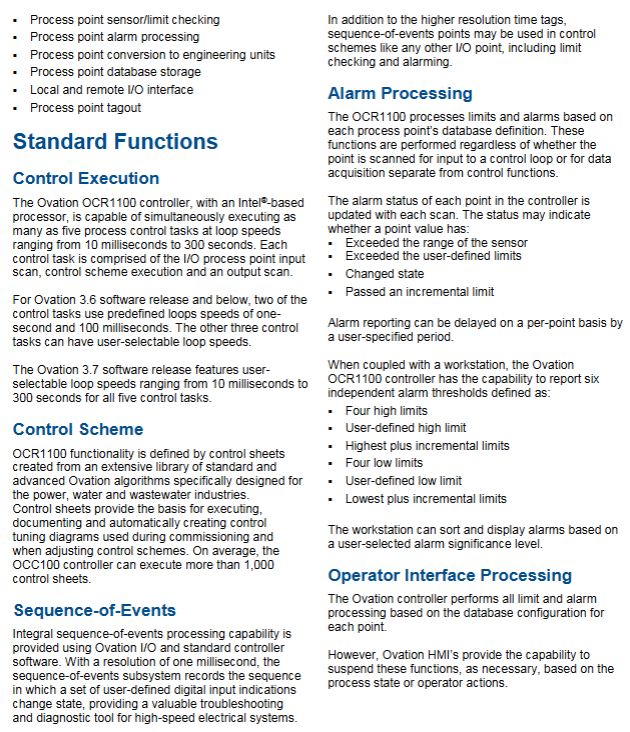
Process point sensor over limit inspection, alarm handling, engineering unit conversion, database storage, tagout
SOE event sequence recording: 1ms timestamp resolution, can be used for troubleshooting, SOE points can participate in control logic and over limit alarm like ordinary I/O points.
Core software and task execution
The processor is based on Intel architecture and can run up to 5 control tasks simultaneously. Each task includes I/O input scanning, control scheme computation, and output scanning.
Ovation 3.6 and earlier versions: 2 fixed task cycles (100 ms, 1 s), with the remaining 3 tasks customizable by users;
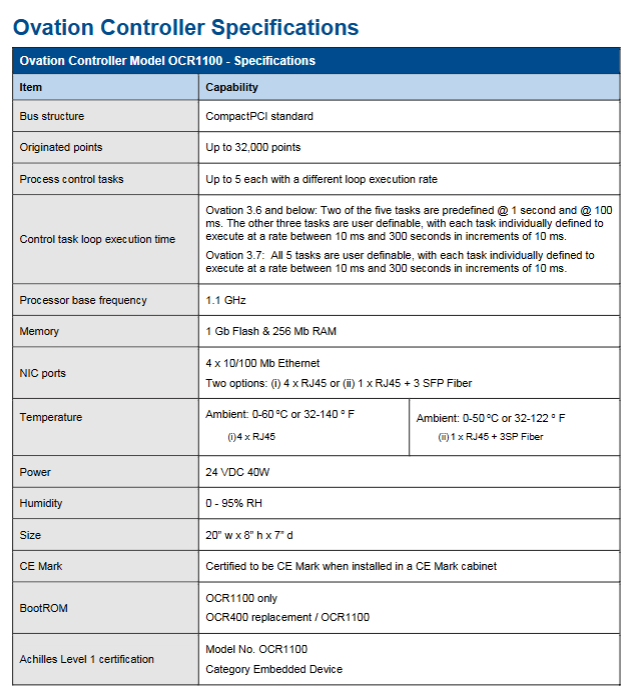
Ovation version 3.7: All 5 task cycles can be configured by the user, with a scanning cycle range of 10 ms~300 s and a step size of 10 ms.
The control logic is implemented by Control Sheets, which contains a large number of algorithm libraries for the power and water treatment industries; A single controller can execute an average of over 1000 control pages and automatically generate debugging and tuning documents.
Non volatile storage: saves application programs, point databases, configurations, and tuning parameters.
Alarm processing: Each process point updates the alarm status with the scanning cycle; Support sensor over limit, user high and low limits, status changes, and incremental limit alarms; Support single point alarm delay; The HMI workstation can be configured with 6 independent alarm thresholds (4 high limits, 4 low limits, etc.), and the HMI can display them in order of alarm priority.
Controller software license variant (enabled through authorization)
Simulation controller Simulator: uses simulation I/O instead of hardware I/O for factory FAT acceptance and factory model simulation, without the need for real on-site hardware.
Advanced Controller: Authorize unlocking advanced algorithms such as dynamic matrix DMC, autoregression, soot blowing, fuzzy logic, temperature curve, programmable function blocks, etc.
Virtual Controller: a software version Ovation controller running on the Windows platform, a real-time operating system; No hardware I/O interface, mostly used for simulation solutions, does not support redundancy.
Redundant architecture (Bumpless undisturbed switching)
OCR1100 supports multi-component redundancy, including network interfaces, processor memory, network controllers, processor power supplies, I/O interfaces, input power supplies, I/O power supplies, auxiliary power supplies, and remote I/O communication links.
Hardware architecture: Passive backplane base plate, simultaneously installed with main controller and backup controller; 24V redundant power supply is provided to two controllers respectively. A single controller is divided into two main modules: ① processor/memory/network module; ② Local&remote I/O interface+internal power module.
Working Mode
Main control mode Control: The main controller reads and writes I/O, performs all control operations, and continuously monitors the health status of the backup controller.
Backup mode: The backup controller performs self diagnosis and continuously synchronizes all databases, point values, and tuning parameters of the main controller; Do not operate I/O.
Automatic failover triggering conditions: processor failure, network controller failure, I/O interface failure, main controller power failure, main controller reset. The watchdog circuit cuts off the I/O of the faulty main controller, and the backup controller immediately takes over, achieving disturbance free switching. The faulty controller can be powered off for maintenance, and after repairing and powering on, it will automatically return to standby mode, allowing the system to continue redundant operation.
External interface and I/O capability
Physical bus: CompactPCI i-bus industrial PC bus; Real time multitasking operating system, TCP/IP communication, supporting routing and resource management; The software is cross platform portable and supports virtual controller solutions.
Ethernet network card NIC: 4-channel 10/100 Mb Ethernet; Choose one hardware version: ① 4 x RJ45 electrical ports; ② 1 x RJ45+3 x SFP optical ports.
I/O system compatibility: Ovation I/O, old WDPF I/O, Q-Line I/O.
I/O type specification upper limit
Local Ovation I/O 16 branches, each with up to 8 modules, totaling 128 I/O modules
Local Q-Line I/O 1 node, 48 Q-Line cards; Scalable with an additional 1 node
Remote Ovation I/O up to 8 nodes, with a maximum of 64 modules per node
Remote Q-Line I/O up to 8 nodes, with 48 cards per node
Up to 16 remote node interfaces, with a maximum of 64 modules per interface
Fieldbus: Supports Foundation Fieldbus, PROFIBUS, DeviceNet intelligent field devices, which can transmit intelligent device information transparently to the upper computer and interface with Emerson AMS equipment asset management suite.
Virtual I/O (Ethernet TCP/IP): interfaces with third-party systems such as Modbus TCP, AB PLC DF-1, GE turbine control system, Toshiba turbine control system, etc. through standard protocols.
Note: Expansion Q-Line and various remote I/O cannot be enabled simultaneously, and only one type of expansion I/O can be selected at a time.
Hardware Technical Specifications
Project parameters
Processor clock speed 1.1 GHz Intel
Store 1 GB of Flash and 256 MB of RAM
Power supply 24 VDC, 40 W; no fan
Working temperature 4 x RJ45 version: 0-60 ℃; SFP optical port version: 0-50 ℃
Humidity 0-95% RH, no condensation
Size 20 “wide x 8” high x 7 “deep
Achilles Level 1 security certification; The whole machine can obtain CE certification when installed in a compliant cabinet
Compatibility can replace OCR400 controller with downward compatibility; Ovation 3.5 and above versions of the system support all functions of OCR1100; Provide migration tools to upgrade old controller logic and database to new hardware
Cabinet configuration
The controller and I/O module both support DIN rail installation and are divided into standard control cabinets and expansion cabinets.
Standard control cabinet: capable of installing redundant controllers; Two I/O branches in front of the board, and two additional branches on the backplane; Up to 32 I/O modules; Built in redundant power supply and distribution module. Size: 2006.6 × 609.6 × 609.6 mm, with a full weight of 191.81 kg.
Expansion cabinet: up to 32 additional I/O modules and 4 branches can be added; Can accommodate redundant power supply spare parts; Same size, fully equipped with 178.31 kg.
The cabinet supports front and rear door opening, and can also be customized with a front door only access version; Customizable sheet metal, protection level, wiring harness, Marshaling adapter cabinet.
Standard compliance
IEC 61131-3: Adhere to international industrial control programming standards, unify programming syntax and models.
Achilles Level 1: Critical infrastructure network security certification, evaluating network resilience against attacks.