KUKA KR QUANTEC PA series heavy-duty palletizing robot
Official manual for installation, debugging, maintenance and repair of KUKA KR QUANTEC PA series heavy-duty palletizing robot body. PA=Palletizer palletizer model; Including standard version, Arctic low-temperature version, and HO food hygiene version; Covering KR 120 R3200 PA, KR 180 R3200 PA, KR 240 R3200 PA; Controller compatible with KR C4, KR C5; Only supports ground installation, not wall mounted or suspended ceilings.
Product Description
Body structure: 6-axis articulated arm palletizing robot, core components: hollow wrist HW, forearm, boom, turntable, base, hydraulic pneumatic balance cylinder (a signature component of PA palletizing models, offsetting the weight of the boom).
Derivative variants
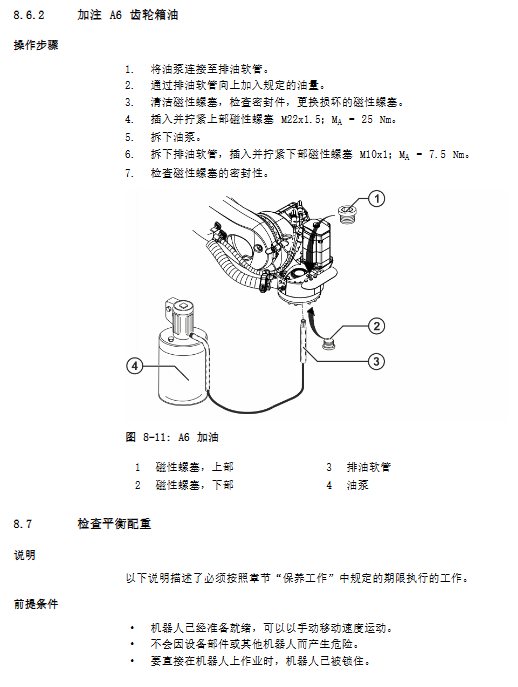
PA standard version: General industrial palletizing; Gear oil: Optigear Synt.ALR 150.
PA-HO Health Edition: Secondary Food Industry; Rust prevention upgrade; Specialized sanitary gear oil Optileb GT 1800/220.
PA arc low-temperature version: low-temperature cold storage; Operating at -30~+10 ℃; Low temperature specialized lubricating oil.
Installation form: limited to ground installation only, allowing a small inclination angle of ± 5 ° for the base.
Expected use: palletizing and handling heavy components; Must meet the specified environmental conditions.
Prohibited misuse (misuse results in loss of full warranty): trampling on heights, overloading, carrying people and animals, outdoor activities, explosion-proof areas, and radioactive environments.
Body flange: ISO 9409-1, flange circle diameter 125 mm, 12 × M12 10.9; The document provides the flange force/torque for two operating conditions: normal operation and emergency stop impact.
Additional load interface: The turntable, upper arm, and lower arm are all reserved with additional load installation surfaces, and the maximum allowable additional load is specified.
Available options: free rotation device (manual release of brake), pipeline package, transportation hoist.
Technical Data
Public basic parameters
Protection level: IP65 for the whole machine and IP65 for the wrist; Noise level is less than 75 dB (A).
Standard version operating temperature: 0~55 ℃; Arctic low-temperature version -30~+10 ℃; Storage -40~60 ℃.
Cable adaptation KR C4/KR C5; Cable 7-50 meters, maximum length 50 meters.
Installation: Only on the ground, the base is allowed to tilt ± 5 °; The base size is 830mm, and the minimum grade of concrete foundation is C20/25.
Core parameters of three models
Model rated load, self weight, maximum arm span, repeat positioning accuracy
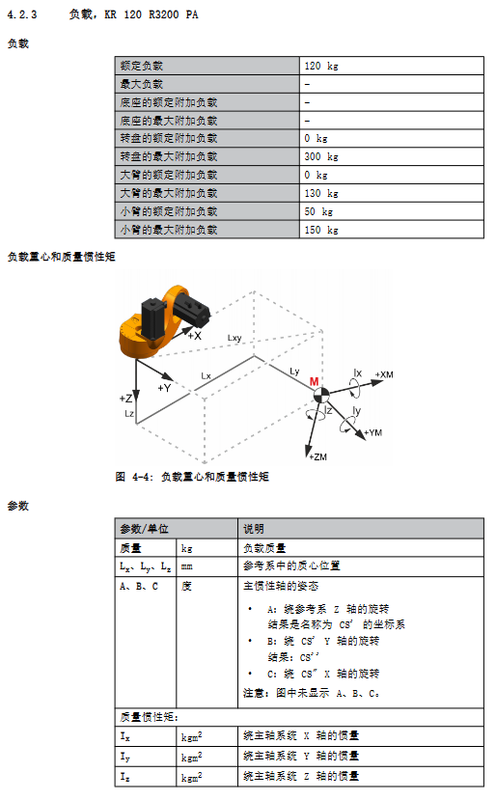
KR 120 R3200 PA 120 kg Approximately 1075 kg 3195 mm ± 0.06 mm
KR 180 R3200 PA 180 kg Approximately 1093 kg 3195 mm ± 0.06 mm
KR 240 R3200 PA 240 kg Approximately 1103 kg 3195 mm ± 0.06 mm
Each model is provided with: the range of motion for each axis, the maximum speed of the rated load axis, the load curve graph (which must be simultaneously verified for mass, center of gravity, and moment of inertia, and must be entered into the controller through KUKA Load software verification), wrist flange load (normal, emergency stop), additional load limits for the turntable/boom/forearm, and foundation load (vertical force, horizontal force, overturning moment, A1 rotational moment). This chapter also includes: instructions on the body nameplate, REACH regulatory information, and charts of stop distances/stop times for each axis corresponding to the STOP 0 and STOP 1 shutdown categories (varying with POV program magnification and load changes).
Planning and Layout
Provide 2 sets of ground fixing solutions:
Ground fixing kit with center positioning pin (part number 0000-185-574): concrete foundation, foundation plate+positioning pin+M24 bolt+chemical anchor bolt; If the foundation is uneven, leveling mortar can be used. It is strictly prohibited to pour mortar into the bolt hole position.
Rack fixing device (part number 0000-185-590): directly fix the customer’s steel structure/slide table; Cylindrical pin+flat pin positioning, 8 M24 bolts are tightened diagonally in steps.
Cable planning
KR C4: Motor X20-X30, Data X21-X31;
KR C5: Motor XD20-XD30, Data XF21-XF31;
16mm ² equipotential grounding conductor; Follow VDE 0100 and EN 60204-1;
Minimum bending radius of cables: motor cables ≥ 150 mm, data cables ≥ 60 mm; motor cables and data cables are routed separately.
The rear of the body base is the external interface A1, which includes motor, data, and pipeline package interfaces.
Transportation
It must be placed in the designated standard transportation posture in advance, and all models share a set of transportation axis angles.
Two ways of transportation:
Forklift: The base comes with a fork slot; The minimum carrying capacity of a forklift is 2 tons; Can be crossed in both directions.
Crane lifting: Special transport lifting equipment (0000-199-484), 3 M16 eyebolts; Tools and pipeline packages must be removed to avoid center of gravity deviation.
Avoid impact and vibration during transportation; Prohibit the use of non certified suspension points.
Chapter 7: Putting into Operation and Restarting into Operation
3 sets of installation procedures: foundation kit concrete foundation installation, frame steel structure installation, robot positioning.
Step: Forklift/lifting device in place → Positioning pin in place → Robot positioning → Diagonally tighten M24 multiple times (final torque 640 Nm); Leveling and grouting; Grouting materials are strictly prohibited from entering bolt holes; Tighten all base bolts after 100 hours of operation.
Wiring: motor cables, data cables, equipotential grounding; Connector buckle locking; Complete the equipotential conduction test.
T1 manual mode low-speed trial run of the whole machine.
Maintenance
The PA palletizing model has a unique hydraulic nitrogen balance cylinder, which is a pressure component and must be maintained by professional personnel.
Maintenance cycle benchmark
First 100 operating hours: Check the torque of all fasteners and bolts;
5000 hours or at the latest 1 year: Lubricate the balance cylinder bearings and apply lubricating grease to the A1 cable harness;
20000 operating hours or 5 years, whichever comes first: replace all gearbox oil;
10 years: The balance cylinder assembly must be replaced.
Lubricating oil differentiation
Standard version PA: Gear oil Optigear Synt. ALR 150;
HO Sanitary Edition PA: Gear Oil Optileb GT 1800/220;
Arctic Low Temperature Edition: Low Temperature Special Oil Product;
Key points for oil change operation: The gearbox is in a hot working state; Ventilate and release pressure before draining oil to prevent hot oil splashing; Magnetic plug specified torque; If the oil discharge is less than 70% of the nominal capacity, the gearbox needs to be flushed, and if it is less than 50%, it needs to be flushed again; Oil change completed T1 low-speed running in, check the seal for no leakage.
Maintenance checklist
Visual inspection of A1 cable sheath and application of lubricating grease;
A1/A2/A3/A5/A6 each shaft gearbox oil drain rinse fill;
Balance cylinder: pressure inspection, bearing lubrication, 10-year overall replacement;
Whole machine cleaning: Only neutral water-soluble cleaning agents are allowed; High pressure steam jet cleaning is strictly prohibited.
Maintenance
Includes A1-A6 motor replacement and electrical system schematic.
Safety rules for motor replacement: Before disassembling the motors A2/A3/A5/A6, the arm must be securely fastened with a sling, and the balance cylinder must also be mechanically locked; Failure of the power-off brake can cause the arm to fall and squeeze to death.
Thinly apply Microlube GL261 grease to the spline area of the new motor; Replace all O-rings with new ones; Diagonal graded tightening of bolts; After replacing the motor, the axis must be zero point calibrated for mastering; T1 low-speed test run.
Complete electrical schematic diagram: drawings of each axis motor, brake, temperature sensor, micro RDC encoder, and grounding circuit.
Electrical components: MFG multifunctional junction box, RDC box; All motor plugs are XM (power) and XP (encoder temperature).
Stopping Operation, Warehousing, and Disposal
Dismantling process: The robot moves to the standard transport posture; Emergency stop, lock and power off; Dismantling tools and fixtures; Disconnect the cable and ground it; Loosen the base bolts and lift vertically.
Storage conditions: The storage location should be dry and dust-free to avoid condensation; ‑40~60 ℃; Body cleaning and covering; Seal electrical connectors and place desiccants if necessary; Remove the additional load from the dismantling tool.
Scrap disposal:
Classification and recycling of cast aluminum, cast steel, steel, copper cables, and electrical components; Gear oil is treated as hazardous waste.
Before scrapping the balance cylinder, it must be depressurized. There is high-pressure nitrogen and hydraulic oil inside, and disassembling without depressurization will cause explosion and injury.
Options: Free Rotation Device (Brake Release)
Purpose: Manual movement of joints in case of power failure, only for emergency personnel to rescue and escape.
Mandatory warning: After using the free rotation device to move the joint, all axes must be recalibrated and the brake function must be tested; Otherwise, it may collide and injure people.