Sysmex XN-L series (XN-530/XN-430/XN-330) fully automatic blood cell analyzer
Introduction
Instrument use: In vitro diagnostic fully automatic blood cell analyzer for clinical laboratories, which can only detect human whole blood or quality control blood; Using electrical impedance, laser scattering, and fluorescence staining techniques, quantitative, identification, and proportion analysis of blood tangible components such as red blood cells, white blood cells, and platelets are completed. The instrument results cannot replace clinical diagnosis and judgment. Failure to operate according to the manual will result in the loss of product warranty.
Model differentiation
XN-530: Configure an independent external display and support batch injection with a sampler;
XN-430: all-in-one machine, built-in touch screen, injector analysis mode;
XN-330: all-in-one machine, built-in touch screen, open manual sampling.
Reportable parameters
Note: MCV/MCH/MCHC are derived parameters for calculation; MicroR and MacroR are not detectable in pre dilution mode.
WDF channel (five categories of white blood cells): absolute values and percentages of WBC, neutrophils, lymphocytes, monocytes, eosinophils, and basophils, immature granulocyte IG #, IG%;
RBC/PLT channel: RBC、PLT、HCT、MCV、MCH、MCHC、RDW‑SD、RDW‑CV、PDW、MPV、P‑LCR、PCT、MicroR、MacroR;
HGB channel: Hemoglobin HGB.
Manual symbols, trademarks: define warning, biohazard, high temperature, static electricity and other document identification; List product identifiers such as IVD, LOT, REF, etc; Sysmex, CELLPACK, etc. are trademarks of our company, while Windows is a trademark of Microsoft.
Compliance certification: CE (EU IVD Directive 98/79/EC, RoHS, Radio Equipment Directive), EAC Eurasian Economic Union certification.
Security Information
2.1 General Electric Safety
Avoid getting hair, fingers, and clothing caught up in the instrument during operation; Prohibit liquids and metal foreign objects from falling into the machine; Do not touch the internal circuit board; The power supply specified on the nameplate must be used and reliably grounded; The power cord must not be pulled under heavy pressure; If there is any odor/smoke, immediately turn off the power and contact after-sales service.
Prohibit analysis of coagulated blood; Prioritize using CELLCLEAN AUTO for maintenance and cleaning, or manually replace CELLCLEAN.
2.2 Installation Safety
Unpacking, installation, and initial debugging must be completed by Sysmex technicians; The user’s self movement of the machine is not covered by the warranty; Power off before connecting external devices;
Installation environment: Waterproof splash, avoid high temperature and humidity, dust, direct sunlight, vibration; Good ventilation; Stay away from electromagnetic interference equipment, chemicals, and flammable anesthetic gases; Indoor use only; The height difference between the reagent container and the bottom of the instrument is ≤ 1m. It is prohibited to place reagents on the top of the instrument.
2.3 Electromagnetic Compatibility (EMC)
Compliant with IEC61326-2-6, CISPR11 Class A equipment, wireless interference may occur in home environments; Built in 13.56MHz RFID radio frequency identification module. FCC Class A digital devices.
2.4 Biological Infection Prevention (Key)
Gloves, masks, goggles, and lab coats must be worn for testing and maintenance; Wash hands after operation; The waste liquid pipeline must be connected to the waste liquid collection container; Prohibit bare handed contact with waste liquid components; In case of sample/waste liquid splashing, rinse with plenty of water and follow laboratory procedures to remove contamination; Immediately flush and seek medical attention if liquid enters the eyes/wound.
The scrapping of instruments and accessories belongs to infectious waste and is not subject to the EU WEEE public recycling regulations. Ordinary garbage recycling is prohibited, and it is recommended to incinerate contaminated parts and contact Sysmex for disposal.
Instrument decontamination: disinfect the external surface after daily work, contamination, and before maintenance; Power off and clean again. Only external wiping is allowed, and internal disassembly and cleaning can only be carried out by maintenance engineers.
2.5 Reagent, laser, computer, software safety
CELLPACK diluent is conductive. If it spills into the circuit area, power off and wipe it dry; CELLCLEAN AUTO contains sodium hypochlorite, which can corrode the casing and be immediately wiped off if splashed.
Built in Class I semiconductor laser, enclosed casing, only for authorized engineers to disassemble, to prevent eye damage.
Only authorized maintenance tools from the original factory can be used; The instrument is virus-free from the factory, but external USB storage media needs to be scanned for viruses.
It is prohibited to install or run any non pre installed software, and third-party software causing malfunctions will be exempted from liability by the manufacturer.
Operators must undergo formal training; Please refer to the fault manual first for troubleshooting. If unable to resolve the issue, please contact Sysmex engineers.
Multiple warning labels are printed on the machine body: Do not reach into the machine during operation; Multiple components are marked with biological infection risks; High temperature anti scalding of the air pump casing; The power cord must be unplugged for disassembly and maintenance.
Component Name and Function
1. XN‑530
Analyzer body: injector start stop switch, mode switch, main power switch, left and right adapter brackets, multiple sets of status LED indicator lights, manual injection component;
Independent touch screen display: OSD adjustment buttons, power, VGA video, USB touch signal interface.
2. XN‑430
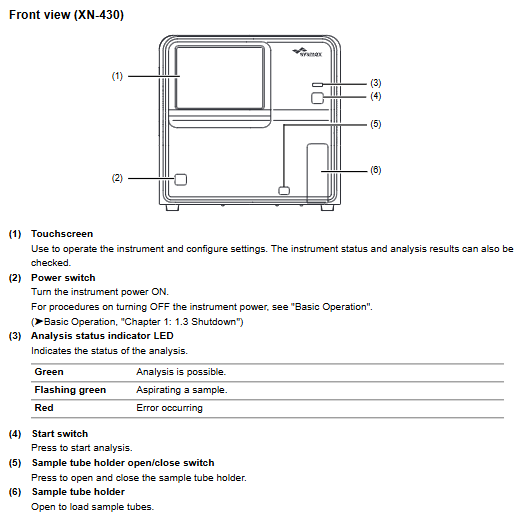
Integrated machine touch screen; power switch; Analysis status LED; Sample rack open/close button; Sample test tube holder.
3. XN‑330
Integrated machine touch screen; Power Supply; Status LED; Direct suction pipette, start button, no automatic sampler.
4. Machine universal external interface (backplane)
RS-232C serial port, VGA (XN-530), LAN port, multiple USB ports; Fuse holder; AC power input; Various reagent suction interfaces (DCL, SLS, WDF); Waste liquid outlet; RU-20 reagent tank sensor, waste liquid full sensor, pneumatic unit PU-17 control interface.
5. Internal components of the machine
Dye placement position, right maintenance cover lock buckle; Air pump unit, RBC detector, pneumatic buffer chamber, puncture sampling needle (530/430); Semiconductor laser components; Fluorescent dye nozzle; High temperature components of the air pump, etc.
6. Optional pneumatic unit PU-17
Provide positive and negative air pressure to the entire machine, and be careful not to block the exhaust holes on the back.
Installation
The installation and relocation of the entire machine must be carried out by Sysmex engineers, and unauthorized movement will result in loss of warranty.
Environmental conditions: ambient temperature of 15-35 ℃; Relative humidity 20-85%;
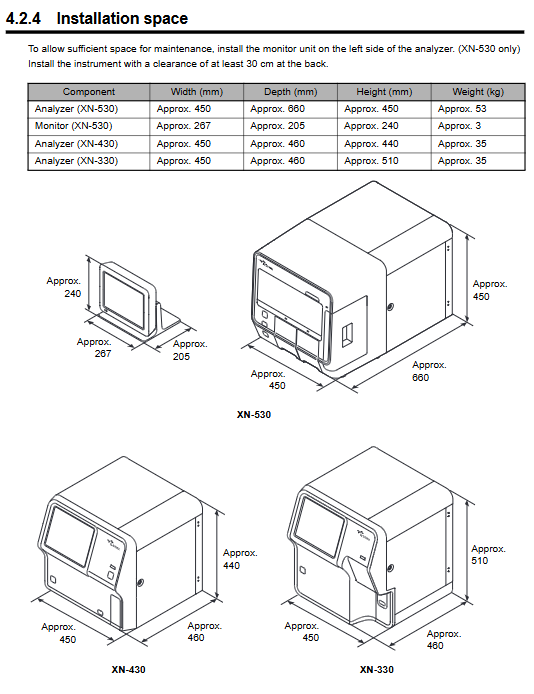
Dimensions and Weight
Model Width x Depth x Height (mm) Weight
XN-530 analyzer 450 × 660 × 450 53 kg
XN-530 monitor 267 × 205 × 240 3 kg
XN‑430 450×460×440 35 kg
XN‑330 450×460×510 35 kg
At least 30cm of maintenance space should be reserved on the back of the instrument.
Power supply: 100-240V AC, 50/60Hz; XN-530 consumes 250VA, XN-430/330 consumes 235VA; Class I protection.
Storage conditions (non operational): Temperature -10~60 ℃, humidity -10~95%, no condensation; Atmospheric pressure 70-106kPa; The operating pressure is 70-106kPa.
Noise level ≤ 60dB (excluding test tube clamping and alarm sound).
Instrument Technical Specifications
1. Detection speed (throughput)
Whole blood mode/pre dilution mode: CBC and CBC+DIFF both have a sample rate of approximately 60 samples per hour (XN-530 does not include additional functions such as barcode and retest).
2. Sample suction volume
Whole blood mode: 25 μ L;
Pre dilution mode: 70 μ L.
3. Report scope and display scope
Distinguish between “whole blood mode” and “pre dilution mode”, list the reportable upper and lower limits and display upper and lower limits of WBC/RBC/HGB/HCT/PLT, as well as five categories and IG. The reporting range of some indicators in the pre dilution mode has narrowed.
4. Analyze performance indicators
Including blank limit LoB, detection limit LoD, and quantification limit LoQ; Linear; Precision (repeatability, reproducibility); Accuracy; Carry a complete set of technical indicators for carrying pollution rates.
Carrying pollution calculation formula: Caryover=\ left [\ frac {(1st Low -3rd Low)} {(3rd High -3rd Low)} \ right] × 100.
5. Sample storage stability
Under refrigeration conditions of 18-26 ℃/2-8 ℃, EDTA anticoagulant can stabilize WBC/RBC/HGB for 72 hours; HCT and MCV can be stored at room temperature for 8 hours and refrigerated for 24 hours; PLT can be stored at room temperature for 48 hours; and white blood cell classification indicators can be stored at room temperature for 48 hours. Restore the refrigerated sample to room temperature before loading onto the machine.
6. Interference factors and interfering substances
The sample itself interferes
Pseudo reduction of HCT: red blood cell agglutination (condensation), small red blood cells, and red blood cell debris;
Pseudoelevation of HCT: significantly increased white blood cells (>100000/μ L), severe diabetes, uremia, spherical red blood cells;
Pseudo reduction of PLT: platelet aggregation, pseudo thrombocytopenia, giant platelets;
Pseudo elevation of PLT: small red blood cells, red blood cell debris, fragmented white blood cells, and cold globulin.
External interferents: Bilirubin C, Bilirubin F, Hemolytic Hemoglobin, Lipoemulsion, Chylyl give the highest concentration without significant interference, and the evaluation criteria refer to CLSI H26-A2.
7. Support sample tube specifications
XN-530/XN-430 conventional tube: with a cap, the total length is 70-85 mm, and the outer diameter is φ 11-15 mm; a special adapter is required for a φ 15mm test tube;
XN-330: outer diameter of φ 11-15mm, length ≤ 85mm;
Micro blood collection tubes are classified into three types of shapes: A/B/C, with clear size limitations; RBT raised bottom microtubes are used for batch injection of XN-530/430; List validated blood collection vessel brands (Terumo, BD, Greiner, SARSTEDT).
Batch injection requires Sysmex original injection adapter, and different test tubes need to adjust the adapter metal accessories.
8. XN-530 barcode specifications
Requirements for barcode pasting location; Readable barcode types: ITF, CODABAR, CODE39, ISBT128, CODE128, JAN/EAN/UPC; Quality control blood uses a special CODE128 barcode; Barcode reading errors will automatically assign sample numbers starting with ERR, and special sample numbers such as QC and CAL-CAL will be marked.
9. Detection principle
Fluid focused DC impedance method: RBC, PLT counting, HCT obtained from red blood cell pulse height; Sheath flow wraps cells through small holes one by one, reducing false pulses and improving counting accuracy.
Semiconductor laser flow cytometry (WDF channel): forward scattered light (cell size), lateral scattered light (intracellular/nuclear), lateral fluorescence (dye labeled cell contents), five categories of white blood cells, while detecting immature granulocytes in IG.
SLS hemoglobin method: cyanide free hemoglobin detection, combining the advantages of sulfur hemoglobin method and oxygenated hemoglobin method, with fast conversion speed, can process methemoglobin in quality control samples.
10. Schematic diagram of fluid circuit
Provide complete liquid flow diagrams for whole blood mode and pre dilution mode, indicating the volume and dilution ratio of each reagent added.
11. Parameter calculation formula
The manual provides all calculation formulas for MCV, MCH, MCHC, RDW-SD, RDW-CV, PDW, P-LCR, MPV, and PCT.
12. Software storage specifications
Up to 100000 sample data can be stored; 10000 patient files; Quality control L-J chart, calibration log, reagent replacement log, and maintenance log capacity limit.
Consumables, Accessories, and Options
Consumables Suppliers: fuses, air pump components;
Standard accessories: various reagent pipettes, power cords, three manuals, brushes, screwdrivers, bottle openers, zip ties, test tube holders, injection adapters, anti-static connectors, etc;
Options for purchasing accessories: graphic printer, list printer; Waste liquid full sensor; Handheld barcode reader; PU-17 pneumatic unit.
Reagent
List the complete set of designated reagents for the instrument: CELLPACK DCL、CELLPACK DST、SULFOLYSER、Lysercell WDF、Fluorocell WDF、CELLCLEAN AUTO; Quality control blood XN-L CHECK; Calibration standard XN-CAL. Instructions for each reagent: expected use, ingredients, storage conditions, expiration date after bottle opening, operating precautions, and disposal.
Key point: The reagent is only suitable for use with Sysmex compatible instruments; Non refillable containers; Expired, cloudy, and discolored products are prohibited; Avoid skin and eye contact; Some reagents contain sodium hypochlorite, methanol, etc. Although quality control blood and calibration samples are used for screening infectious diseases, they are still processed as infectious samples.
Service data and research parameters
Important reminder: Service data and research parameters are only used for instrument monitoring and are prohibited from being used for clinical diagnosis of patients. The research parameter software interface is marked with a gray background color.
Service Data: View in the Service tab of the Data Browser, divided into 4 sub pages
RBC/PLT: Sampling raw pulses R‑MFV/P‑MFV、 Position LD-MD-UD of the discriminator, information on clogged bubbles;
WDF: Flow sampling counting, scattered light/fluorescence signal intensity, laser drive current, iRBC counting;
HARDWARE hardware: component operation counter, temperature, pressure, laser cumulative oscillation time, various sensors;
ADJUSTMENT sensitivity adjustment parameters.
Research Parameters
WBC research parameters: total number of nucleated cells in TNC WBC‑C/WBC‑D、NRBC#、NRBC%、HFLC、 Fluorescence intensity and distribution width of scattered light from various types of cells;
RBC/PLT study parameters.