SUMITOMO T2100Z steel turning
Core technical characteristics of the brand
Matrix: A newly developed alloy matrix for high-strength and tough metal ceramic substrates, effectively suppressing crack propagation; The anti collapse blade (fracture resistance) reaches three times that of traditional metal ceramic grades, breaking through the shortcomings of the old metal ceramic models that were afraid of intermittent impact.
Absotech coating system, coating thickness 3 μ m, HRA hardness 92.0, TRS flexural strength 2.2 GPa
High adhesion coating technology reduces coating peeling;
The blade edge is smoothed to directly obtain excellent machining surface roughness.
Comparison of positioning intervals with the same series of metal ceramics
Key focus of brand positioning
T1000A uncoated metal ceramic high-speed continuous precision machining, almost unable to withstand interruptions
T1500A uncoated metal ceramic universal continuous precision car
T1500Z coated metal ceramics focus on wear resistance and are suitable for continuous use
T2100Z (new) coated metal ceramic with wear-resistant and anti collapse balance, can be lightly to moderately intermittent
T2500Z coated metal ceramic universal, medium load
T3000Z coated metal ceramics focus on rough machining and have low cutting speeds
T2100Z fills the gap in “intermittent processing of metal ceramics”: not only can it be used for continuous precision machining, but it can also be used for light intermittent working conditions with notches and slight casting and forging oxide scales. Compared with hard alloy AC8000P, T2100Z is more suitable for pursuing mirror finish machining; When the main form of processing damage is sticking to the knife, hard alloy is preferred; In the future, the wear of the cutting surface will be the main issue, and the advantage of T2100Z is obvious.
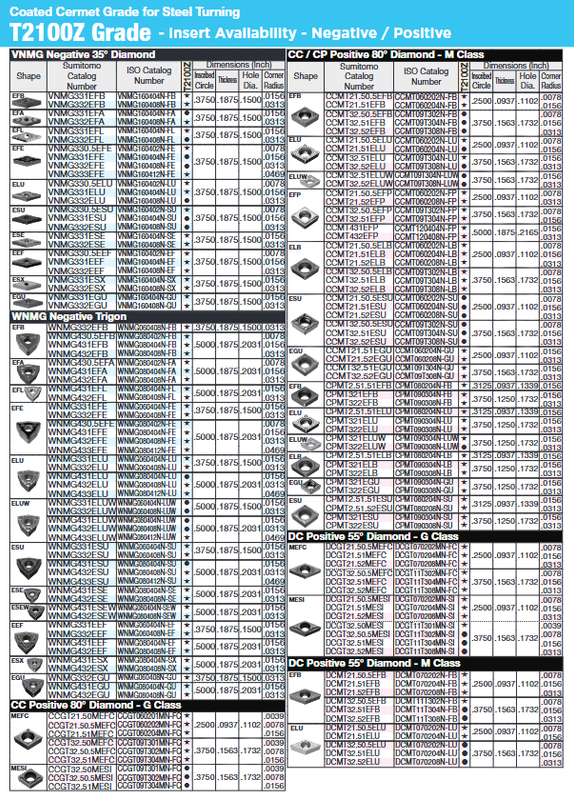
Complete groove system (negative front angle+positive front angle, fully compatible with the previous manual)
Negative front angle blade groove type
Slot type usage
EFB/EFA ultra precision machining with minimal margin
EFE precision machining, sharp cutting edge
EFL precision machining, targeting chip entanglement issues
ELU/ELUW precision machining – light and semi precision; ELUW with Wiper polishing blade to improve surface quality
ESU Negative Front Angle Universal Main Slot Type
ESE/ESEW high efficiency, high feed rate; ESEW polishing blade
Enhanced blade edge for SX, targeting chipping and small impacts
EGU medium cutting, strong universality
LM/RM left and right hand chip grooves
Positive front angle blade groove type (compatible with walking machines, compatible with PSZ)
Slot type usage
EFP ultra precision machining, small cutting depth
ELB sharp edge precision machining
ELU light to medium cutting
ESU front corner universal first recommendation
EGU medium cutting, inner and outer circular, weakly rigid boring
MESI/MEFC small part dedicated groove type for walking machines (CCGT/DCGT/VCGT, etc.)
The sample is accompanied by AP-F chip breaking window diagrams for each groove type, distinguishing the applicable feed cutting depth range for negative M-level, negative G-level, positive M, and positive G blades.
Performance test results (all wet cooling, steel)
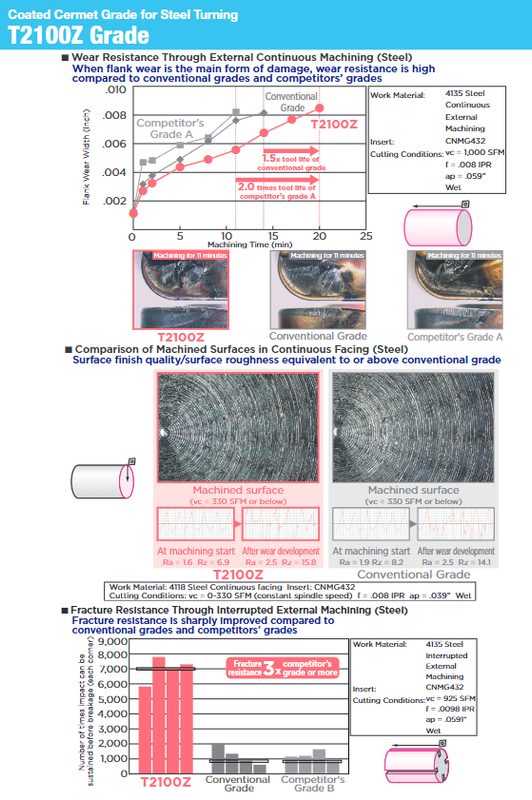
Continuous outer circle wear test (4135 steel) shows that the wear of the rear cutting surface is much smaller than that of traditional metal ceramics and competitor A after the same processing time; the tool life is 1.5 times that of traditional grades and 2 times that of competitor A.
Surface quality comparison (4118 end face turning) T2100Z starting Ra=1.6, after wear Ra=2.5; Compared to traditional grades, the starting Ra is 1.9, and after wear, Ra is 2.5; The roughness is maintained better throughout the processing process, and the surface degradation of the workpiece is slower after blade wear.
The intermittent impact test (4135 steel intermittent outer circle) can withstand more than three times the number of impact fractures of competing brand numbers; Traditional metal ceramics are prone to chipping under intermittent conditions, but the T2100Z significantly improves this.
Recommended cutting parameters (imperial, wet preferred)
Workpiece material working condition ap (in) f (IPR) Vc (SFM)
Soft steel A36 continuous universal 0.008-0.100 0.002-0.010 165-1320
Soft steel A36 light intermittent 0.008-0.100 0.002-0.012 165-1150
Soft steel A36 intermittent 0.008-0.100 0.004-0.014 165-1000
Low carbon/low alloy steel 1010, 4135 continuous universal 0.008-0.100 0.002-0.010 165-1150
Low carbon/low-alloy steel 1010, 4135 light intermittent 0.008-0.1000 0.002-0.012 165-1000
Low carbon/low alloy steel 1010, 4135 heavy intermittent 0.008-0.100 0.004-0.014 165-925
High carbon/high alloy steel 1045, 4140H continuous universal 0.008-0.100 0.002-0.010 165-1000
High carbon/high alloy steel 1045, 4140H light intermittent 0.008-0.100 0.002-0.012 165-925
High carbon/high alloy steel 1045, 4140H heavy intermittent 0.008-0.100 0.004-0.014 165-825
Tip: Metal ceramics are not suitable for large cutting, deep and rough machining; Priority wet; Intermittent working conditions require a reduction in cutting speed.
Actual Processing Application Cases
4118H low carbon steel shaft, DNMG432-EFE T2100Z: 400 pieces/blade tip; Competitor P20 CVD metal ceramic has only 200 pieces, doubling its lifespan and suppressing damage.
4118H Automotive Parts DNMG432-ESE-T2100Z: Compared to competitor B, the lifespan is increased by 1.1 times, and the wear on the rear cutting surface is smaller.
1050 steel wheel hub DNMG432-EFL-T2100Z: 325 pieces, traditional P30 metal ceramic 300 pieces, with improved lifespan and stable surface quality.
A1011 soft steel frame DNMG432-ESE-T2100Z: Compared with P20 hard alloy, it suppresses wear and has stable processing.
Typical parts: automotive shafts, wheel hubs, structural steel small parts, suitable for precision/semi precision machining that requires high smoothness, with slight interruptions allowed.
Blade specification coverage
Negative front angle blades: CNMG, DNMG, SNMG, TNMG, VNMG, WNMG;
Front angle M/G grade blades: CCMT/CCGT, DCMT/DCGT, SCMT, TCMT/TPMT, VBMT/VCGT, WPMT, etc;
Blade tip R coverage: 0.0078/0.0156/0.0313/0.0469 inches;
Inventory marking: l US spot, global warehouse transfer;
Fully compatible with PSZ modular blade heads, GND slots (TGAR metal ceramic blades), EGU and all other slot types.