WESTINGHOUSE eVinci ™ Micro reactor
Product Overview and Core Technologies
Product positioning: Westinghouse eVinci ™ Micro reactors are “nuclear energy cells” developed based on mature heat pipe technology, aimed at addressing the global demand for innovative, transportable, safe, and reliable zero carbon energy, and filling the energy supply gap in remote areas and special scenarios.
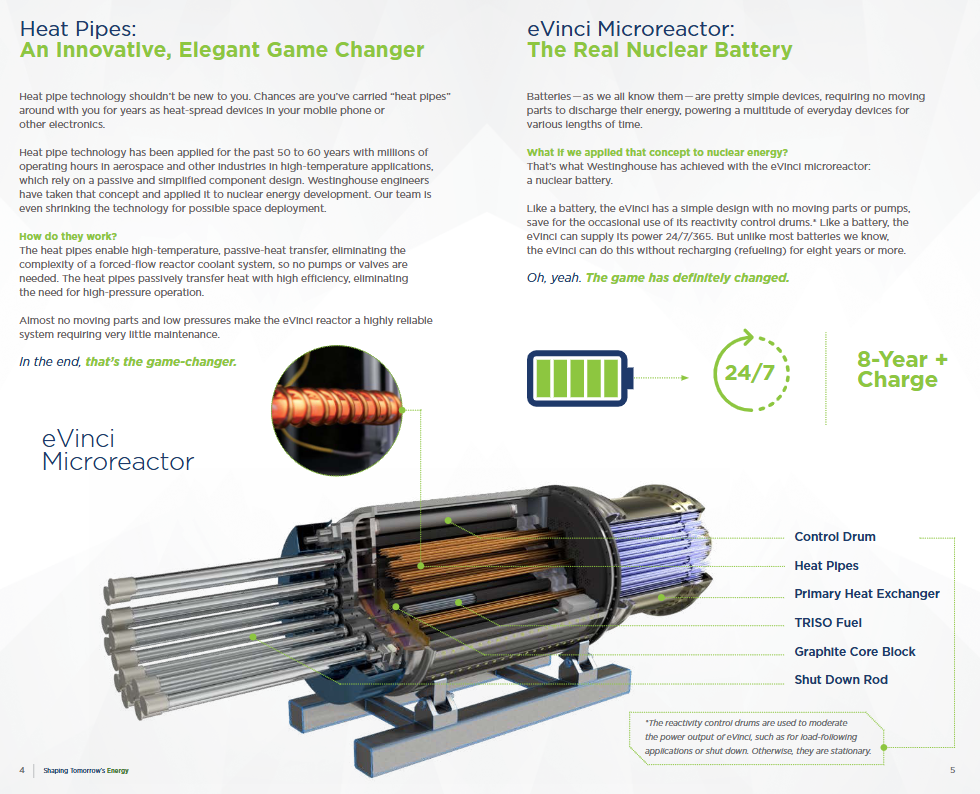
Core technology: With heat pipe technology as the core, this technology has been applied in the fields of aerospace and electronic equipment for 50-60 years, with millions of hours of operating experience; Through passive and efficient heat transfer, there is no need for forced flow cooling systems, completely eliminating moving parts such as pumps and valves, simplifying system complexity.
Core components: TRISO solid fuel, graphite pellets, heat pipes, main heat exchanger, reactivity control drum (power regulation/shutdown), shutdown rods, with no additional moving parts in the overall design.
Key parameters and core characteristics
Category specific specifications
Capacity parameter power generation capacity: 5 MWe; Thermal capacity:~6MWhth
Operating cycle of over 8 years at full power without the need for material replacement
Design features: no moving parts, passive heat transfer, no high-pressure operation, solid fuel technology
Construction and deployment of full factory assembly, ground construction, railway/barge transportation, rapid deployment, and scalability
Built in strong security features, no high risks associated with traditional nuclear power, supporting deployment in city centers/campuses
Environmentally friendly zero carbon emissions, replacing diesel generators and reducing carbon footprint
Only a small number of personnel are needed for operation and maintenance on site, with extremely low maintenance requirements
Analysis of Core Advantages
Innovation and Efficiency: Heat pipe technology simplifies traditional reactor systems, eliminates complex components such as pumps and valves, and achieves high passive heat transfer efficiency without the need for high-pressure operation, reducing the risk of failure.
Transportable deployment: After the entire factory assembly is completed, it can be transported by railway or barge without complex on-site construction, and can be quickly deployed in areas without power grid coverage.
Ultimate safety: Using solid-state TRISO fuel and graphite pellets, there is no high pressure or large demand for cooling water resources. The passive safety system minimizes the risk of accidents and is suitable for sensitive scenarios such as cities and campuses.
Reliable and Durable: Designed with no moving parts to enhance stability, it can operate continuously in harsh environments, with 24/7 uninterrupted power supply and no need for material replacement for over 8 years, reducing maintenance costs.
Environmental Collaboration: Zero carbon power generation can provide regional heating and seamlessly collaborate with renewable energy sources such as wind, solar, and hydropower to help decarbonize the energy structure.
Core application scenarios
Scenario type, specific scenario application value
Replace diesel generators in remote/special off grid communities, mines, military bases, and oil and gas operation areas to solve fuel transportation problems and provide stable zero carbon electricity
Research universities in institutional settings provide electricity and regional heating to support decarbonization; Provide a platform for nuclear technology research and talent cultivation
Renewable energy supporting renewable energy in energy synergy scenarios compensates for the intermittent shortcomings of wind and solar energy, and builds a stable zero carbon energy system
Deployment and Regulatory Progress
Deployment advantages: Ground construction does not require complex underground engineering, rapid deployment and support for large-scale expansion, on-site operation, maintenance, and security only require a small number of personnel.
Regulatory status: Actively promoting regulatory approvals in the United States and Canada, laying the foundation for subsequent commercial deployment.
Value added: In addition to electricity supply, it can provide process heat for regional heating, helping remote communities and institutions achieve sustainable economic development.