Toshiba Integrated Control System V Series Selection Manual
The Toshiba V series integrated control system covers three models: Model 3000 (large), Model 2000 (medium/small), and Model 1000 (ultra small). It can be freely combined through sequential control (S module), loop control (L module), and computer control (C module), and is equipped with multi-layer networks such as Ethernet/TC net/DeviceNet. It supports 20000 tag points, 22 human-machine interface stations, and 32 control stations, and has advantages such as 40ns high-speed data processing and super PID algorithm. It is widely used in multiple industries such as petroleum, chemical, and power, providing high-performance and scalable distributed control solutions.
Core advantages
Hardware: Adopting the DCS template from Japanese company CONTEC, with high reliability; 40ns high-speed data processing
Software: Chinese character operation interface, suitable for domestic operators; Support simulation and remote management
Function: Super PID algorithm, suitable for high-precision control (boiler, combustion control, etc.); 100Mbps industrial control network
Applicable industries: petroleum, chemical, machinery, electricity, textile, metallurgy, pharmaceuticals, building materials, food, water treatment, environmental protection, etc
System architecture
2.1 Network Layering
Network hierarchy core role support type key parameters
Monitoring and management network connection monitors, operating devices, and V-series station Ethernet (single/dual network) support remote access and OPC data sharing
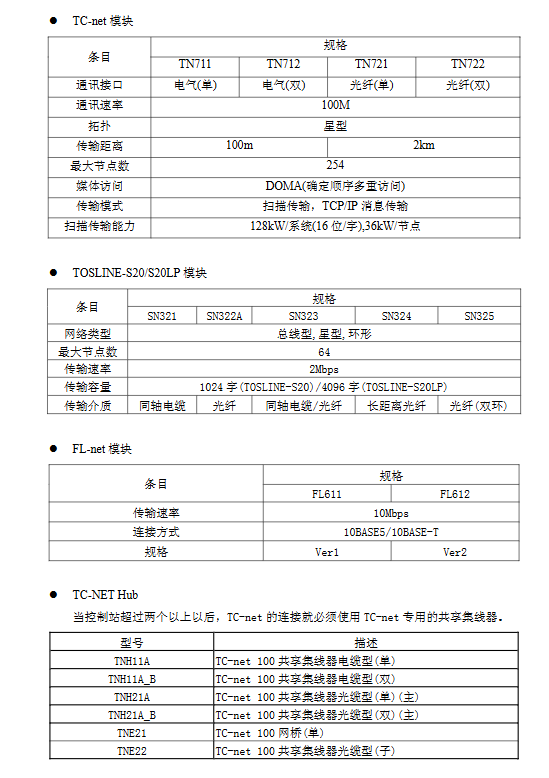
TC net supports 254 nodes for high-speed data transmission between control network stations, including TC net100 (100Mbps) and TOSLINE-S20/S20LP (2Mbps), with a transmission distance of 100m (cable)/2km (optical cable)
Fieldbus network connects field devices (sensors, drivers, etc.) such as DeviceNet and Profibus. The transmission rate of DeviceNet is 125kbps-500kbps, with a maximum of 64 points
2.2 Station Configuration Structure
Main Unit Configuration Bus Type I/O Expansion Capability Core Features
Model 3000 (large) 2-8 main slots+3-9 I/O slots Parallel bus (G3Bus), serial bus Each parallel bus extends 7 I/O units Support redundant configuration, suitable for large factory control
Model 2000 (medium/small) 1-5 main slots+3-8 I/O slots Parallel bus (G2Bus), serial bus Each serial bus connects 15 communication modules to balance expansion and cost, suitable for medium scale scenarios
Model 1000 (ultra small) integrated main module slot I/O bus (I/OBus) can connect up to 16 serial I/O modules. The structure is simple and suitable for small-scale control
Core hardware module
3.1 Main control module
Module type, core function, model adaptation, key specifications
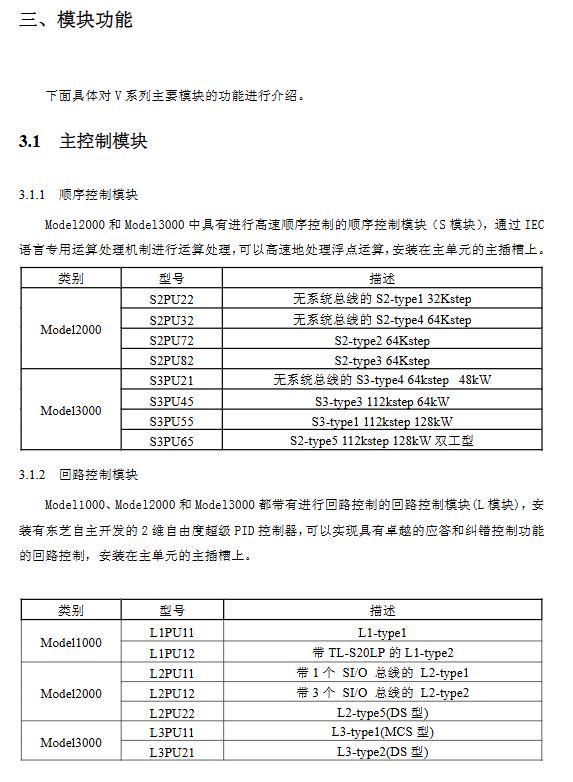
S module (sequential control) high-speed sequential control, floating-point operation processing Model 2000/3000 Model 3000 maximum 112kstep program capacity, 40ns processing speed
L module (loop control) super PID algorithm, high-precision loop control. The entire Model 3000 supports 256 control loops, with a scanning rate of 32 loops/100ms
C module (computer control) Web/OPC server, data processing Model 2000/3000 with Windows system, maximum 512MB memory, 30GB hard drive
3.2 Communication module
Module Name Adaptation Network Model Adaptation Key Parameters
Ethernet module monitoring and management network supports 10BASE-T/100BASE-TX for all models, with a transmission rate of 10/100Mbps
TC net100 module control network Model 3000 dual network redundancy, scanning transmission capacity of 128kW/system
DeviceNet module fieldbus network model 2000/3000, with a maximum of 64 main stations, supporting interconnection of devices from multiple vendors
Profibus module fieldbus network model 2000/3000 transmission rate 9.6kbps-12Mbps, maximum 122 points for the main station
3.3 I/O module
Module type subdivision category key specifications (taking Model 3000 as an example)
Parallel I/O digital input (DI) DI335: 64 points, DC24V, 0.1A/point
Digital output (DO) DO333: 16 points, DC24V, 2.0A/point
Analog input (AI) AD368: 8 points, supports ± 10V/4-20mA, 12 bit resolution
Analog output (AO) DA374: 4 points, supports 4-20mA, 16 bit resolution
Serial I/O Analog Input (SAI) SAI06: 8 points, ± 10mV – ± 5V/4-20mA, 0.1% accuracy
Thermocouple input (STC) STC01: 8 points, supports J/K/T and other types, 0.2% accuracy
Digital Input (SDI) SDI01: 32 points, DC24V, 5mA, 10ms update cycle
Software system
4.1 Programming software
Software name, version type, core function
V-tool2/V-tool3 standalone/client/server version supports IEC61131-3 standard, including configuration editing, symbol assignment, and online debugging
Tag editor integrated tool for managing loop control tag database, including tag signatures, PID parameters, etc
System log auxiliary tool displays error logs, event logs, and I/O error information
4.2 Human Computer Interface Software
Software type represents the key specifications of the product
The OIS-DS large-scale system supports 20000 tag points, 22 human-machine interface stations, and 32 control stations
The OIS-DS SMART small system supports 4000 tag points, 8 human-machine interface stations, and 8 control stations
Core functions – real-time data display, trend monitoring, alarm management, remote access, redundant backup
Core differences among the three models
Comparison Dimension Model 3000 (Large) Model 2000 (Medium/Small) Model 1000 (Ultra Small)
Applicable scenarios: DCS control for large factories, medium/small-scale process control, single point control for small equipment
Maximum program capacity: 112kstep, 64kstep, 6kstep
256 control circuits, maximum 96, 8/500ms
The network supports Ethernet/TC net and other (redundant) Ethernet/TOSLINE and other Ethernet/TOSLINE-S20LP
Main module configuration S/L/C module fully supports S/L/C module only supports L module
Tag points support 20000, 8000, and 4000