Motorola PTX series (PTX700/760/780) portable walkie talkies
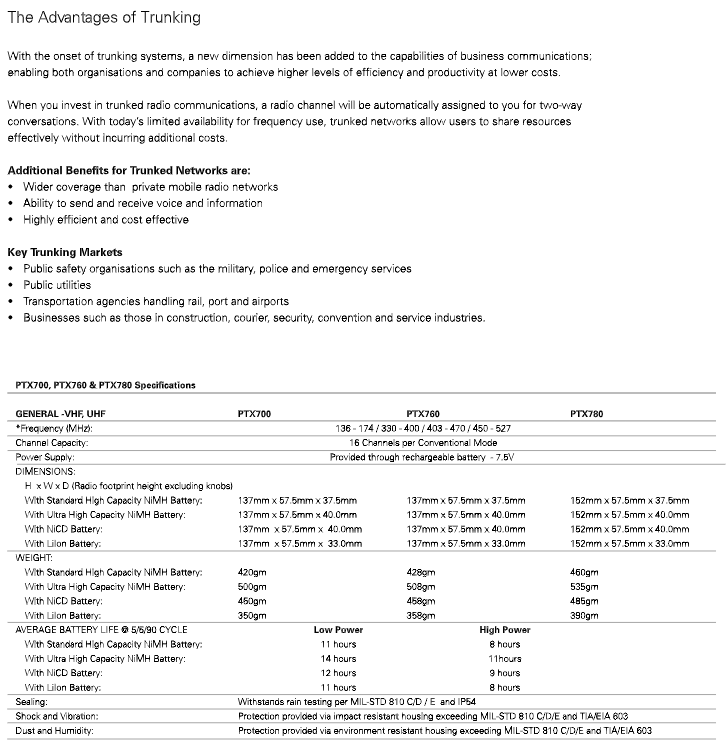
The Motorola PTX700/760/780 is a portable professional walkie talkie compatible with the MPT1327 cluster standard, aimed at industries such as public safety, utilities, and transportation. It has common functions such as 12.5/20/25kHz programmable channel spacing, X-PANDIM voice enhancement technology, MAP27 data interface, and supports multiple communication modes such as individual calls, group calls, and emergency calls; The differences among the three models are reflected in the number of personalized configurations (2/4/60), contact list capacity (16/40/40), programmable dedicated call buttons (3/3/6), and advanced functions (PTX780 adds built-in voice storage and ultra long data message transmission), paired with NiMH/NiCD/Li ion batteries (weight 350-535gm, range 8-14 hours), with industrial grade reliability such as IP54 protection and shock and vibration resistance, meeting the efficient communication needs in mobile scenarios.
Overall positioning and core commonalities of the product
Core positioning: All three walkie talkies are professional equipment from the Motorola MPT Trunked series, designed based on the MPT1327 cluster communication standard, with a focus on “instant messaging in mobile”. They are suitable for team collaboration and emergency dispatch needs in multiple industry scenarios, and have the advantages of efficient channel sharing and wide coverage of cluster systems.
Common core functions
Communication modes: Full coverage of individual calls, group calls, fleet calls, inter fleet calls, broadcast calls, emergency calls (with dedicated buttons, prioritized when the system is busy), PABX/PSTN public network calls, meeting diverse communication needs.
Audio technology: equipped with X-PANDIM patented speech compression and expansion technology, improving speech clarity in noisy environments; The low-level expansion function reduces background noise during call intervals, further optimizing audio quality.
Data and Interface: Both are equipped with MAP27 data interface, supporting data message transmission and remote control of walkie talkies; PTX760/780 supports an additional 32 alphanumeric short data status message programming, and PTX780 can transmit data messages of any length through business channels (requiring a matching modem).
Channel and Expansion: Supports programmable channel spacing of 12.5/20/25kHz to adapt to different frequency band resources; Under normal mode, each model supports 16 channels; Voice storage and Mandown alarm functions can be expanded through optional boards.
Reliability design: IP54 level sealed protection, able to withstand rain; The shell is resistant to impact and vibration, complying with MIL-STD 810 C/D/E and TIA/EIA 603 standards; Dustproof and moisture-proof, suitable for harsh industrial environments.
Differential comparison of three models
table
Comparison Dimension PTX700 (Basic) PTX760 (Multi functional) PTX780 (High end)
2 personalized configurations (cluster/regular mode) 4 personalized configurations (cluster/regular mode) 60 personalized configurations (cluster/regular mode)
Contact list capacity: 16 entries, 40 entries, 40 entries
Programmable dedicated call buttons 3, 3, 6
Cache 1 missed call, 5 missed calls, and 10 missed calls
Display and menu -14 character alphanumeric display (including signal/battery icon), intuitive menu 4-line alphanumeric display (quick message reading), intuitive menu
Call recognition – alphanumeric decoding, exclusive ringtone alphanumeric decoding, exclusive ringtone
Advanced Features – Call Barring, One Click Dialing with Built in Voice Storage (Message/Playback), Unregulated Data Transmission, Any Length Data Message
Voice storage optional accessories optional accessories built-in
Hardware specification details
(1) Basic parameters
table
Category specification details
Frequency range VHF: 136-174MHz; UHF I:403-470MHz; UHF II:450-527MHz; 330-400MHz
Under normal mode, each model supports 16 channels for channel capacity
Power specification: 7.5V rechargeable battery (available in three types: NiMH/NiCD/Li ion)
Frequency stability of emission performance: ± 2.5ppm (-25 ℃ to 55 ℃); Transmission power: VHF 5W, UHF (including 330-400MHz) 4W; Modulation limitations: 12.5kHz ± 2.5, 20kHz ± 4.0, 25kHz ± 5.0
Sensitivity of receiving performance: EIA 0.25 μ V (12dB SINAD), ETS 0.50 μ V (20dB SINAD); Adjacent channel selectivity: 12.5kHz 60dB, 20/25kHz 70dB; Stray suppression: 70dB; rated audio output: 0.5W; audio distortion: ≤ 3%
(2) Size and weight (by battery type)
table
Model Battery Type Size (H × W × D) Weight
PTX700 standard high-capacity NiMH 137mm × 57.5mm × 37.5mm 420gm
PTX700 ultra-high capacity NiMH 137mm × 57.5mm × 40.0mm 500gm
PTX700 NiCD 137mm×57.5mm×40.0mm 450gm
PTX700 Li-ion 137mm×57.5mm×33.0mm 350gm
PTX760 standard high-capacity NiMH 137mm × 57.5mm × 37.5mm 428gm
PTX760 Ultra High Capacity NiMH 137mm × 57.5mm × 40.0mm 508gm
PTX760 NiCD 137mm×57.5mm×40.0mm 458gm
PTX760 Li-ion 137mm×57.5mm×33.0mm 358gm
PTX780 standard high-capacity NiMH 152mm × 57.5mm × 37.5mm 460gm
PTX780 Ultra High Capacity NiMH 152mm × 57.5mm × 40.0mm 535gm
PTX780 NiCD 152mm×57.5mm×40.0mm 485gm
PTX780 Li-ion 152mm×57.5mm×33.0mm 390gm
(3) Battery life (5/5/90 working cycles)
table
Battery type Low power mode Endurance High power mode Endurance
Standard high-capacity NiMH 8 hours 11 hours
Ultra high capacity NiMH 14 hours 11 hours
NiCD 12 hours 9 hours
Li ion 11 hours 8 hours
Accessories and Certification
Optional accessories: Lightweight earphones (AZRMN4018), NiMH battery+belt clip (PMNN4008), portable bag (HLN9701), remote speaker microphone (PMNN4002), multi unit charger, impres intelligent energy system.
Safety certification: Obtained Factory Mutual certification, and when equipped with FM certified batteries, can be used in hazardous environments of Class 1, Zone 1 (Groups C/D/E/F/G), Class 2, Zone 1, Class 3, Zone 1, and Class 1, Zone 2 (Groups A/B/C/D) for intrinsic safety; Compliant with ISO 9001 quality standards.
Advantages of cluster system
Core advantages: automatic channel allocation, efficient sharing of frequency resources; The coverage area is wider than that of dedicated mobile radio networks; Support voice and data transmission; High cost-effectiveness.
Adaptation scenarios: public safety emergency dispatch, maintenance of public utility equipment, dispatch of transportation hubs (railways/ports/airports), team collaboration in the construction/security/express delivery industry.